|
September is National
Preparedness Month. Maine CDC’s Public Health Emergency and Response (PHEP)
team provides oversight and coordination of all public health and medical response
and recovery resources that are required to reduce and/or prevent loss of life
from an infectious disease outbreak, a natural disaster, or an act of
terrorism. This is accomplished by activating and staffing the Public Health
Emergency Operations Center, which is the central nervous system for all
response and recovery activities being conducted by public health and
healthcare responders.
In between public health
emergencies, the PHEP program is busy preparing for the next emergency by
updating emergency operations plans based on lessons learned, facilitating the
identification and prioritization of public health threats, facilitating
incident management training, developing and facilitating response exercises
among with partners statewide, managing response equipment and supply caches,
rotating and distributing medical countermeasures, testing emergency
communications equipment, and recruiting medical volunteers.
In the past year, the
Maine Responds coordinator has recruited 564 medical volunteers, bringing our
total number of deployable volunteers to more than 900 individuals. PHEP has developed
six new Medical Reserve Corps Units; there is now one in each of the eight
public health districts. The Maine Health Alert Network has the highest
enrollment numbers (n=15,000) since implementing the HAN system in 2007. PHEP
also increased operational ability to safely transport highly infectious
disease patients to specialized healthcare facilities to receive appropriate
and specialized care.
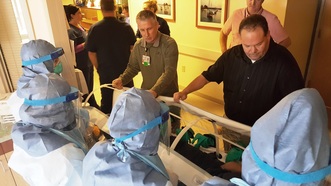 PHEP staff and partners during an exercise last year.
The
Downeast District continues to build strong relationships with our emergency
preparedness partners through active participation in tabletop exercises.
Bar
Harbor Airport held a full-scale airplane in the water scenario with the
district liaison working in the Emergency Operation Center (EOC) for the event.
Castine conducted a table
top exercise around a hurricane-type event that caused road closures to the
peninsula and subsequent damage and contamination to the local drinking water
infrastructure. Maine CDC staff provided
consultation on boil order procedures and drinking water protocols for home
owners and food establishments.
Although not as high a public health concern,
both Gouldsboro and Bucksport reviewed their emergency operations plans around
dammed waterways and then conducted table top exercises around high
precipitation events, causing breaching and damage to the dams and potential
flooding impacts on residences, roads, and infrastructure.
All in all, these
were great opportunities for regional public health and public safety working
with local communities to better prepare for potential realistic emergencies.
The flu has officially arrived in Maine for the 2017-2018 season. U.S. CDC recommends a yearly flu vaccine as the first and
most important step in protecting against flu viruses. Vaccine for the
2017-2018 flu season has been updated to better match circulating flu viruses.
Disease Surveillance and Reporting
Maine CDC is hosting a “Start of the 2017-18
Influenza Season” conference call at 1:00 p.m. Thursday, September 28. The intent of this call is to provide updates for the season,
outline resources available, and remind facilities of the requirements for the flu season. This call is particularly relevant for: infection
practitioners, providers, laboratorians, employee health, emergency
preparedness, hospital administration, and long term care facilities. Talking
points will be distributed after the call, as well as questions and information
highlighted on the call.
Lines may be limited, so if multiple people from
one location intend to call in, please call in together.
Call in number:
877-455-0244 Code: 6681820529#
For up-to-date information and recommendations on influenza
for health professionals, go to http://www.cdc.gov/flu/professionals
For influenza surveillance information in Maine,
go to www.maineflu.gov.
2017-2018 Vaccine
Information for Providers
Children younger than eight who have never received flu
vaccine will need a booster dose no less than 28 days after the first dose of flu
vaccine.
Vaccine is open for ordering. Limited supplies of multi-dose
vials are available. If interested in ordering multi-dose vials, please call
vaccine management at 287-3347.
Influenza vaccine ordered for the 2017/2018 season IS subject to replacement for
preventable wastage.
Children under the age of 19 only are eligible for
vaccine through the Maine Immunization Program. Repeated fraudulent
administration of this public vaccine to individuals 19 years and older will result
in a referral to CMS for fraud investigation.
Under Maine statute, all doses of public vaccine
administered must be recorded in the Immunization Registry within five working
days.
Ordering guidelines:
-
2017 Provider Agreement must be active
-
Temperatures and inventory reconciliation must
be up to date
-
Order only a supply anticipated to be utilized
in the next six-week time period
VFC eligibility screening is mandatory for every child and
every vaccine. Eligibility screening must be documented in the ImmPact registry.
- Under 19 years of age
-
Medicaid
-
Uninsured
-
American Indian/Alaska Native
Privately insured children do receive public vaccine;
however, they must be documented as Not
VFC Eligible in ImmPact.
From September 10-16, Maine joins the rest of the United
States and the international community in recognizing World Suicide Prevention Week. World Suicide Prevention Week is an
opportunity to learn about the role that all of us can play in preventing
suicide and commit to supporting the mental health of our family, friends, and communities.
In 2015, 235 Mainers died by suicide, making suicide was the
second-leading cause of death for Maine youth and young adults between the ages
of 15-34. Every suicide death or suicide attempt has a ripple effect that
stretches far beyond the individual and their family, affecting schools,
workplaces, and entire communities. Few of us remain untouched.
But there is good news: suicide is preventable. This year’s
theme for World Suicide Prevention Week is “Take
a minute, save a life,” reminding us that even small actions can have a big
impact on the lives of those who may be struggling. If you suspect someone you
know may be at risk of suicide, follow these steps:
- Show you care by listening carefully and without
judgment.
-
Ask them if they are thinking about suicide. Be
direct and empathetic. (Asking about suicide does not increase the risk of suicide.)
-
Stay with them (or have another caring person
stay with them) while you locate help.
-
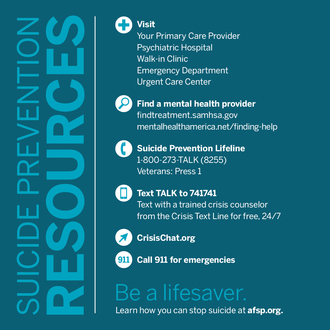
Call the Maine Crisis Hotline (1-888-568-1112)
or the National Suicide Prevention Lifeline (1-800-273-8255).
-
If the person is at immediate risk of harming
themselves, call 911.
If you would like to learn more about how you can help
prevent suicide in your community or workplace, we invite you to attend one of
the many training sessions offered in partnership with the Maine Suicide
Prevention Program. For more
information, please contact Sheila Nelson at 207-287-3856 or sheila.nelson@maine.gov, or visit the
Maine Suicide Prevention Program training website: http://www.namimaine.org/?page=TrainingCalendar.
|