|
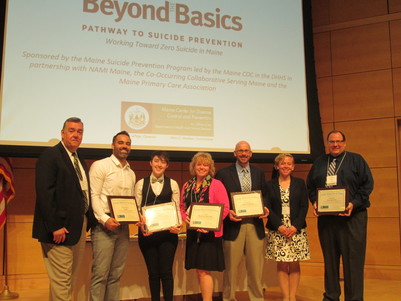
From left to right-Ken Albert, Director and Chief Operating Officer, Maine CDC; Kyle Poissonnier, founder of Katalyst; MaKayla Reed, volunteer for The Trevor Project; Jodi Beck, Director of Clinical Integration and Physician Practice Improvement for Kennebec Regional Health Alliance, MaineGeneral Health; Anthony Ronzio, Director of news for the Bangor Daily News; Kristen McAuley, Team Lead, Healthy and Safe Living, Division of Population Health, Maine CDC; Brian Walsh, Principal of Hermon High School.
CAL ME Award recipients not pictured- Ethel Jalbert and Tonya Bailey-Curry, community volunteers.
More than 200 people attended the
Maine Suicide Prevention Program’s conferece, 2015 Beyond the Basics: Pathway to Suicide
Prevention, last week. Ken Albert, Director and Chief Operating
Officer of Maine CDC, presented the Caring About Lives in Maine Awards
to seven Individuals and agencies for their leadership and dedication to
suicide prevention.
May
is National Hepatitis Awareness Month, and Maine CDC urges people to talk with
their providers about testing for hepatitis.
US
CDC reports that people born from 1945 through 1965 are five times more likely
to be infected with Hepatitis C than other adults. There are
approximately 3.2 million individuals living with hepatitis C in the country,
and it is estimated that 75 percent of these individuals are Baby Boomer age
(ages 50 to 70).
Most
people living with hepatitis C do not know they are infected and can live with
the disease for decades without having symptoms or feeling sick. If left
untreated, hepatitis C can lead to serious liver damage, including cirrhosis
and liver cancer. Hepatitis C is the leading cause of liver transplant in
the United States.
Symptoms
of hepatitis C include fever, fatigue and loss of appetite, nausea, vomiting,
abdominal pain, darkened urine, clay-colored stools, joint paint and
jaundice. It is estimated that only 20 to 30 percent of individuals who
have Hepatitis C experience symptoms. People who have ever injected drugs,
shared needles and equipment, or who were born to a Hepatitis C positive mother
join Baby Boomers in the highest risk category.
Recent
advancement in therapies for treatment of hepatitis C can cure up to 95 percent
of infections. Maine CDC recommends that people talk to their
health care provider about their risk for hepatitis C.
Testing days are scheduled in May for individuals who are uninsured and at high
risk for hepatitis C. The dates and locations are:
- May 18: Waterville Family Planning 18 Silver Street Waterville 207-509-3267
- May 19: Florence House (women's shelter) via Portland Public Health. 103 India St Portland 207-874-8446
Those
who are interested in being tested should call the test site prior to the
testing day to find out if they qualify for the free test.
For
more information about hepatitis, visit: http://www.cdc.gov/knowmorehepatitis
For
more information about viral hepatitis resources in Maine, visit: www.mainepublichealth.gov/hepatitis
Lyme disease is the most common vector-borne
disease in Maine. Cases have been increasing each year in Maine, and occur in
all 16 counties. More than 1,395 cases of Lyme disease were reported statewide
in 2014, a record high for Maine. Lyme
disease is most common among school age children and mature adults over the age
of 65. Most infections occur during the summer months. A total of 71 cases have already been reported in 2015.
The most common early symptom of Lyme disease is an expanding red rash that occurs 3-30 days after being bitten. Fever, headache, joint and muscle pains and fatigue are also common during the first several weeks. Later features of Lyme disease can include arthritis in one or more joints (often the knee), Bell's palsy and other cranial nerve palsies, meningitis and carditis (AV block). Lyme disease is treatable, and the majority of patients recover after receiving appropriate therapy.
Lyme disease is a reportable condition in the
State of Maine. Providers should report all diagnosed
erythema migrans rashes and all positive lab diagnoses. Cases can be reported by fax at
1-800-293-7534 or by phone at 1-800-821-5821.
Other tickborne diseases:
Other diseases that are carried by ticks in Maine include anaplasmosis, babesiosis, ehrlichiosis, Powassan and Rocky Mountain spotted fever. They are all reportable in Maine.
In 2014, providers reported 191 cases of
anaplasmosis, more the twice the number of cases reported in 2013. Providers reported 42 cases of babesiosis, a
slight increase from 2013. Four anaplasmosis cases and one babesiosis case have already been reported in 2015.
For more information:
High blood pressure, often referred to as the “silent
killer,” does not have any symptoms, but can cause serious damage to arteries,
leading to heart disease and stroke. Nearly one in three adults in the United States
has high blood pressure and many people remain unaware of this condition
because there are no symptoms.
A routine doctor’s appointment often involves a health
professional checking your blood pressure. The results of this simple test may
identify a condition that, when managed, could help reduce your chances for
stroke or heart attack.
The national high blood pressure campaign, Measure Up/Pressure Down®, encourages
adults to get in control by making simple lifestyle changes, including:
1. Know your numbers –
Understanding what blood pressure is, and what your numbers are, is an
important first step. Work with your health care provider to determine your
individual blood pressure goals and treatment plan if your numbers are too
high.
2. Eat right – A diet with
excessive sodium (salt) can lead to higher blood pressure. Check food labels
before you buy and choose foods with less than 400 mgs of sodium per serving.
3. Stay active – By being active at
least 30 minutes a day at least 5 times a week, you can help reduce your blood
pressure.
4. Reduce stress – A stressful
situation can increase blood pressure for a short period of time. Try to reduce
the occurrence of these situations and look for healthy ways - like
meditation or walking - to help you deal with stress.
5. Set alcohol limits and eliminate
tobacco – Over time, consuming a high amount of alcohol can damage the heart.
Tobacco use and secondhand smoke can immediately raise blood pressure levels
and cause damage to the lining of arteries. If you’re interested in quitting
tobacco, call the Maine Tobacco HelpLine 1-800-207-1230.
6. Take medication – Your doctor
may recommend taking a blood pressure medication to keep levels steady. Be sure
to follow the directions provided for taking the medications to ensure you’re
getting the most benefit from them.
Through Measure Up/Pressure Down®, you are encouraged to
measure, monitor and maintain your blood pressure level to stay in control of
this health condition. If you don’t know your blood pressure and want more
information to determine if you might be at risk for high blood pressure, visit
MaineHeartHealth.org.
Heather Dyer and Steve Pierce, chemists at Maine CDC’s
Health and Environmental Testing Lab, recently presented on toxicology forensics
at the Maine Impaired Driving Summit. They were recognized by AAA Northern New
England and Maine Bureau of Highway Safety for their support in organizing the
statewide summit.
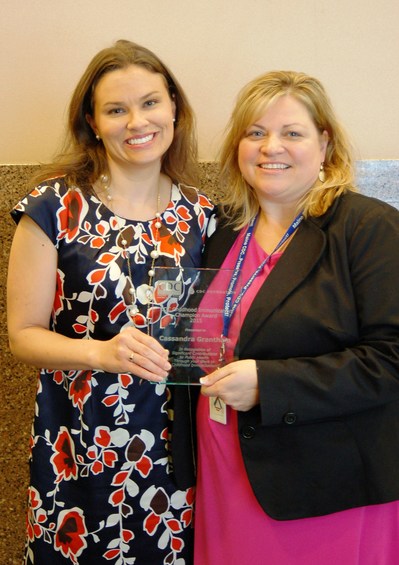 Cassandra Grantham (L) was recently honored as US CDC's Childhood Immunization Champion for Maine. She is pictured with Tonya Philbrick, Director of the Maine Immunization Program at Maine CDC.
The Maine Immunization Program is
proud to announce that Cassandra Cote Grantham, a health communication
specialist at MaineHealth in Portland, has been selected as the US CDC Childhood
Immunization Champion for Maine.
Cassandra was nominated and
selected from a pool of health care professionals, community advocates and
other immunization leaders for making a significant
contribution to public health in Maine through her work in children’s
immunization.
In 2010, Cassandra
established MaineHealth’s childhood immunization program, with the goal of
increasing Maine’s childhood immunization rates to the highest in New England
by 2016. Under this program, she has launched several educational initiatives,
such as the Vax Maine Kids website and Kohl’s Vax Kids—a program to increase
immunization awareness among parents most likely to delay or skip their child’s
vaccinations.
To read her
profile on the CDC’s website and to learn more about CDC’s Childhood Immunization Champion Award program, please visit http://www.cdc.gov/vaccines/champions
The United States is currently experiencing a large, multi-state outbreak of measles. As of May 1, 169 cases have been reported in 20 states and the District of Columbia. There are no cases in
Maine. The last confirmed case of measles in Maine was in 1997.
For more information, go to http://www.cdc.gov/measles/
Cases of pertussis (whooping cough) continue to be reported statewide.
A total of 160 cases have been reported in Maine this year, as of May 11. The majority of the cases are in school-aged children.
Maine CDC encourages providers who see patients for cough in an outbreak area to test for pertussis and treat empirically. (Providers do not need to wait for positive
results to return or a two-week history of cough in order to treat.)
DTaP vaccine is recommended for all infants and children. Tdap vaccine is recommended for all preteens, teens, and adults, including health care providers and during the third trimester of every pregnancy. Per ACOG (American Congress of Obstetricians and Gynecologists), Tdap is also recommended for every pregnancy in
the third trimester.
For more guidance and information, visit http://go.usa.gov/dCO
Liberia has been declared Ebola-free by the
World Health Organization (WHO). As
of May 9, the latest Ebola case count reported from WHO is 14,954 confirmed
cases globally with an estimated 11,079 deaths.
The
Maine CDC Public Health Emergency Operations Center continues to monitor the
situation.
For
more information, visit http://www.cdc.gov/vhf/ebola/
|