ASL Interpreters and Cart provided - please contact Nancy by September 1 if you need other Communication accommodations.
Annual Awards
The Commission for the Deaf, Hard of Hearing and Late Deafened will recognize several community members with awards for their dedication and work within the Deaf community.
Have you noticed someone who is or has been active in the Deaf community or has worked hard for the community and deserves to be recognized? If so, here is your chance to nominate them for an award.
A Lifetime Achievement Award, this award is named for Clifton F. Rodgers, a life-long resident of Maine. He attended the Maine School for the Deaf and lived in Belfast for more than thirty years with his wife Dorothy. Cliff was a member of the Division of Deafness Advisory Council for many years and also worked for the Division of Deafness (DoD) as a Rehabilitation Assistant.
Quotes describing him include: “He made an indelible impression on everyone he came in contact with, for his style always created good will and warm feelings,” “His knowledge of Maine and its Deaf Culture were immense,” and “He passed through this world making it a better place.”
This award is unique in that nominations for the award must be made by Commission members. The award is given to an individual in recognition for outstanding service in a professional or voluntary capacity to the Deaf and hard-of-hearing communities in Maine.
The award is presented to an individual who has worked in or with the Deaf community for many years. It is given in recognition of a “lifetime of achievement.”
Promoting American Sign Language, Deaf Culture, and Deaf People Award
This award is given to a person who worked to improve Maine’s Deaf community through leadership by promoting American Sign Language, Deaf Culture, and Deaf People.
Outstanding Citizenship Award
This award is given to a person who is a leader in the Deaf community.
Citizenship Youth Award
This award is given to a student who is a leader in school and the Deaf community.
Ginny Hewes - Advocate for the Needs of the Deaf Community Award
Ginny Hewes was known as the “I Love You” (in American Sign Language) Lady of Saco. Mother to a Deaf daughter, Ginny became a tireless advocate for not only her own daughter, but for all Deaf children. As a result of her personal advocacy, the Deaf Services Coordinator position was established at the (then) Department of Mental Health and Mental Retardation, which has, in turn, resulted in specialty signing group homes, culturally competent case management services, linguistically competent mental health counseling services, and the largest source of employment for culturally Deaf signing adults in Maine—social work. Her reach has extended far beyond the needs of her own daughter, beyond even Deaf children, to make a positive impact on all Deaf, Hard-of-Hearing and Late-Deafened Mainers. This award is given to a person or organization that advocates for the needs of Deaf and hard-of-hearing persons in Maine.
Special Commendation Award
This award is given to an individual or agency whose activities in and with the Deaf community deserve recognition.
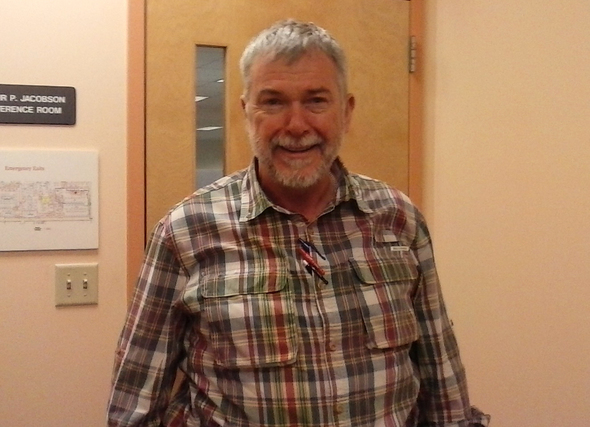
Could you share
with us what your family life was like as a child?
I'm
the oldest of 11 siblings, and the only member of my family who is deaf.
What mode of
communication did you use as a child?
Speech
and speechreading. I became deaf at 5, and my family was advised to keep
me away from Sign. I did not encounter Sign until I entered Gallaudet
College, and did not truly learn American Sign Language until many years later,
when I worked in the dormitories at the Arizona School for the Deaf in Tucson.
Where did you go
to school?
I
became deaf while in kindergarten at my local parochial school, and then
bounced around a little before being placed in the Boston School for the Deaf
in Randolph, Mass. After graduating from their elementary program (grade
8 at the time), I went to St. John's Preparatory School in Danvers, Mass for
three years before enrolling at what was then Gallaudet College. After
several spells alternating between Gallaudet and employment, I finally took my
BA, in Liberal Studies, from Providence College, down in Rhode Island.
What is your
family life like now?
Brenda
Schertz and I have been married for more than 20 years. We have no
children.
When did you
move to Maine and why?
You
can probably blame Jonathan Connick for that! Actually, I'm grateful to
him. A position opened for someone to teach computer classes to Deaf
adults and I understand that Jon was chief among those who argued that the
teacher should be Deaf. I had more than 20 years of experience as an IT
professional, ending as a system administrator for the Massachusetts Commission
for the Deaf and Hard of Hearing, while teaching - computer applications and
English as a Second Language, mostly - on the side. The opening of the
position here in Maine was very nicely timed. It also required me to work
only a 40-hour week, which after the 60 - 80 hour work week of a sysadmin
seemed almost like a paid vacation.
What kind of
work have you done in Maine?
Well,
I started work here on September 4, 2001, one week before the Towers
fell. I continued to teach computer applications full-time until the
spring of 2002, when funds were reallocated from my program, as with many
others. Before I could come up with a graceful exit plan, Dennis
Fitzgibbons of Alpha One offered me a job in Deaf Services. I jumped on
it and stayed with Alpha One for eleven years. I'm immensely grateful to
Dennis and to Betsy Grass, who was my supervisor for much of that time.
(Lisa Rouelle, a current member of the board at the Maine Center on Deafness,
was also my supervisor for a time.) I had never before worked in human
services - in Independent Living, to be precise - and I think the experience
allowed me to grow (and not just around the waist!). I used to joke, when my
relatives asked what exactly I did, that I went out to eat with half the people
in the state and got into fights with the other half. Those aren't the
exact proportions, but the description is close enough. I was able to
teach a number of courses - chiefly computer operations and English as a Second
Language, but also a variety of workshops on subjects such as civics. In
addition, I was allowed to work closely with the Interpreter Training Program
at the University of Southern Maine, to the extent of teaching some courses,
both solo and in partnership with Brenda and others. I have just about
always had a strong belief in the individual and in people's right to control
their own lives. Getting involved in independent living was one of the
best things that has happened to me.
You’re leaving
Maine and that is absolutely sad for Maine’s Deaf and hearing communities.
Where are you going and what will you be doing?
I'm
going to join Brenda in Rochester, NY, where she has been living and working
since early last fall. I've been trying to keep my focus on my current
job, to the extent that I really have no idea what I'll do next. Brenda
has booked us a two-week trip abroad early this summer, so I expect to get a
breather, a bit of time to sort of figure out what I want to do when I grow up.
As a Deaf
professional what would your proudest accomplishments be here in Maine?
I
think that the establishment of the NOTYET Program would probably rank high on
the list. That was a collaborative effort - working with, among others,
Dr. Judy Shepard-Kegl and Brenda at USM to create a safe and supportive
environment for fledgling interpreters to try their wings, and for established
interpreters to try new things. I made some good friends there, I
think. I also had some part - probably minor, but nonetheless satisfying
- in the development of a few Deaf individuals here. I really do wish I
had been able to accomplish more.
Could you tell
us a little about yourself?
I
suppose I'm a nerd with social inclinations, what Gina Olivia would call a
solitaire (although lump of anthracite is nearer to truth in my case). I
read voraciously on a wide range of subjects, mostly because I'm curious about
almost everything. I am very happily married - delighted, in fact, and
still slightly bemused at my luck.
Where do you
work?
At
the Maine Center on Deafness, where I have been for the past two years, since
leaving Alpha One.
What do you do?
I
am currently the interim executive director.
What population
do you work with?
Pretty
much the entire d/Deaf and hard-of-hearing population and those who interact
with them.
What are some of
your successes?
I
am not sure, but I hope that some of my belief in egalitarianism has had an
impact on some people. I would like to think that my teaching also helped
- not so much the specific skills I taught as the knowledge that we all have
things to learn and we all are capable of learning them, I as much as anyone.
What are some of
your challenges?
Mostly
myself. I have way more to learn than I have been able to digest, and I
have a tendency to get in my own way.
What would you
like to see happen for those that you work with?
I
would love to see more d/Deaf people take leadership roles in our community,
especially those who are native Mainers. I believe that some of this is
now happening; there are changes underway in a number of Deaf
organizations. I am sorry that I will not be here to witness - or
participate in - that process.
Is there
anything you feel is important to mention?
I
am really going to miss Maine. I have come to care very much for the
place and its people.
Video Remote Interpreting (VRI) is happening at State of Maine Agencies
The Maine Department of Health and Human Services (DHHS) has initiated Video Remote Interpreting (VRI) services in its Lewiston and Portland offices. This service makes American Sign Language (ASL) interpreting available for people who walk into those offices and on short notice when in-person interpreters are not available. DHHS is committed to continuing to provide in-person ASL interpreters whenever possible. VRI may be used to interpret a short conversation between customers and staff persons, or to make a future appointment when there will be enough lead-time to obtain in-person interpreters.
DHHS welcomes your comments about how the new VRI service is working when you visit Portland or Lewiston offices. Please contact the front desk at either location with your comments.
The State of Maine has contracted with three providers of VRI services, and VRI access will expand throughout selected state offices statewide in the coming months.
For clarification, VRI services are fee-for-service interpreting, to be used when a sign language using Deaf person is in the same room as the non-signing service provider. On the contrary, Video Relay Services (VRS) is an interpreting service that makes telephone calls accessible to sign language users. It is paid for through the Federal Communications Commission (FCC), no charge to VRS users. FCC rules do not permit VRS to be used when the signing person and the service provider are in the same room.
Division of Vocational Rehabilitation, Maine Department of Labor - Bureau of Rehabilitation Services
The Division of Vocational Rehabilitation, also known as VR, assists individuals who have disabilities to get and keep a job. VR works with adults, as well as with eligible students to coordinate information and resources as they transition to the world of work.
To be eligible you must:
Have a documented disability that prevents you from getting or keeping a job.
Need VR services to keep a job. (Eligibility must be determined in 60 days. Medical records can usually provide the necessary documentation.)
If you are receiving Social Security Disability Insurance (SSDI) or Supplemental Security Income (SSI) based on a disability and have an interest in working, you are presumed eligible for VR services.
To apply for VR, you need to call one of our offices and schedule an appointment with a VR counselor. The counselor will explain the program and learn more about you and your goals. You are strongly encouraged to view the online VR orientation video prior to applying for services.
Every person’s employment plan is different. Your VR counselor will work with you to decide what jobs best fit your interests and skills. You’ll also consider where you live, the current job market, and what transportation is available. VR will consider any service you need to achieve the agreed-upon vocational goal.
As you identify careers, VR can provide information about the skills and training you need. If training is necessary, VR may help with the cost of the program. VR may also buy tools, uniforms or basic equipment needed to start a job. Sometimes VR can assist with payment for some medical/psychological services. If you need a job coach (on-the-job support), VR will provide one.
In general, services end 90 days after you start working.
It does not cost you anything to apply for services. There is no charge for testing, vocational evaluation, counseling, or job placement assistance. If you are eligible for services, your counselor will ask you about your income and expenses. Depending upon your income, you may be asked to contribute to the cost of VR services. VR cannot pay for any services you received before you applied to VR , or any services not agreed upon with your counselor and written in your Individualized Plan for Employment.
CONTACTS
The Division for the Deaf, Hard of Hearing and Late Deafened provides a program of services to Deaf, hard of hearing and late-deafened people in Maine, which includes information and referral, advocacy, and accessibility promotion.
Bureau of Rehabilitation Services, Administrative Office 150 State House Station, Augusta 04333-0150 Tel: (207) 623-6799 - TTY users please us Maine Relay 711 - Fax: 287-5292
Office Directory by Town, including Division of Vocational Rehabilitation and Division for the Blind and Visually Impaired: http://www.maine.gov/rehab/offices.shtml
The Maine Department of Labor provides equal opportunity in employment and programs. Auxiliary aids and services are available upon request to individuals with disabilities.