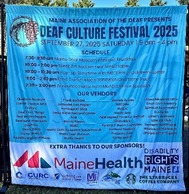
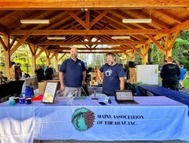
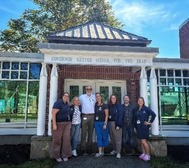
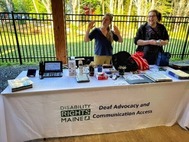
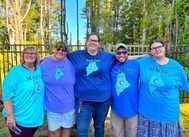
It has been a busy few months with the Annual Deaf Culture Tea awards and Deaf Culture Festival. This year MJ Grant was our keynote speaker at the Annual Deaf Culture Tea Awards. Please enjoy an interview with MJ in this issue. We also recognized seven people who deserved the awards. I want to take a minute to remind you that you can start nominating people for the 2026 Annual Deaf Culture Tea Awards!
We are excited to share that Maine EMS has developed a new communication card to share with others. Please see the information below for more information on this.
This past October marks two years since the October 25th incident in Lewison. We want to take a moment to honor those who we lost and also to think about the survivors and their families and everyone who was impacted by this event.
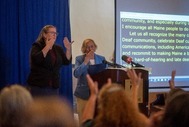
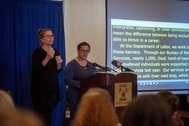
The 34th Annual Deaf Culture Tea Awards celebration took place on September 18, 2025, from 2 PM to 4 PM! Approximately 100 people attended the Annual Tea at the Hall of Flags, State House, in Augusta. Governor Janet Mills addressed the celebration and Maine Department of Labor Deputy Commissioner Kim Smith welcomed everyone at the event. Several media outlets also covered the festivities. A video recording of the 34th Annual Deaf Culture Tea Awards ceremony is on the DDHHLD website, see it at https://www.maine.gov/rehab/dod/index.shtml.
Amy Richardson, Deaf interpreter & Kim Smith, Maine Department of Labor, Deputy Commissioner.
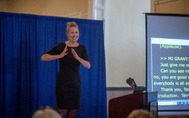
The keynote speaker for the 34th Deaf Tea was Mary Jane “MJ”. Mary Jane “MJ” Grant was born to Deaf parents in Sanford, Maine, where she still resides. She is a mother of four and a proud CODA shaped by Deaf culture. Rooted in the Deaf community, she has been a professional interpreter since 1997, taught interpreting at the University of Southern Maine, and founded Mary Jane Grant Sign Language Interpreting Services in 2010. In the years that followed she walked alongside her father through Progressive Supranuclear Palsy until his passing in 2019, while at the same time her mother’s dementia slowly deepened and eventually required long term care. That ongoing caregiving journey revealed the barriers to care that Deaf seniors face. Sharing these experiences became the inspiration for her documentary “I Remember When” and for presentations on caregiving, dementia, and building inclusive, culturally and linguistically appropriate systems of care. Through this work and her collaborations with national and international organizations, she continues to use storytelling to open hearts and minds toward a world where no one is left behind.
The title of her keynote presentation was Love in Action, Presence in Community.
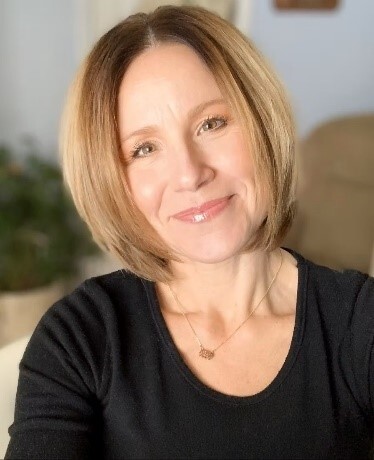
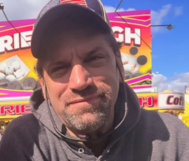
MJ Grant, Keynote Speaker.
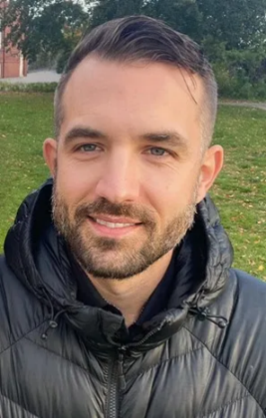
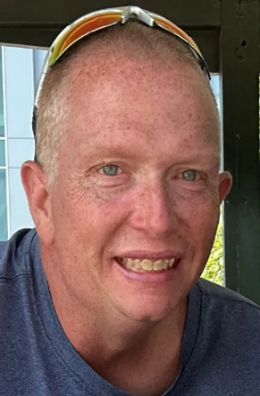
Awards were presented by Commission for the Deaf, Hard of Hearing and Late Deafened co-chair, Lisette Bélanger, Regan Thibodeau, Laurel Kelly and Julie Novack.
We would like to remind people they can start nominating for the 2026 Annual Deaf Culture Tea Awards as soon as now. Contact Terry Morrell at 207-470-7668 or E-mail: Terry.L.Morrell@maine.gov for details.
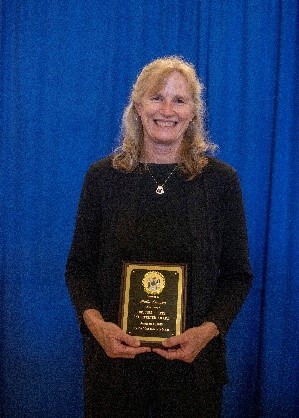
Ginny Hewes - Advocate for the Needs of the Deaf Community Award
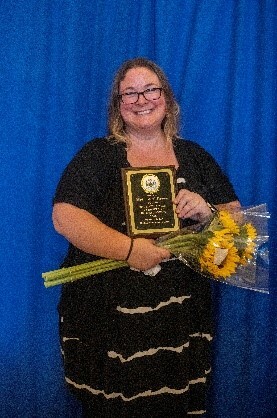
This award is given to a person or organization that advocates for the needs of the Deaf and hard-of-hearing persons in Maine. Ginny Hewes was known as the “I Love You” (in ASL) Lady of Saco. Mother to a Deaf daughter, Ginny became a tireless advocate for not just her own daughter, but for all Deaf children. As a result of her personal advocacy, the Deaf Services Coordinator position was established at the Department of Health and Human Services, which has in turn resulted in specialty signing group homes, culturally competent case management services, linguistically competent mental health counseling services, and the largest source of employment for culturally Deaf signing adults in Maine, social work. Her reach has extended far beyond the needs of her own daughter, beyond even Deaf children, to make and positive impact on all Deaf, Hard of Hearing and Late Deafened Mainers
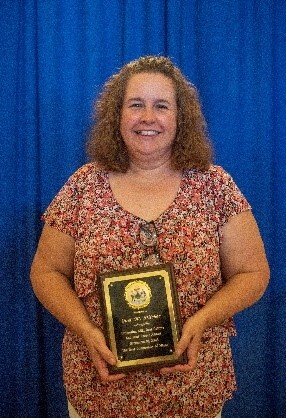
Maria (Mars) Hammond.
Outstanding Citizenship Award
This award is given to a person who is a leader in the Deaf community.
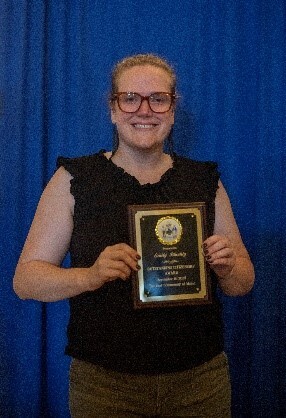
EMILY BLACHLY
Emily Blachly.
Citizenship Youth Award
This award is given to a student who is a leader in school and a Deaf community.
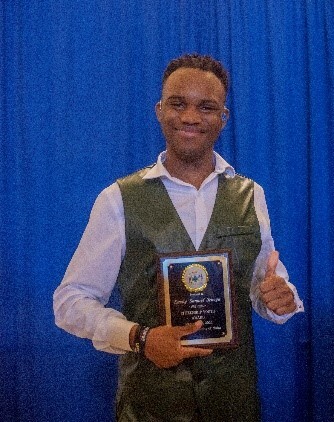
LUCKY SAMUEL IRAOYA
Lucky Samuel Iraoya.
Promoting American Sign Language, Deaf Culture, and Deaf People Award
This award is given to members of the Deaf community who are in one way or another is “Promoting American Sign Language, Deaf Culture, and Deaf People.” They may be a really good friend and/or colleague of ours that always give us a time and space to celebrate who we are as Deaf people because Deaf culture is something to be proud about, especially how it leads to many great things such as American Sign Language.
GINA M. PITCHER
Gina M. Pitcher.
This award is given to an individual, agency or business whose activities in and with a Deaf community deserves recognition.
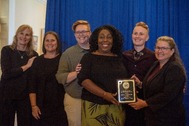
MAINE SIGN LANGUAGE INTERPRETER COLLECTIVE – MeSLIC
Maine Sign Language Interpreter Collective – MeSLIC
Left to Right: Polly Lawson, Amanda Eisenhart, Elaine Williams, Meli Stamp, Evah Hellewell & Amy Richardson.
Dr. Toni Rees Interpreter Award
This award is given to an American Sign Language interpreter who deserves recognition for outstanding service in a professional and voluntary capacity to air communities.
POLLY LAWSON
Polly Lawson.
Clifton F. Rodgers Award
This award is given to a person who deserves recognition for outstanding service in a professional or voluntary capacity to a Deaf and hard-of-hearing communities in Maine.
This award is named for Clifton F. Rodgers, a resident of Maine, all his life. He attended a Maine School for a Deaf and lived in Belfast for over 30 years with his wife Dorothy. Cliff was a member of an Advisory Council and worked for a Division of Deafness. Quotes that describe him were "He made an indelible impression on everyone he came in contact with, for his style always created goodwill and warm feelings"; "His knowledge of Maine and its Deaf Culture were immense"; and "He passed through this world making it a better place".
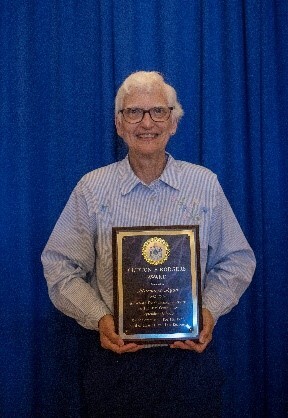
This award is presented to an individual who has worked in or with Deaf, Hard of Hearing and Late Deafened individuals for many years. It is like a "life-time achievement award".
MARGARET RYAN
Margaret Ryan.
.
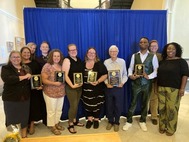
Pictured Left to Right: Amy Richardson, Amanda Eisenhart, Polly Lawson, Evah Hellewell, Gina Pitcher, Emily Blachly, Mars Hammond, Margaret Ryan, Lucky Samuel Iraoya, Elaine Williams & Meli Stamp.
As a child of a Deaf adult (CODA) what mode of communication did you use as a child?
I grew up with a mix of languages, both spoken English and American Sign Language (ASL). My parents are Deaf and grew up in a time when signing was not encouraged in many residential Deaf schools. Still, students signed in the dormitories, and that is where ASL truly flourished and became their primary language. Because of their oral roots, my parents often signed and spoke at the same time in our home with my sister and me, who are both hearing.
Where did you go to school? I grew up in Sanford, Maine, and attended the Sanford school system. I graduated from Sanford High School and later took courses at the University of Southern Maine in the ASL/English Linguistics program. Beyond that, much of my education has come from the school of life, through parenting, caregiving, and the everyday experiences that continue to teach me what it means to be human.
Have you always lived in Maine? Yes, Maine has always been home. I was born and raised in Sanford and have lived here for the past 51 years, my entire life. It is where my story began and where I have raised my own family.
What is your family life like now? I am a mother of four children, ranging from 31 to 11. My father passed from Progressive Supranuclear Palsy, and my mother, who is 83 and Deaf, lives in a long-term care facility. She is living with dementia, and I have been walking the path of caregiving and advocacy for her. We also have a dog named Midnight and two cats who keep us entertained day and night. It is a lively household indeed.
Could you tell us a little about yourself? I am a person who loves the human experience in all its complexity and wonder. I find joy in dancing, roller skating, connecting with others, and remembering what it felt like to see the world through the eyes of a child. I have a bit of wanderlust and a deep curiosity about people and the places that shape them. I have also dabbled in radio as an on-air personality, which was a fun and unexpected adventure.
I try to live my life by saying yes to new experiences, even when they scare me a little. Those moments of stepping into the unknown have taught me so much about courage, humility, and connection.
I often think of myself as a hummingbird, moving from one experience to another, gathering little pieces of sweetness and wisdom along the way. The roles in my life have included being a mother of four, a child of Deaf adults, a sign language interpreter, a business owner, and a storyteller. My work and my life are deeply intertwined with the Deaf community, which has shaped so much of who I am. I am passionate about sharing stories that open hearts and bring people together. My journey as a caregiver to my mother, who is Deaf and living with dementia, has also become an important part of my purpose and the message I share with others.
As a professional, what are your proudest accomplishments? I am proud of building my interpreting agency from the ground up with a lot of support from Maine’s Deaf community. I am also proud of using my platform to share my mom’s story, which has reached millions online and opened up conversations about dementia, isolation, aging, and accessibility.
What population do you work with? I work with people from all walks of life. My work connects me with Deaf and hearing individuals in just about every setting you can imagine, from medical appointments and classrooms to workshops, staff meetings, and community events. In many ways, my work is about being part of the everyday moments that make up people’s lives.
What are some of your successes? On a personal level, raising four children has been one of my greatest successes. It is no easy feat, but it has been the most meaningful part of my life. Connecting with people around the world has also been deeply rewarding. Each time someone shares that my mom’s story helped them feel less alone, it reminds me why I do what I do.On a professional level, running a successful interpreting agency and being invited to speak nationally and internationally about my caregiving journey have been incredible honors.
What are some of your challenges? Life constantly asks me to hold both the beautiful and the hard, often at the same time. It can be challenging, but it is also where I find perspective, compassion, and purpose. And let’s face it, our world is not always glorious right now, so sometimes it feels a little extra hard.
Professionally and personally, one ongoing challenge is the lack of direct care services provided in sign language. All humans deserve to receive care that honors both their communication and cultural needs. It cannot truly be called direct care if it is not offered in a person’s natural language. Accessibility and inclusion should be built into every level of service, not added as an afterthought.
What would you like to see happening for those that you work with? I would love to see more Deaf-centered care in healthcare settings, especially for our aging Deaf population. I want to see systems shift so that accessibility is not an afterthought but an integral part of how services are designed.
Is there anything you feel is important to mention? Our stories matter. Sharing them creates connection and can change how we think and how we build or reshape systems. I believe in the power of showing up authentically and letting our experiences light the way for others.
What are your proudest accomplishments? Personally, I am proud of being a mother of four and staying open to learning every day. There is so much wisdom in our children when we take the time to listen and stay curious. Carrying my parents’ legacy forward is also something I hold with deep pride.
Professionally, I am proud of founding my interpreting agency from the ground up and being trusted to serve the community for so many years. Having the opportunity to share my personal story with the world has also been a profound blessing. I have learned that when we open our hearts, others often feel safe to open theirs too.
Where do you work? I run my own agency, Mary Jane Grant Sign Language Interpreting Services, based here in Maine. I currently run my business from my home office and also freelance as a sign language interpreter. Another part of my work includes presenting to various communities nationwide and internationally about my caregiving journey.
What do you do at your job? I oversee interpreting requests, connect customers with qualified interpreters, and manage the daily operations of my agency. Beyond the logistics, my role is about building bridges between Deaf and hearing individuals and fostering stronger connections between systems and communities.
What do you feel is important for people to know? That accessibility is not optional. It is a human right. Connection, presence, and love are at the heart of everything we do, and we all have the power to change the world by healing ourselves.
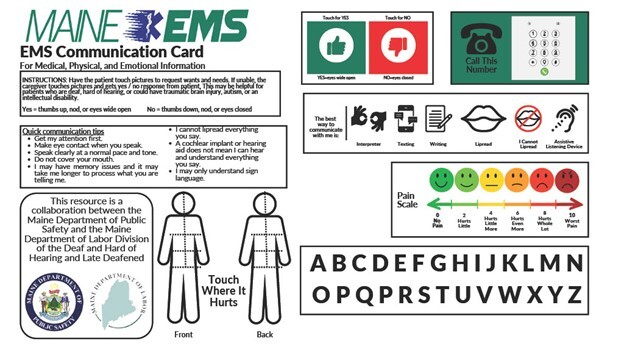
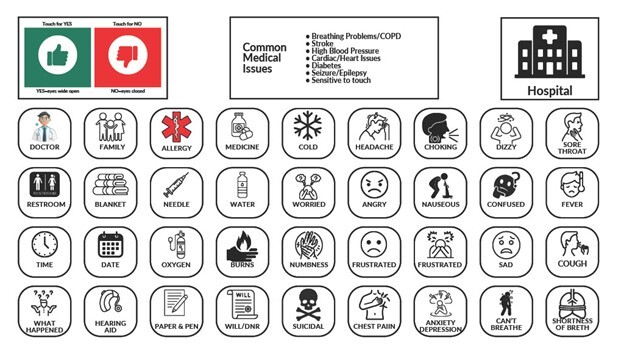
Front of the Maine Emergency Medical Services Communication Card.
Back of the Maine Emergency Medical Services Communication Card.
The Maine Department of Labor Division for the Deaf, Hard of Hearing, and Late Deafened, is excited to announce the release of the 2025 EMS Communication Card as a part of the updated Maine EMS Protocols. (Effective December 1, 2025)
This vital new resource is a collaboration with the Maine Department of Public Safety Maine Emergency Medical Services and is designed to significantly improve communication between Emergency Medical Services (EMS) providers and patients who are Deaf, hard of hearing, late deafened, or who may have other communication challenges.
A Tool for Clearer Communication in Emergencies
This comprehensive, visual protocol card is intended to be used by EMS providers to communicate quickly and effectively with patients during an emergency.
Key features of the card include:
Communication Options: Sections for indicating the patient's best way to communicate, such as texting, writing, or needing an Interpreter.
Quick Communication Tips: Guidance for EMS staff, including reminders like "Get my attention first," "Make eye contact," and "Do not cover your mouth".
Visual Aids: Pictures and symbols that patients can touch to express common needs (e.g., water, restroom, blanket), emotional states (e.g., worried, frustrated, anxiety/depression), and medical issues (e.g., chest Pain, can't breathe).
Essential Medical Information: A pain scale (0-10) and diagrams to indicate where it hurts, as well as a list of common medical conditions.
We encourage everyone in our community, especially those who interact with or work in emergency services, to review and share this important resource.