
More Volunteers Needed To Adopt Heron Colonies
Maine Department of Inland Fisheries and Wildlife sent this bulletin at 05/15/2013 03:49 PM EDT
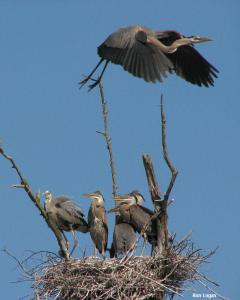 Photo by Ron Logan
More Volunteers Needed To Adopt Heron Colonies
The month of May marks the beginning of the great blue heron watching season by more than 100 volunteers across the state as part of the Heron Observation Network (HERON).
This will be the fifth year that HERON volunteers gather data about nesting great blue herons, including their colony locations, the number of breeding pairs, and the number of young seen in each nest.
The citizen science project is part of an effort to understand the status of Maine’s great blue heron breeding population. In 2007, great blue herons were listed as a state Species of Special Concern due to a 64 percent decline among the coastal island colonies since 1983. It is unknown whether that decline is a statewide phenomenon or whether it is restricted to only the coastal colonies. More volunteers are needed to help answer the question.
By “adopting” a colony, volunteers agree to visit it at least once during the breeding season (May-July) and report back to MDIFW whether or not it was active and the number of active and inactive nests. Observations are made from a distance and only if disturbance to the nesting birds can be avoided. If the volunteers are willing to commit additional time, they can visit as often as every other week to track individual nests and report the number of young that hatch and fledge. This data can be used to better understand productivity and nest success rates, which may in turn affect the adult breeding population trend over time.
Great blue herons are Maine’s largest and most widespread wading bird. In Maine, they nest as single pairs or in colonies of 2–120 pairs. They build large stick nests in live or dead trees in uplands, wetlands, and on islands. While most of Maine is potential nesting habitat, a majority of the colonies occur in beaver flowages, with nests in snags surrounded by open water. New colonies are found each year, which indicates we are likely missing some, too. Colonies may persist for decades, but they also may blink on and off, or splinter into several small colonies. This dynamic nature of heron nesting ecology adds to the challenge of obtaining an accurate count of breeding pairs in any given year.
This is where the Heron Observation Network can help. With volunteers watching colonies across the state over time, we are gaining a clearer picture of the locations and numbers of nesting pairs. However, there are still colonies that we do not know about and that have not been adopted. If you or someone you know is interested in adopting a colony, or knows the whereabouts of a colony, please e-mail Danielle D’Auria at danielle.dauria@maine.gov or call 207-941-4478.
Thanks to a Maine-based conservation sticker company, Burly Bird, you can also help support HERON’s research and monitoring efforts by purchasing a HERON sticker. These UV-coated vinyl stickers can be purchased at www.burlybird.com or MDIFW’s online store at www.mefishwildlife.com for $4 each with $3 going directly to fund future heron research.
For more information about HERON, please visit the project's blog at http://maineheron.wordpress.com/ or the HERON Facebook page at www.facebook.com/maineheron.


