Chronic Wasting Diseases (CWD) is a fatal nervous system disease that impacts cervid (deer family) mammals. In deer, it has a 100% mortality rate.
If established in Maine, Chronic Wasting Disease (CWD) may have devastating impacts on the state’s deer and moose herds, our hunting heritage, and Maine’s economy. CWD has never been found in Maine, but it has been found in wild cervid populations in 25 U.S. states and two Canadian provinces and captive populations in 17 states and three provinces.
CWD is readily spread from deer to deer. It wears a deer down and eventually kills every infected animal. CWD is always fatal – there is no treatment, no vaccine, and no resistance. Without action by hunters and state and provincial fish and wildlife agencies, CWD will continue to spread. Left unchecked, CWD will do irreparable harm to deer herds throughout New England, including Maine.
As a hunter, you are personally responsible for following all applicable laws and regulations, including those pertaining to the transport of deer and/or deer parts across state and provincial borders.
Frequently asked questions
Why shouldn't I use urine-based lures?
In most cases, the urine used in commercial "doe-in-heat" or other buck lures is collected from captive deer or elk farms. At this time, we do not know whether any captive/farmed deer or elk used by the lure industry have ever contracted CWD, and there are no standardized or widely accepted protocols in place for testing deer lures for CWD prions.
If these deer or elk are infected, CWD prions may be present in the lures. Once prions are in the environment, they can remain in the soils for years, creating multiple opportunities for Maine deer to contact and ingest them. Depending upon how they are handled, CWD-contaminated deer lures could also pose human health risks.
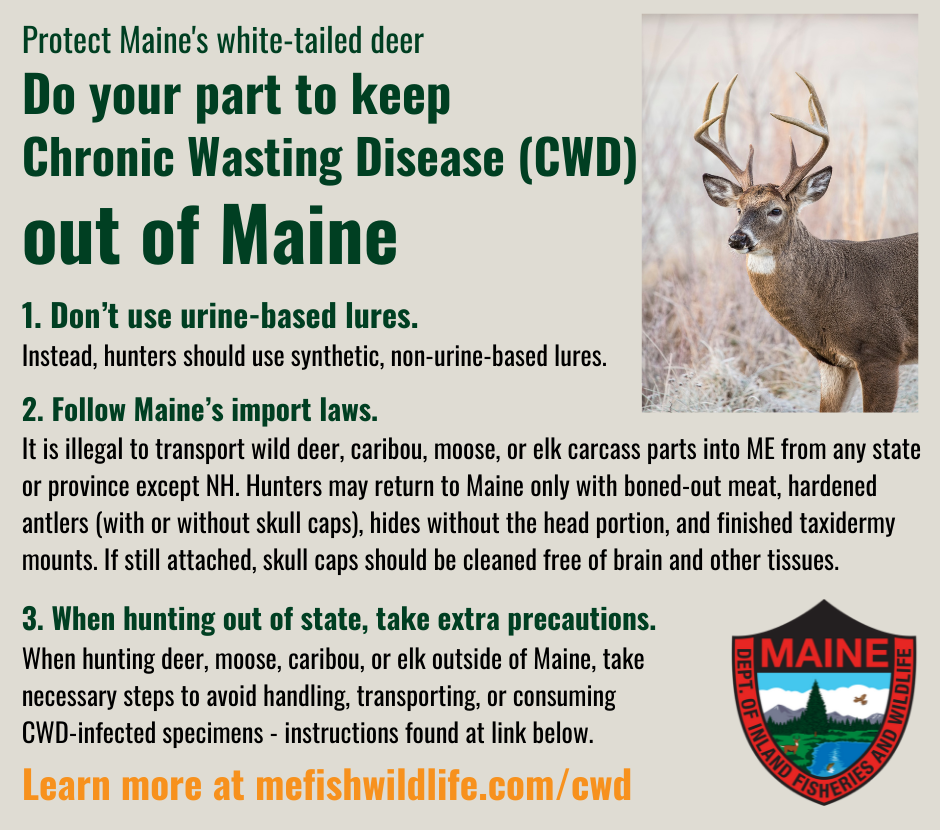
Instead, use synthetic, non-urine based lures.
What extra precautions should I take if hunting deer, moose, caribou, or elk outside of Maine?
Take the following steps to avoid handling, transporting, or consuming CWD-infected specimens (adapted from the Wisconsin Department of Natural Resources):
-
When field dressing, wear rubber or latex gloves, and minimize contact with the brain spinal cord, spleen, and lymph nodes. Remove all internal organs and dispose of them by burial or other means that prevents contact with live deer or scavengers. Always use a hunting knife (not one that will be reused in the kitchen), and clean it (and all equipment) of residue before disinfecting in a 50/50 bleach-water solution for 1 hour.
-
When cutting and processing, wear rubber or latex gloves and minimize handling of brain or spinal tissues. Only cut through the spinal column to remove the head, using a separate knife or saw. Similarly, if removing antlers, use a separate saw for that purpose only. Bone out the meat and remove all fat and connective tissue (the web-like membranes). This will also remove lymph nodes. Dispose of feet, hide, brain, spinal cord, bones, and head by burial or other means that prevents contact by live deer or scavengers; and thoroughly clean and sanitize your work area with a 50/50 bleach-water solution.
-
Before consuming the meat, if you have more than one deer, be sure to keep meat and trimmings from each one separate. If your out-of-state deer is sampled for CWD testing, wait for the test results before eating the meat.
What are State agencies doing to prevent a CWD outbreak?
MDIFW, the Maine Department of Agriculture, Conservation, and Forestry (DACF), Maine Wildlife Services (WS), and other state departments all play a role in testing and monitoring Maine’s cervid populations for CWD.
DACF and MDIFW coordinate efforts to prevent CWD from entering the state, and they also work closely with other states, the federal government, and private organizations on various CWD-related topics. Their activities cover three key areas: prevention, monitoring, and outreach.
In 2002, MDIFW began testing a sub-sample of each year’s deer and moose harvest. Thus far, all have been negative. Learn more.
|