APRIL 2026
The Maine Department of Environmental Protection (DEP) is launching the Maine Enterprise Licensing System (MELS), a centralized web-based program for all Water Quality needs. Beginning in mid to late 2027, all Water Quality applications should be submitted through MELS. MELS will enable electronic submission of incident reports, annual reports, and permit applications, including MEPDES permit renewals, without the need to submit a separate copy with a wet ink signature.
MELS will improve our service to the regulated community, increase transparency, and make management of Water Quality requirements more efficient. As registered users associated with a permit or permit application, the regulated community will be able see when an application has been accepted, if corrections are requested, and if the permit renewal is in process. Once a new permit is issued, an electronic copy of the permit will also be available on the MELS dashboard. To provide input and help shape the development of MELS, please complete the following short survey- MELS Water Quality Survey- by May 15, 2026.
We’ll be in touch again as we get closer to launching MELS for the Bureau of Water Quality. In the meantime, if you’d like to learn more about MELS and how it’s currently being used by the other DEP Bureaus, please visit: Maine DEP: MELS Hub.
For more information, please contact Holly Ireland, Holly.T.Ireland@maine.gov.
|
Don’t wait until the last minute to prepare for seasonal chlorination/disinfection! It is a good idea to start getting ready early so there is time to make adjustments/repairs as necessary.
Your chlorine contact chamber (CCC) may have accumulated water/solids during the winter that need to be cleaned-out/emptied. Perform a thorough inspection of the chlorination system to ensure the integrity of the entire system. Meter accuracy can be verified by pumping into a bucket or barrel of known volume and comparing it to the meter readings. Tank(s) should be visually inspected for corrosion and physical damage. Verify treatment chemicals are stored to capture any leaks in a secondary containment area.
Start-up procedures for chlorination/ disinfection include:
- Check that all valves are in their proper position and tagged
- All piping should be inspected and found to be in operating condition
- Feed and safety equipment should be checked and found in operating condition
- Procedures should include a program to sequentially open valves, and start equipment
Once operating, the operator must verify that chemical feed rates are correct. Test the total chlorine residual (TRC) at least twice on separate days and evaluate results to ensure target doses and residuals are being met. Make adjustments as needed.
Copyrighted material. Used by permission of Triplepoint Environmental website: www.lagoons.com. Printing of this article does not include an endorsement by the Maine DEP.
Spring is the time of the year when unmixed lagoons turn over, so it’s also the time of the year when operators (and local residents) are concerned about wastewater lagoon odor control. Although spring lagoon turnover and its accompanying odors may be normal and expected, that doesn’t mean they are tolerated. Learn what causes lagoons to turn over and what can be done to mitigate odor.
What causes lagoon turnover?
An unmixed wastewater lagoon will settle into layers, with denser, cooler water at the bottom and lighter, warmer water at the top. This is known as thermal stratification. In spring and fall, the change in ambient temperatures causes the layers to mix and eventually create a uniform temperature. As the layers begin to destratify and mix, the settled solids become resuspended and the odorous gases trapped at the bottom are released to the surface, a phenomenon called lagoon turnover. In a healthy, functional lagoon, this process should take about a week. In a well-aerated and mixed lagoon, it won’t happen at all.
What makes spring turnover and odors so severe?
Spring is usually the time of highest BOD loads in a wastewater lagoon. You’ve got the BOD that’s been stored over the winter, new influent BOD, and the BOD demands of the accumulated sludge at the bottom of the lagoon.
In the spring, increased sunlight warms the top layer of the lagoon, melting the surface ice and allowing sunlight to penetrate, creating convection currents. Gradually, with the sun’s warmth and wind, the entire lagoon reaches a uniform temperature and circulation increases.
Figure 1 – Sludge Turnover
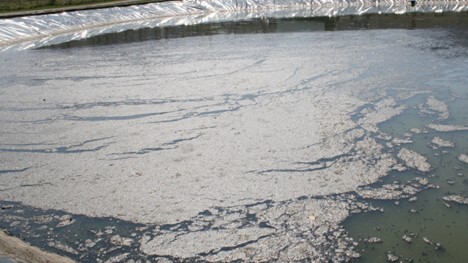
This increased circulation disturbs the accumulated sludge and solids that have been lurking at the bottom of the lagoon and pushes them to the surface. This releases hydrogen sulfide (H2S), the stinky gas that is generated by anaerobic digestion.
The dislodging of the settled sludge and solids also results in benthal feedback or benthal release, which is when nutrients like nitrogen and inorganic materials like metals that have been trapped in the sludge get released back into the lagoon. Benthal feedback can cause ammonia levels in the lagoon to be higher than in the influent.
Once the temperature hits 50 degrees F or so, bacterial action begins in earnest and starts to consume all the BOD that’s been stored up over the winter. The problem is, aerobic BOD-eating bacteria need dissolved oxygen to work, and there just isn’t enough. In the spring, a wastewater lagoon can need as much as triple the usual amount of DO—as much as 5–6 lbs. of O2 per pound of influent BOD—to handle the increased load.
Problems Caused by Lagoon Turnover
Without sufficient DO, the bacteria resort to anaerobic digestion, which is a slow and smelly process. Sludge accumulates, odors linger, and effluent violations from undertreatment are likely, including:
-
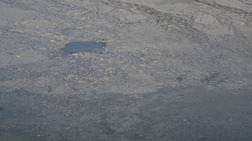
Floating sludge: As the increasing sunlight and wind circulate the water, the solids settled at the bottom, which have been quietly anaerobically digesting, are churned up. The anaerobic digestion process releases gas as a byproduct, which becomes entrained in the sludge. Once dislodged, the gas trapped in the sludge causes it to rise from the bottom of the lagoon and float.
Figure 2 – Floating Sludge
|
-
Intense Odors: With the rising gas byproduct of anaerobic digestion, unpleasant lagoon odors are released into the atmosphere all at once. These odors, coupled with those of the floating sludge mat, are strong during lagoon turnover. If picked up by the wind, these odors will likely result in angry calls and a feature story in your local newspaper.
-
Lagoon Treatment Suffers: Lagoon turnover can be a sign that your lagoon is septic and is breaking down nutrients via anaerobic digestion. Expect a spike in effluent BOD, TSS, and other treatment parameters at some point in the near future if corrective action is not taken.
How to Prevent Spring Lagoon Odors
To prevent lagoon turnover, you need to combat the causes:
-
Increase circulation to prevent stratification: By continually circulating the water, the lagoon layers will never be able to fully stratify. With both a homogeneous lagoon water temperature and environment, no spring lagoon turnover will occur.
-
Increase dissolved oxygen levels to combat low DO: One of the easiest ways to do this is to add aeration to your lagoon. By maintaining an aerobic environment you will limit the production of noxious H2S gases.
-
Increase mixing to prevent sludge buildup on the bottom: Proper lagoon mixing limits sludge accumulation by keeping solids in the water column where they can break down aerobically and odor-free.
Mixing is a critical component of wastewater lagoon aeration, keeping oxygen distributed throughout the water column and preventing solids from settling as sludge. Lagoon aerators that combine efficient fine bubble aeration with coarse bubble mixing in a single portable unit is one way to eliminate floating sludge and odors.
|

Changes to MEPDES/WDL Application process
When you are ready to renew your permit, you should be aware of changes to the application forms. Please remember that if your permit expires and you have not submitted a complete application for processing prior to the expiration, your facility will be discharging without a license and could be subject to enforcement action.
Below is guidance to navigate changes to Maine DEP’s MEPDES/WDL application process.
Digital Submissions for Wastewater Applications
The Department is moving to digital submissions for wastewater applications via a designated DEP email site.
We no longer require permittees to send two print copies to the Department. However, please send one copy with the wet signature page(s) of your application to Laura Crossley, Maine DEP, 17 State House Station, Augusta, ME 04333.
Please also submit your entire application as a single pdf to: WaterPermits.DEP@maine.gov. If you are unable to access email or lack the online capabilities to complete such a task, please let us know.
Application Form Submission Updates - General Application
There have been recent changes to the General Application. The updated POTW application has been posted to the website as of April 1. Please use this instead of the EPA Form 2A that we had been using in the interim of the form updates.
All permittees: Complete the updated MEPDES General Application Form. Be sure to include in your submittal to MEDEP any additional forms specified on page 4 of the application form.
Additional information: Facilities classified as “sludge only facility” that do not discharge to surface waters and “new or existing treatment works treating domestic sewage” must also fill out EPA Form 2S
Concentrated Animal Feeding Operations (CAFOs)
CAFOs must fill out:
- EPA Form 1;
- MEPDES General Application Form; and
- Microsoft Word - DEPLW0569 - CAFO and Livestock Operation Permit Application.doc (maine.gov)
Overboard Discharges (OBDs)
OBD’s with flow rates greater than 2000 GPD: Please use the MELS Hub to submit your application. You will need to scan and upload an attachment of the MEPDES General Application Form and EPA Form 2E to the application submitted in MELS.
Note: Always follow MEDEP’s instructions when filling out forms!
Signatory Policy Updates
MEDEP is updating our signatory policies to coincide with 40 CFR Part 122.22, as follows:
- All POTW applications must be signed by an elected Select Board Member, Town Manager or equivalent.
- All non-POTW applications must be signed by an owner, responsible corporate officer, or manager having the duty of making major capital investment recommendations and initiating and directing other comprehensive long-term environmental compliance measures.
More information on signatory requirements for different types of organizations can be found in 40 CFR § 122.22 Signatories to permit applications and reports.
Maine DEP is happy to answer your questions about these changes to the application and submission process. Please contact the Licensing Coordinator, Laura.Crossley@maine.gov, 207-615-6711 to discuss further.
|

Welcome to Ed Molleo, Maine Water Utilities Association’s (MWUA) new Executive Director!
Ed has previously held pivotal leadership roles in the broad fields of health and safety, largely with nonprofit entities. He has extensive training and experience in communications, strategic planning, emergency operations, and project management. Since 2017, he has held a particular focus on public health — an interest stemming from his personal and academic environmental studies. Prior to MWUA, Ed served as the Director of Communications with HealthReach Community Health Centers, and before that as a key member of both the Maine CDC Public Health Emergency Preparedness and Hospital Preparedness programs.
Ed’s vision for MWUA includes modernizing the Association’s communications; identifying new partners, sponsors, and other stakeholders; and identifying (and meeting!) the unmet needs of Maine’s water and wastewater communities. Working closely in collaboration with both the Maine Water Environment Association (MeWEA) and the Joint Environmental Training Coordinating Committee (JETCC/NEIWPCC), Ed’s goals include raising awareness about water industry career paths, facilitating public education and awareness about all it takes to deliver reliable and safe drinking water to communities, and advocating for water works across Maine with our elected and appointed officials to ensure a considerate regulatory environment.
For more information, visit https://www.mwua.org/ or call 207-623-9511.
|
MRWA Present In-Person Confined Space Entry Training in Auburn
On Tuesday, April 21, 2026 from 8:30 AM - 12:30 PM MRWA will present Confined Space Entry for water and wastewater operators. The class teaches knowledge and skills necessary to safely identify, evaluate, and work in confined spaces commonly encountered in treatment facilities, pump stations, and distribution or collection systems. Participants will learn to recognize confined space hazards, understand regulatory requirements, review proper confined space retrieval equipment, and implement safe entry procedures to protect workers and maintain compliance.
Topics include confined space classification, hazards and monitoring, ventilation techniques, lockout/tagout coordination, permit-required confined space procedures, rescue planning, and the roles and responsibilities of entrants, attendants, and entry supervisors. The course also covers practical hazard recognition specific to water and wastewater environments such as wet wells, tanks, vaults, and manholes. Upon completion, operators will have a clear understanding of safe entry procedures, required documentation, and best practices during confined space work.
Note: Attendees will need to bring their own confined space safety gear / PPE - As you will be able to experience confined space entry.
To registers, go to: Registration.
MRWA Apprenticeship and Utility Appreciation Day 2026
Join MRWA at their Richmond office for Apprenticeship and Utility Appreciation Day on Wednesday, April 29, 2026 from noon- 4 PM.
MRWA is excited to invite apprentices, water utility professionals, and industry experts to a day filled with hands-on learning, networking, and appreciation for the hard work that keeps Maine’s drinking water flowing! The schedule includes:
- Morning Field Trip for Apprentices – Location TBD
- Complimentary Lunch at 12pm – MRWA Headquarters - For Everyone
Enjoy lunch on us and connect with fellow water professionals! Meet the MRWA Board and other operators from around the State. Check out the latest water utility technology and tools in action! And join us for an afternoon technical training session to earn 2 Free TCH Credits! This year's theme is all about PFAS. We will have technology, engineering, and lab experts on-site.
Don’t miss this opportunity to learn, connect, and celebrate the water professionals who keep our communities running.
For more information and to register, go to Apprenticeship and Utility Appreciation Day 2026 - Maine Rural Water Association.
NEWEA Spring Meeting May 17-20 in Falmouth, MA
NEWEA’s Spring Meeting & Exhibit will take place May 17-20, 2026 at the Sea Crest Resort in N. Falmouth, Massachusetts. This annual three-day technical meeting for water quality professionals in the clean water industry offers opportunities to:
- Network with colleagues
- Learn the latest trends in technical sessions
- See the latest technologies from exhibitors
- Earn Training Contact Hours (TCHs)
We expect about 300 engineers, consultants, scientists, operators, and students to join us for technical sessions, exhibit displays, networking opportunities, Operations Challenge and more.
NEWEA Spring Meeting & Exhibit - NEWEA - New England Water Environment Association.
1. Facultative bacteria require:
a. Nitrogen
b. Hydrogen
c. Duckweed
d. Aerobic or anaerobic conditions
e. Alkalinity
2. ____________________ removes settleable solids.
a. Biological
b. Aeration
c. Denitrification
d. Detention
e. Sedimentation
3. Inorganic solids include:
a. Sand, Grit, & Minerals
b. Sand, Grit, & BOD
c. Oil & Grease
d. Organic material from Plants, Animals, or Humans
e. Both a & d
4. If the flow to a treatment plant is 2.1 MGD, what is the average flow in gallons per minute?
a. 1389
b. 3024
c. 5040
d. 1,458.3
e. 8750
5. Your pump pumped for 24 hours and pumped 302,400 gallons. The capacity of the pump is:
a. 110 gpm
b. 210 gpm
c. 755 gpm
d. 5040 gpm
e. 12,600 gpm
6. What treatment device is commonly used to separate and remove large objects from raw wastewater?
a. Clarifier
b. Classifier
c. Rotary Drum Screen
d. Mechanically Raked Bar Screen
e. Positive displacements pump
Answers:
1. d.
2. e.
3. a.
4. d. 2,100,000 gal per day/1400 min/day = 1458.3 gpm.
5. b. 302,400 gallon/1440 minutes/day = 210 gpm.
6. d. Mechanically Raked Bar Screen
|





