|
April/May 2026 Newsletter
Science Driven. Community Powered.
|
|
Birds on the Move, and How You Can Help
The Chesapeake Bay plays a quiet but critical role each spring as millions of birds move along the Atlantic Flyway. Stretching from South America to the Arctic, this migration route funnels birds directly through the region, making the Bay a vital stopover for rest and refueling. Its islands, wetlands, and even urban habitats provide essential food and shelter at a time when birds are expending enormous energy.
“The Chesapeake Bay is sort of funneling birds right to Baltimore,” said Maryland Environmental Service (MES) Senior Environmental Specialist Cal Liddell. “Our coastal habitats and places like Masonville Cove become incredibly important when birds are looking to fuel up.”
Spring migration is already underway, with early warblers like northern parula and black-and-white warbler making appearances. Activity typically peaks in late April, though timing can shift depending on weather patterns.
While large-scale conservation matters, everyday actions can make a real difference. Here are a couple of helpful solutions:
- Apply decals or patterned films to glass to help prevent window strikes so birds recognize them as barriers instead of open habitat.
- Turn off unnecessary outdoor lights between 11 p.m. and 6 a.m. to reduce confusion for birds migrating overnight. Learn more from Lights Out Baltimore.
- Plant native trees, shrubs, and flowers to provide food (berries, seeds, insects) and shelter. They are adapted to local conditions, require less water, and support the insects birds need for energy.
 |
|
Protecting migratory birds starts close to home, and small actions add up along a journey that spans continents. If you find a bird you think is in need of assistance, contact a local wildlife rehabilitator.
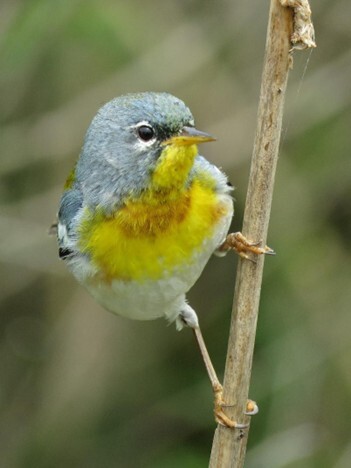
Photo (Left): Head outside for your chance to see migrating birds such as this northern parula. Masonville Cove is open to the public from 9:00 a.m. to 4:00 p.m. Monday through Saturday. Participate in a bird banding demonstration or sign up for a bird walk with the Baltimore Bird Club.
Photo by Tim Carney, MES
|
|
|
Banding Reveals Birds Returning to a Desirable Habitat
At Masonville Cove, a bird banding program is helping researchers better understand migration along the Chesapeake Bay, while also revealing something exciting: the return of birds first banded in 2023.
Since the program began, more than 3,000 birds representing about 90 species have been banded through a partnership led by the Maryland Port Administration (MPA), MES, U.S. Fish and Wildlife Service (USFWS), and the nonprofit Birds of Urban Baltimore (BUrB). BUrB holds the permits from the U.S. Geological Survey and the Maryland Department of Natural Resources (DNR) authorizing the banding work, with volunteers supporting the banding effort through fieldwork and data collection.
|
Bird banding is a hands-on process in which birds are safely captured, fitted with a small, metal leg band, and measured before being released. Researchers record details like size, weight, age, and sex, which help build a long-term picture of migration routes, survival, and behavior.
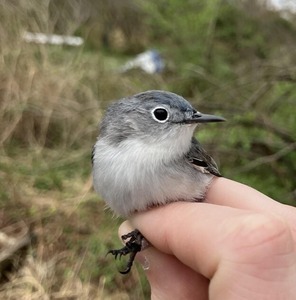
Photo (Right): A blue-gray gnatcatcher was caught for the first time at the station on April 3, 2026.
Photo by Photo by Cal Liddell, MES
|
|
 |
Fall 2025 marked the third season of migration banding at Masonville Cove. The team banded 838 birds of 56 species between early August and early November, with a brief late-season session in December. On September 27, the station set a single-day record with 107 new birds banded and three recaptures processed. Throughout the full year, the team banded 1,341 birds of 72 species. More than 210 members of the public also visited the station, and the volunteer team grew by six new members, the largest increase in a single season so far.
According to MES Environmental Specialist Cal Liddell, seeing birds return has been especially rewarding. “This year we’ve started catching a lot of birds that we originally banded in 2023, such as Carolina chickadee and a northern rough-winged swallow”. These recaptures indicate that Masonville is an important stop along the Atlantic Flyway, where birds reliably return to rest, feed, or breed.
|
|
Environmental Data Helping Decision Makers in Real Time
For more than two decades, the National Oceanic and Atmospheric Administration (NOAA) and MPA have jointly built and maintained a system most people never see but nearly every ship entering the Port of Baltimore relies on every day.
NOAA’s PORTS® (Physical Oceanographic Real-Time System) is a network of sensors that continuously monitors conditions in and around the Port and throughout the Chesapeake Bay. It provides real-time data on water levels, currents, winds, visibility, air and water temperatures, and bridge clearance heights. The information updates every few minutes and is delivered directly to people making critical navigation and operational decisions. Pilots access it through web tools or receive it directly on their portable pilot units while underway, and terminal operators use it to make loading and scheduling adjustments.
“This is really about giving pilots confidence in a very dynamic environment,” said NOAA PORTS® Program Manager Christopher DiVeglio. “In Baltimore, things change quickly. Having precise, real-time information makes a difference in every transit.”
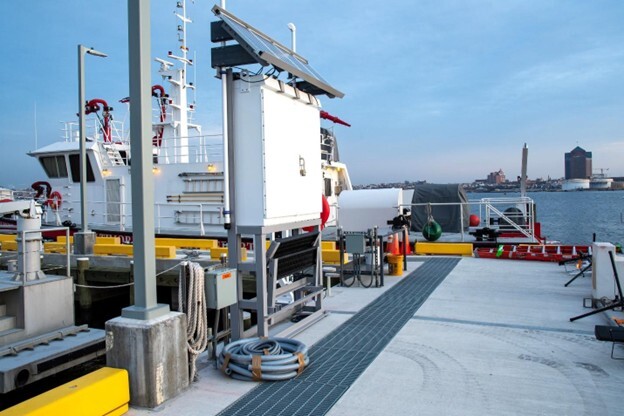 Photo (Above): Baltimore Harbor Water Level and Meteorological Station
Photo by NOAA
Those differences appear in small but important ways. Air Gap sensors near the Bay Bridge provide clearance measurements accurate within millimeters—crucial for “Super-Post-Panamax” ships. Real-time water level data helps pilots safely maximize a ship’s draft; an extra foot of water can mean thousands of tons of additional cargo worth hundreds of thousands of dollars. Current data is equally vital, allowing pilots to correct their course early if currents are “pushing” a vessel.
Through a long-standing partnership with NOAA’s National Ocean Service, MPA funds the operations and maintenance of the physical sensors, while NOAA manages data ingestion, quality control, and processing. The collaboration has been in place since 2001.
The value of PORTS® comes from both accuracy and speed. Data is collected every six minutes and delivered within minutes of that, ensuring decision-makers are always working with the most current information.
Beyond navigation, PORTS® data supports engineers designing waterfront infrastructure, emergency managers responding to storms, and long-term planners tracking changing Bay conditions.
“Most of the time, it is invisible infrastructure,” said MPA Director of the Office of Navigation, Innovation, and Stewardship (NIS) Holly Miller. “Ships still move, cranes still load, and the harbor stays busy. But underneath everything is a constant stream of data helping everyone make slightly better decisions, one transit at a time.”
|
|
Stewardship Fueled by Science: The Science of Geotubes in the DMMP
Dredging is essential to keeping Maryland’s waterways and the Port of Baltimore open for commerce, but managing the millions of cubic yards of sediment each year presents an ongoing challenge. One of the greatest constraints is drying dredged material, a process that traditionally requires large amounts of land, favorable weather, and significant time.
To address this challenge, MPA is exploring innovative geotube technology that could transform how dredged material is managed and reused.
At Colgate Creek, MPA recently completed the second phase of its first Direct-Into-Geotube (DIG) project, removing approximately 162,000 cubic yards of sediment near Dundalk and Seagirt Marine Terminals. Rather than placing the material directly into Cox Creek or Masonville Dredged Material Containment Facilities (DMCFs), sediment was pumped into geotubes for on-site drying. This approach preserves valuable containment capacity while creating material that can be reused for future projects, including raising dikes at Masonville DMCF to +42 feet and supporting closure activities at Hawkins Point DMCF South Cell.
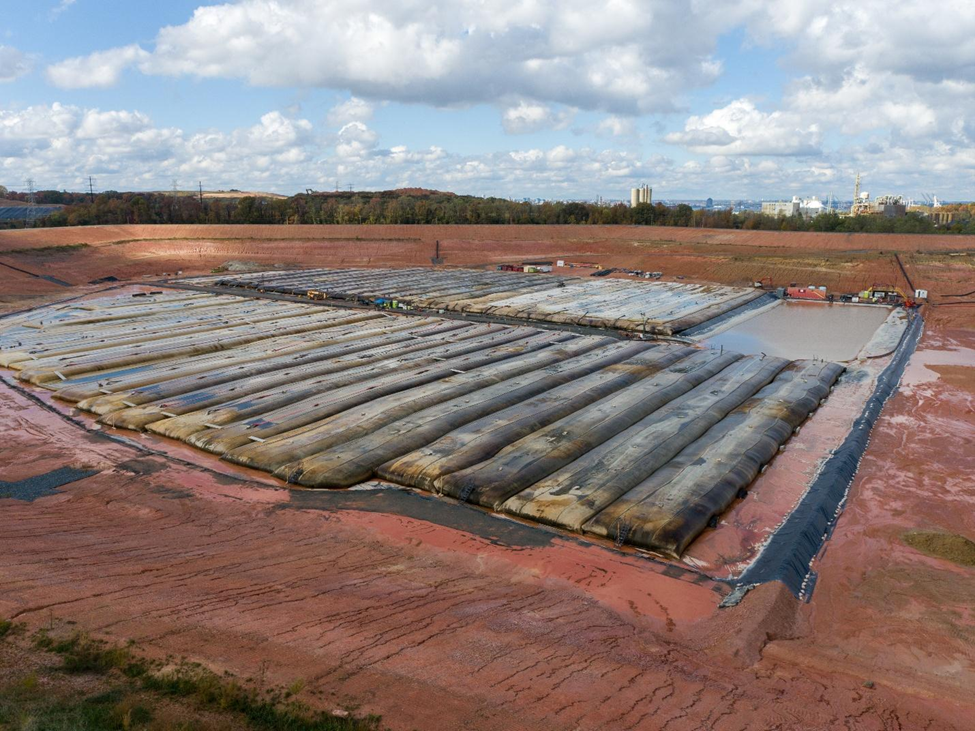 Photo (Above) Geotubes containing dredged material from the Colgate Creek dredging project, approximately 100,000 cubic yards.
Photo by MES
The potential benefits extend far beyond a single project. Geotubes offer a faster, more controlled alternative by mixing dredged material with polymers and allowing water to filter through specialized fabric while sediment remains contained.
To further improve performance, MPA and Arcadis are conducting research at the Cox Creek Dredge Material Containment Facility (DMCF), testing different geotube fabrics and flocculants to identify the most effective combinations for local sediment conditions.
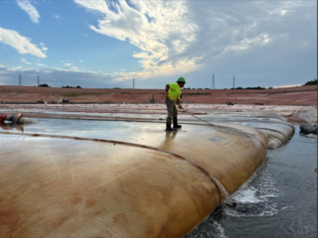
Together, these efforts demonstrate how geotube technology is accelerating innovation, expanding reuse opportunities, and helping ensure a more sustainable future for Maryland’s dredging program.
Photo (Right): A worker manually agitates the geotube to improve drying efficiency at the Cox Creek DMCF.
Photo by MES
|
|
|
From Data to Decisions: Academic Research Steering Dredged Material Management
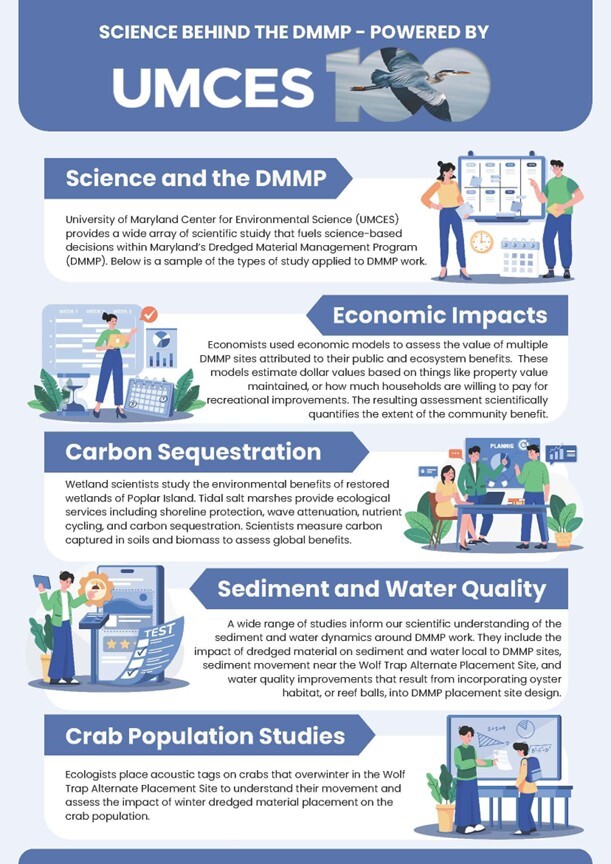
Decision-making by the MPA NIS has long been grounded in science, ensuring that every major action reflects decades of research and collaboration. This work is not done in isolation—MPA relies on a broad network of experts across academia and the private sector, with the University of Maryland Center for Environmental Science (UMCES) and its partner, Morgan State University’s Patuxent Environmental & Aquatic Research Laboratory (MSU PEARL), serving as foundational leaders in environmental research related to dredged material management in Maryland.
MPA’s stewardship programs demonstrate how deeply science is embedded in practice. At the Paul S. Sarbanes Ecosystem Restoration Project at Poplar Island (Poplar Island), researchers measure carbon captured in restored wetlands, documenting climate resilience benefits. Sediment transport modeling at the Wolf Trap Alternate Placement Site improves dredging strategies, while oyster habitat studies reveal measurable water quality gains through natural filtration. Long-term monitoring near Hart-Miller Island (HMI) confirms that these efforts protect surrounding ecosystems, and blue crab studies ensure dredging remains compatible with fisheries.
Through partnerships with organizations such as UMCES and MSU PEARL, science is translated into tangible environmental, community, and economic benefits. Studies at Masonville Cove show residents attribute a $10 million value to the restored urban green space, while the Mid-Chesapeake Bay Island Ecosystem Restoration (Mid-Bay) Project is projected to create jobs, strengthen local economies, and protect shorelines.
Together, these efforts demonstrate how, what could be a challenge, dredged material management can become an opportunity to restore habitats, build resilience, expand recreation, and create lasting value for Maryland communities.
|
|
Earth Day in Action at Turner Station
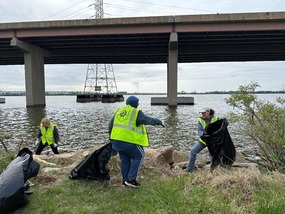
Baltimore Port Alliance (BPA) volunteers came together on Earth Day 2026 to support the Turner Station community in Baltimore County, Maryland, located near Dundalk and Sparrows Point. In total, 40 participants, including volunteers from the MPA, Mediterranean Shipping Company, Amports, Ports America Chesapeake, Vane Brothers, The Terminal Corporation, C. Steinweg, Wallenius Wilhelmsen, MES, Stevenson University, EcoLogix Group, Inc., and B&D Environmental, dedicated their time and energy to help with greening and cleaning efforts.
 |
|
The day focused on two key projects. At Fleming Park, volunteers conducted a shoreline cleanup along Bear Creek, removing debris and helping restore the natural environment. Teams also worked at Chestnut Park, where they tackled weeding, mulching, and grass cutting to improve the park’s appearance and usability for residents. |
Photo (Above): MPA volunteers work along Bear Creek.
Photo by Bruna Attila, B&D Environmental
“A huge shout out to the Port workers with over 40 eager volunteers showing up ready to work! They made an incredible impact cleaning up Bear Creek at Fleming Park, even bringing a truck to help move debris to the dumpsters at Turner Station Park,” said Edie Brooks, Turner Station Conservation Teams board member and organizer of the event. “And, they didn’t stop there; after their work at Fleming Park, they continued helping at Chestnut Park and other areas throughout the community. We appreciate you!”
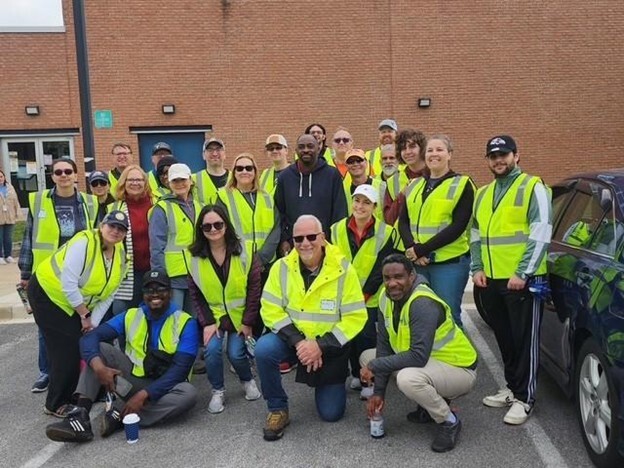 Photo (Above): Some of the 40 volunteers who marked Earth Day with service in Turner Station.
Photo by Gloria Nelson, Turner Station Conservation Teams
|
|
Record Attendance at BPA’s 8th Annual Hiring & Career Expo
Held on April 30th, BPA’s 8th Annual Hiring & Career Expo drew record attendance, bringing nearly 400 job seekers and 38 exhibitors to the Community College of Baltimore County Dundalk campus (CCBC Dundalk). One of the region’s largest maritime workforce events, the Expo featured some of the top employers from the industry.
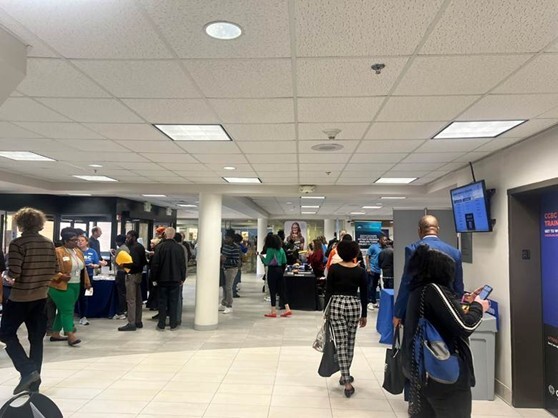 Photo (Above): BPA’s 8th Annual Hiring & Career Expo reached its largest turnout to date, drawing nearly 400 job seekers alongside 38 exhibitors.
Photo by Angie Ashley, Angie Ashley Consulting
Focused specifically on careers in the maritime, transportation, and logistics industries, the Expo connected attendees directly with employers offering opportunities ranging from entry-level positions with paid training to experienced professional roles. Job seekers were also able to apply for open positions, participate in on-site prescreening interviews, and 100 participants took advantage of complimentary professional headshots.
“The goal is always to help people find meaningful employment while also ensuring that exhibitors can connect with strong talent. The focus is on creating opportunities for both sides—job seekers and employers—to find the right fit,” said Katrina Jones, MPA Program Manager for Education and Stakeholder Engagement. “The event also offers a wide range of opportunities, from entry-level roles that require no experience and provide training to more advanced professional career positions.”
|
K. Love, a job seeker, described the event, “The very friendly people with BPA will provide you with any information you need to get you on the correct path to find your new career.”
The event website remains active for about 60 days after the Expo, allowing individuals who could not attend the opportunity to access employer information and current openings.
Photo (Right): The Expo provides excellent face-to-face networking opportunities, as well as resources available virtually for approximately 60 days after the event.
|
|
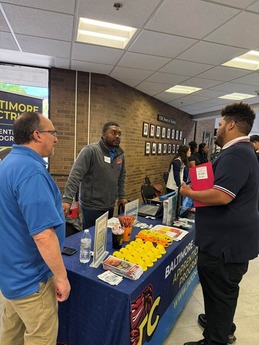 |
Photo by Angie Ashley, Angie Ashley Consulting
“Thank you to CCBC Dundalk for hosting the event each year, as well as BPA for their support. This event would not be successful each year without their support,” continued Jones.
|
|
Students Challenge and Inspire MPA Team
In early April, staff from MPA NIS had the unique opportunity to engage with students at the Maryland Correctional Institution in Jessup through the Goucher Prison Education Partnership (GPEP).
“We were surprised to receive the request through our website, but we always look forward to opportunities to engage with diverse audiences,” said MPA Program Manager for Education and Stakeholder Engagement, Katrina Jones. What began as a planned introductory presentation on Maryland’s dredged material management program quickly evolved into a dynamic, student-driven conversation.
Nearly 20 students in an environmental science and engineering course came prepared with thoughtful questions that spanned policy, technical processes, and community impacts. Their curiosity and openness set the tone for a meaningful exchange.
One participant shared that he arrived skeptical about community impacts but left with a deeper appreciation for the Port’s transparency. The dialogue created an energizing environment free from assumptions and grounded in genuine interest.
Despite the non-digital classroom setting, the session thrived using printed materials and conversation. “The MPA visit enabled the real world of complex environmental policy and practice to enter our classroom,” said instructor Edward Landa. “It was a uniquely rewarding experience that the students greatly appreciated.”
Kelvin Moulden, MPA Chief of Innovative Reuse Strategy & Partnerships, echoed the sentiment: “It was great to see how engaged, curious, and earnest everyone was. It was very encouraging.”
Founded in 2012, GPEP provides rigorous college coursework inside Maryland correctional institutions, serving about 130 students each year. NIS staff were honored to support the program—an experience that left a lasting impression and may be the start of continued collaboration.
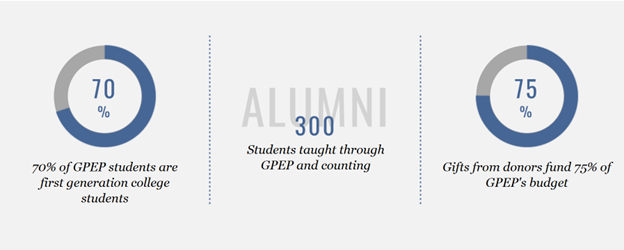 Photo by GPEP
|
|
BPA Connects with Dundalk Community Through “Port 101” Presentation
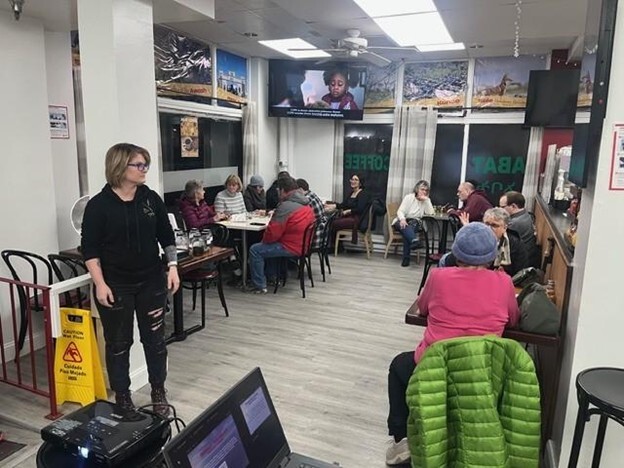
Members of the BPA continued their community outreach efforts on February 11, 2026, with a visit to the Old Dundalk Neighborhood Association (ODNA), engaging about 15 residents in a conversation about the Port of Baltimore.
The PowerPoint presentation, often referred to as “Port 101,” provides a clear and concise look at how the Port operates day to day. Co-chair of the BPA’s Environmental Committee, Rupert Denney, showcased the Port’s history and economic impact, then brought the story to life by showing the types of vessels that call on Baltimore and how cargo moves from ship to shore and on to its final destination. He also emphasized the Port’s sustainability programs, from repurposing materials, such as out-of-service marine containers and redundant lumber, both for use in community gardens, and to ongoing work that supports cleaner air and water.
 |
|
The outreach initiative grew out of interest from past Port tour participants who wanted to bring this information back to their communities. Prior to this meeting, the BPA Environmental Committee had been invited to talk to several local groups, creating the opportunity to reach out to many of the Port’s neighbors who may not otherwise have had the chance to discover how the Port operates. |
Photo (Above): Dundalk community members gather for the Port 101 presentation.
Photo by Dan Spack, EcoLogix Group, Inc.
Beyond sharing information, these meetings are also a chance to listen. Community members can ask questions, share perspectives, and better understand how the Port connects to their daily lives and neighborhoods.
“Thanks so much for offering an opportunity to tour the Port of Baltimore, and for attending our meeting so we can see how everything works at the Port!” said ODNA President Jessica Lilli.
To request a Port 101 presentation, contact EcoLogix Group, Inc. Principal Dan Spack at dspack@ecologixgroup.com.
|
|
Get the Scoop on Dredging
Staff from MPA NIS held the third “Get the Scoop on Dredging” event on March 24 in Baltimore County, bringing community members together for a closer look at how dredging in Maryland works and why it matters.
This event walks participants through the full lifecycle of dredging in Maryland, from how sediment is tested and evaluated to the permits and environmental standards that guide the work. Attendees also learned how dredged material is removed from shipping channels and where it goes next, whether to containment facilities or for reuse.
|
A key focus of the March session was HMI. Presenters shared the site’s history, its role in dredged material management, and how parts of it have been transformed into a public state park. Long-term monitoring data from the island, collected over more than 40 years, helped illustrate how science has shaped today’s practices.
Maintaining channels is essential to keeping the Port of Baltimore open and supporting the regional economy. At the same time, dredging has enabled environmental benefits like habitat creation and wetland restoration.
|
|
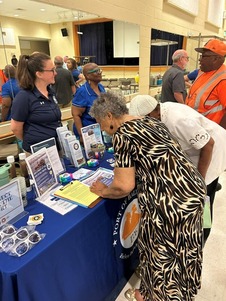 |
Photo (Above): Community members get the scoop on dredging in Baltimore County.
Photo by MPA
To request a presentation for your community or learn more about this event, submit a request to ecoport@marylandports.com.
|
|
Mid-Bay Outreach Team Engages Fisheries Advisory Commissions
The management of dredged material is a complex undertaking that affects a wide range of stakeholders in and around the communities where MPA projects operate. The DMMP benefits from engagement with diverse stakeholder groups whose perspectives help inform decisions and ensure projects deliver lasting operational, environmental, and community value.
For the Mid-Bay Project, engagement with water users—particularly the fishing community—is an important part of project coordination and communication. In April 2026, members of the Mid-Bay Outreach Team presented to two advisory bodies that support the Maryland DNR: the Sport Fisheries Advisory Commission, which represents recreational fishing interests, and the Tidal Fisheries Advisory Commission, which represents commercial fishing interests. These commissions provide Maryland DNR with valuable insight into how natural resources are used by different stakeholder groups and the economic and social importance of fisheries across Maryland’s coastal communities.
During the meetings, the outreach team shared updates on the Mid-Bay Project, including an overview of the program, restoration activities at Barren and James Islands, environmental benefits associated with island restoration, and the current status of construction and monitoring. Particular attention was given to monitoring efforts related to fisheries resources.
 |
|
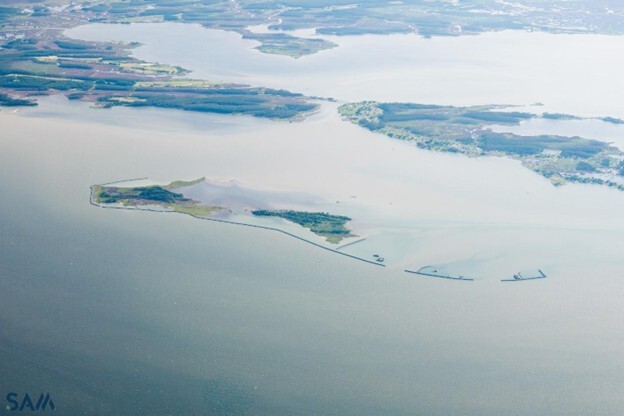
Photo (Left): Aerial imagery of Barren Island, where the Mid-Bay project is restoring 72 acres and another 2,072 acres of lost island habitat at James Island, using dredged material sourced from the Port of Baltimore approach channels and the Honga River.
Photo by SAM
|
Engagement with these commissions provided an opportunity to share safety information related to construction activities at James and Barren Islands and to strengthen relationships with the recreational and commercial fishing communities.
These conversations highlight the shared interest among project partners and stakeholders in protecting and restoring habitats that support fisheries, coastal livelihoods, and recreational opportunities across the Chesapeake Bay.
|
|
Introducing the Inaugural Friends of Masonville Cove Board
Earlier this year, the Friends of Masonville Cove officially elected its inaugural board, bringing the group one step closer to official 501(c)(3) status.
Chair Ralinda Wimbush, founder of WOCO Hike and Sound Healing, brings extensive experience building community in nature.
Vice-Chair Sharon Dorsey, a Maryland native, offers a strong background in conservation and environmental stewardship, strengthened by her time with the USFWS.
Secretary/Treasurer Natalie Cohen, program manager with the Baltimore Office of Sustainability, is deeply rooted in South Baltimore, and her expertise in urban sustainability provides critical insight.
 Courtesy Photos
Each member joins the board having already been involved with Masonville Cove in different ways, including community outreach, programming, and sustainability work, and has a strong understanding of both the site and the surrounding community.
Building a board that reflects that community was an intentional priority from the start, according to MPA Outreach Coordinator Danielle Fisher. “Having community members in leadership roles helps ensure that the group is rooted in the community and can effectively connect people to the work happening at the site. Their existing relationships and experience with the partnership help strengthen that connection and support ongoing engagement,” said Fisher.
Having spent the past year focused on learning, the Friends are moving into a new phase focused on engagement and sustainability. Friends of Masonville Cove will serve as a fiscal sponsor, helping support programs and initiatives outlined in Masonville Cove’s Strategic Plan, focused on strengthening community connection, expanding youth engagement pathways, increasing regional visibility, and improving collaborative leadership within the partnership.
“As a new organization, there are a lot of opportunities for people to get involved, whether through volunteering or joining committees,” continued Fisher. “Join us and help build something that feels connected, relevant, and rooted in the community.” For more information, join the Friends mailing list or sign up for the Masonville Cove Newsletter.
|
|
It Pays to Be a Friend of Masonville Cove
On April 10, participants connected to Masonville Cove programs were offered a unique opportunity to deepen their engagement with the natural world, at no cost. Through a special grant-funded initiative, Nature Worx delivered an immersive training designed to provide practical tools that enable educators, program leaders, and community partners to enhance their programming with intentional, mindful nature connection experiences. Participants can now capitalize on nature’s healing and restorative qualities in providing meaningful connections to the environment while supporting the well-being of the communities they serve.
Rooted in a mission to reconnect people with nature in ways that foster emotional balance, resilience, and a sense of belonging, Nature Worx combines science-based practices with experiential learning. The three-hour training introduced participants to the research behind nature connection, followed by hands-on demonstrations and small group practice sessions that allowed attendees to apply new techniques in real time.
Designed for anyone who engages with the public, the training emphasized simple, adaptable approaches that can be woven into a wide range of programs—from environmental education to community outreach.
This valuable opportunity was made possible through funding from the Chesapeake Bay Trust, underscoring the continued investment in innovative, people-centered approaches to environmental stewardship at Masonville Cove.
|
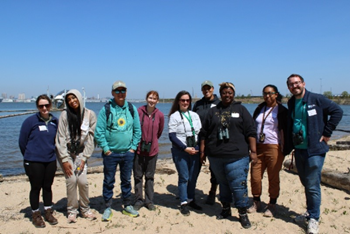
Photo (Right): Masonville Cove partners and supporters are grateful to the Chesapeake Bay Trust for funding the Nature Worx training.
Photo by Lisa Robbins, Nature Worx
|
|
 |
|
|
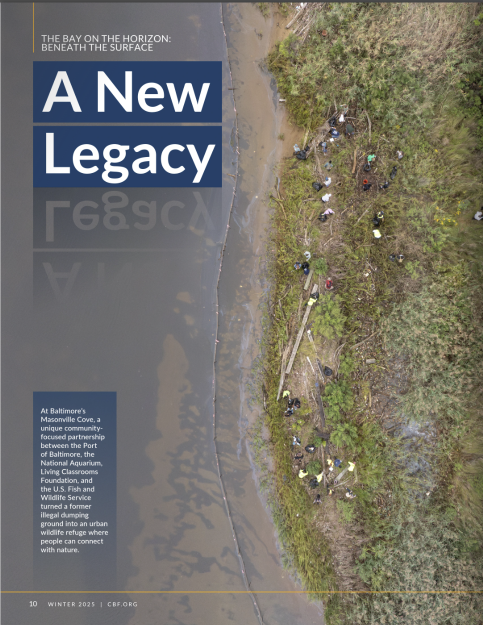
CBF’s Save the Bay Magazine Features Masonville Cove
The Chesapeake Bay Foundation (CBF) has recognized the DMMP as a model in its nationally distributed magazine article, “A New Legacy.” The feature elevates the visibility of the Port of Baltimore by highlighting MPA’s leadership in advancing innovative, conservation-focused approaches that deliver environmental, community, and economic benefits across the region.
They point to Masonville Cove, a once-degraded site that has been transformed into a thriving urban wildlife refuge that now supports diverse habitats, educational programming, and public access. As the article notes, “In short, Masonville Cove has become a haven for wildlife, showing how successful restoration efforts can be.” The project reflects how long-term commitment, careful planning, and community engagement can restore both ecosystems and connections to the waterfront.
Beyond Masonville Cove, the article also highlights the broader practice of beneficial use, repurposing clean dredged material to restore wetlands and enhance habitat throughout the Chesapeake Bay region. These efforts demonstrate how dredged material can extend environmental value while supporting the continued function of the Port of Baltimore.
CBF remains a highly valued collaborator, contributing across five DMMP committees and helping shape ongoing efforts through shared expertise and perspective. Their partnership also helps elevate and celebrate the outcomes of this work—grounded in environmental stewardship while supporting the operational strength and economic vitality of Maryland’s waterborne commerce. As CBF’s Carmera Thomas-Wilhite emphasizes, “It takes time, it takes partnerships, it takes funding… Real change is possible.”
See it for yourself and read “A New Legacy,” in the Save the Bay Magazine to see how these collaborative efforts are making a lasting impact.
|
|
|
These committee meetings are open to the public, some meetings may be virtual or in-person. Please visit maryland-dmmp.com for details and to access information for each meeting. For questions, please contact ecoport@marylandports.com.
|
|
June
Management Committee Meeting – June 17th at 10 AM
In-Person Event – For more information, visit https://maryland-dmmp.com/committees/.
World Trade Center - Stanton Room 401 E Pratt St. - 20th Floor, Baltimore, Maryland, 21202
July
Citizens Advisory Committee Meeting – July 1st at 5 PM
In-Person Event – For more information, visit https://maryland-dmmp.com/committees/.
Hart-Miller Island Citizens Oversight Committee Meeting – July 14th at 5 PM
In-Person Event – For more information, visit https://maryland-dmmp.com/committees/.
Hart-Miller Island - 2024A Riverview Rd, Essex, MD, 21221
Cox Creek Citizens Oversight Committee – July 22nd at 5:30 PM
Hybrid Event – For more information, visit https://maryland-dmmp.com/committees/.
Cox Creek Operations and Maintenance Complex - 1000 Kembo Rd., Baltimore, MD, 21226
|
|
The ECOPort Newsletter is the Maryland Port Administration’s bi-monthly update of projects and programs that help the agency contribute to a thriving economy, environmental stewardship, and community partnerships. As always, we thank the many private sector businesses, government leaders, communities, and individual citizens who have helped make these achievements a reality. |
|
|
Jonathan Daniels, Executive Director
Maryland Port Administration
The World Trade Center
401 East Pratt Street, Baltimore MD 21202
1-800-638-7519 / www.marylandports.com
|
|
|
|
|