|
Dredging Into Fall
Fall 2025 Release
|
|
Rare Piping Plover Spotted at Port Site
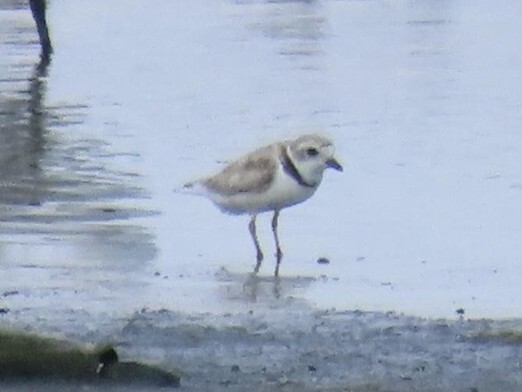
Recently, the Masonville Dredged Material Containment Facility (DMCF) welcomed a remarkable visitor: a piping plover. This bird, which was first observed by Maryland Environmental Service (MES) Senior Environmental Specialist II Tim Carney, marks the first such sighting at Masonville and possibly one of the first recorded in Baltimore City. The small, sand-colored shorebird holds special significance, as it is listed as endangered in Maryland and threatened at the federal level.
 |
|
“It was really exciting,” said MES Environmental Specialist Cal Liddell. “The eBird records didn’t show any prior sightings here, so it was significant for us and for the local birding community.”
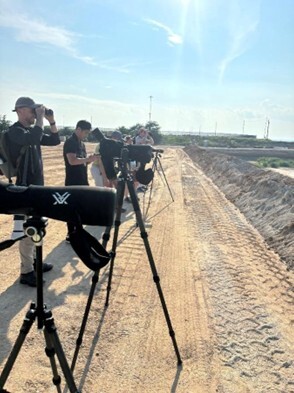
To share the excitement, staff worked quickly to get the word out and open after-hours access at the DMCF for more than 30 birders. “We wanted to make sure people had the chance to experience this first-time sighting,” Liddell explained. “Everyone who came got to see the bird. It was a joy to share that with the community.” The birders who visited were also able to observe a family of black-necked stilts, which is the first breeding record for this species in Baltimore City.
|
Photo (above): Swift action by MPA and MES staff enabled more than 30 birders to view a rare piping plover at the Masonville DMCF.
Photo by Cal Liddell/MES
Transformed from a former dumping ground, today Masonville Cove is a beautiful haven for wildlife, including more than 250 bird species and the first known pair of nesting bald eagles recorded in Baltimore City. Thanks to the restoration efforts of the Maryland Port Administration (MPA) and community members, more than 61,000 tons of trash and debris that dated back to the Great Baltimore Fire of 1904 were removed, leading to today’s urban oasis of 70 acres of water and 54 acres of restored wetlands and nature trails.
“Our piping plover visitor really shows how far the site has come,” Liddell said.
Photo (above): Camouflaged in the sand, according to the Maryland Ornithological Society, piping plovers are nearly invisible until they run a short distance, stop, and tilt forward to pull an insect or worm from the soft sand.
Photo by Tim Carney/MES
Since the Masonville DMCF is an active construction site, special tours of rare bird viewings are limited. The adjacent Masonville Cove Environmental Education Center is open Monday through Saturday, 9 a.m. to 4 p.m., and visitors are encouraged to log sightings on the eBird website. For more information, write to birdingtours@menv.com.
|
|
Interagency Workgroup Charts Cleaner Course Aboard the Spirit of Baltimore
On September 11, the Maryland Department of the Environment (MDE), Maryland Department of Transportation (MDOT), MPA, BGE, and Maryland Energy Administration (MEA) gathered for an in-person meeting of the Inter-Agency Air Quality Workgroup aboard the Spirit of Baltimore.
Established in 2015, this partnership unites state agencies and private partners to cut emissions, improve energy efficiency, and bring clean-air benefits to communities near the Port of Baltimore. What began as a voluntary agreement has evolved into a forum for securing grants, piloting zero-emission equipment, and supporting underserved neighborhoods affected by Port activity.
“As a project partner on a 2018 Diesel Emissions Reduction Act (DERA) grant, the Spirit of Baltimore provided the perfect setting,” said MPA’s Environmental Manager Cindy Hudson. “The vessel, nearly 45 years old, had original engines from the 1980s that had been rebuilt but never replaced. The grant enabled the repowering of the vessel and delivered significant benefits, including reduced fuel use, lower emissions, quieter operation, and improved efficiency.”
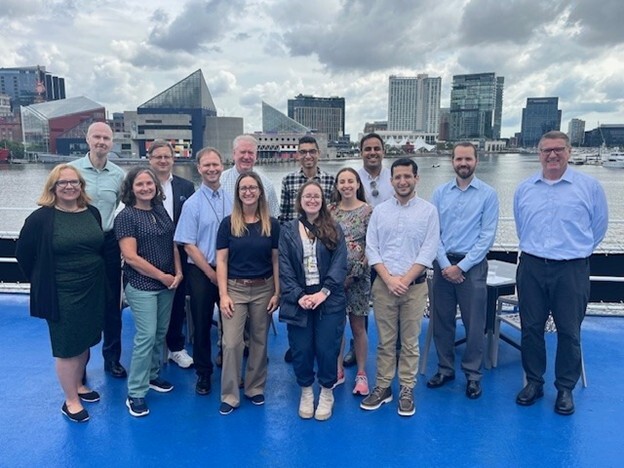
Photo (above): Members of the Inter-Agency Air Quality Workgroup met on board the Spirit of Baltimore, which received $318,000 in DERA grant funding toward an $800,000 upgrade to newer, cleaner engines.
Photo by Spirit of Baltimore Staff
Meeting face-to-face sparked collaboration among agency staff, utility partners, and the Hornblower Group, which operates the Spirit of Baltimore. Participants also exchanged updates on large-scale zero-emission cargo equipment replacements, new electric dray trucks, and plans for statewide electric vehicle (EV) charging along the I-95 corridor.
“Meeting on a vessel that was successfully upgraded with clean-air technology was the perfect reminder of what the Workgroup is all about, which is finding practical, cost-smart ways to cut emissions, boost energy efficiency, and work hand-in-hand with local communities,” continued Hudson.
|
|
Turning Dredged Material into Community and Environmental Wins at Stoney Beach
MPA helped the Stoney Beach Condominium community in Northern Anne Arundel County turn dredged material into a valuable environmental and recreational resource.
“Beneficial use of dredged material is not only important because Maryland law requires it, but also because it provides real environmental benefits. The Dredged Material Management Act of 2001 emphasizes innovative and beneficial use, and MPA is always looking for ways to put dredged material to good use. When the Stoney Beach community needed to stabilize their shoreline, we were able to provide material dredged from Anne Arundel County’s waterways,” said MPA Chief of Innovative Reuse Strategy & Partnerships Kelvin Moulden.
Dredging keeps waterways safe and navigable, and the material removed doesn’t have to go to waste. “Reusing dredged material safeguards shorelines, restores islands, and creates long-term resilience. It’s not a waste product; it’s an opportunity to restore natural habitats and improve coastal resilience,” Moulden said.
The project, supported by MPA, the Stoney Beach Condo Association, Maryland Department of Natural Resources (DNR), BayLand Consultants and Designers, Inc., and Environmental Quality Resources, LLC, created new marsh habitat and planted native grasses to protect the shoreline. The restored area supports wildlife, including threatened and endangered species, while providing erosion control and enhanced recreational access for residents.
Communities and organizations interested in the beneficial use of dredged material can learn more information and request dredged material here.
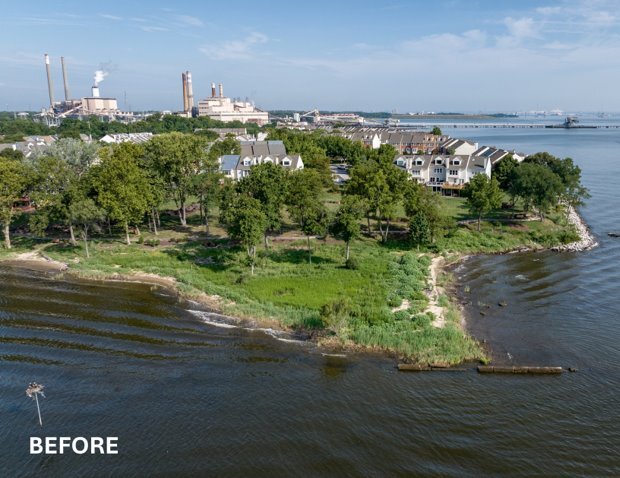 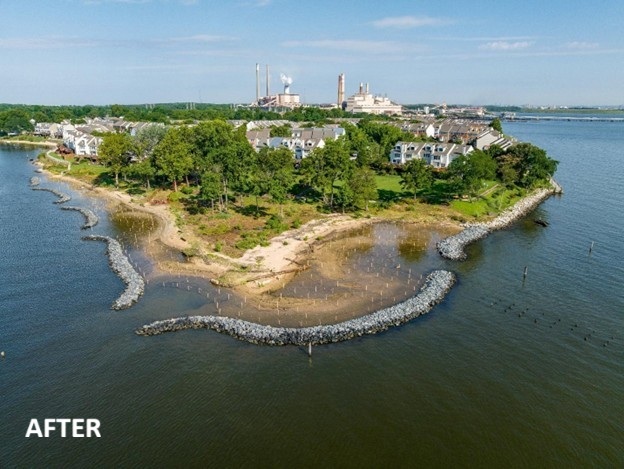 Photos (above): A win-win for the Port and a community, dredged material bolsters a shoreline in northern Anne Arundel County.
Photos by BayLand Consultants & Designers, Inc.
|
|
Stoney Beach Community Walking Path Gets a Sustainable Makeover with MPA Support
The Stoney Beach Condominium community on the Patapsco River has taken a major step in enhancing its recreational and environmental amenities with the refurbishment of its walking path, thanks to a partnership with the MPA and the Baltimore Port Alliance Environmental Committee.
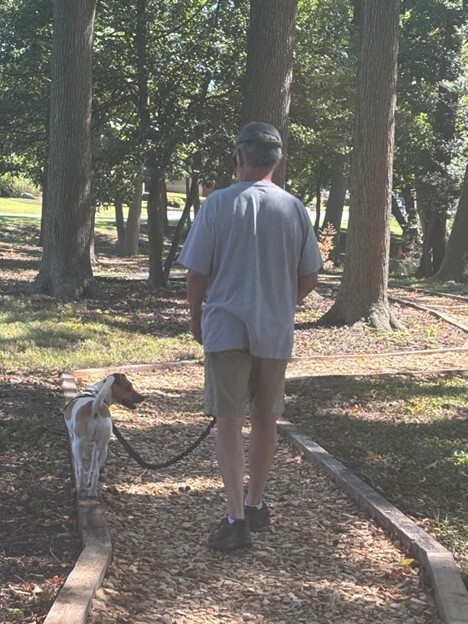
“Every 8-10 years, a full replacement is usually needed for our community walking path, which includes wood timbers that erode over time,” said Julie Stratton, community manager for the Stoney Beach Condominium Community. Initially connected through a DNR living shoreline grant, MPA's Program Manager for Education and Stakeholder Engagement Katrina Jones provided information that enabled the community to access donated 4x4 timbers and used wood dunnage for the project.
 |
|
“This project saved the community a significant amount of money by utilizing donated timbers,” Stratton explained. “We used Strickland Outdoor Services to complete this project, and they also donated wood chips to line the path. The residents have responded very positively to Phase 1 of the refurbished path, commenting on how nice it has turned out.”
Photo (left): Donated timber now borders the Stoney Beach Condominium Community walking trail.
Photo by Julie Stratton
|
With over 1,300 feet still to be refurbished, Stoney Beach continues to seek additional timber to complete the walking path. The project complements the community’s broader environmental goals, including living shoreline efforts and a pollinator habitat funded through local grants. “The walking path provides a beautiful space for residents to experience and appreciate nature. It is one of our most popular amenities,” Stratton noted.
Reflecting on the value of partnerships, she added, “It is invaluable to have the relationships we’ve built with various nonprofits. The grants, free trees, shrubs, and donated timbers have saved the community money, which for homeowners translates into lower association fees. It is a win-win all around.”
|
|
More than a Number: Measuring Masonville’s Value
What is the true worth of a place that connects people and nature? A recent study from the Morgan State University Patuxent Environmental & Aquatic Research Laboratory (PEARL), helps answer that question, translating how much nearby residents value Masonville Cove’s recreational space, educational programs, and environmental restoration into measurable terms.
Researchers asked more than 1,000 Baltimore-area residents, including a subset of the adjacent area, how much they value access to Masonville Cove, the nation’s first Urban Wildlife Refuge Partnership. The results showed that, on average, households were willing to pay about $131 a year for the benefits it provides. When scaled up, that translates to a community value of roughly $10 million.
|
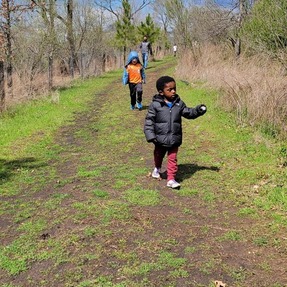
“For comparison, similar studies of other greenspaces typically find values between $50 and around $200 per household. Masonville Cove sits at the high end, a clear signal of how much the site matters to Baltimore residents,” said MPA Environmental Analyst Rachael Gilde.
Photo (right): The valuation study of Masonville Cove quantifies that it is a place people deeply value.
Photo by MPA
|
|
 |
The study also revealed something just as important: who you ask matters. Survey participants represented both the wider Baltimore region and the neighborhoods closest to Masonville Cove, where access to quality greenspace has historically been limited. “These voices underscored Masonville Cove’s role as a rare and valuable resource in a part of the city that has often had fewer environmental amenities,” continued Gilde.
“The findings confirm that the investment in Masonville Cove aligns with community priorities and strengthens the case for restoration and engagement work moving forward,” said Gilde.
|
|
Play Naturally: Masonville Cove’s New Outdoor Adventure
A natural playground of fallen logs and tree stumps creates a place for adventures at Masonville Cove’s new nature playground, made possible through the Masonville Cove Links (MCL) WildSTEM internship program that builds upon a national The Links, Incorporated LINKS-STEMREADY program and a pilot with the Harbor City (MD) Chapter of The Links, Incorporated.
“The playground was a project that we chipped away at over three cohorts of the WildSTEM Internship Program. Each cohort contributed—one student focused on research, another designed it, and another managed the installation. Together, their work finally brought the project into the ground,” said MPA Environmental Analyst Rachael Gilde.
Unlike traditional playgrounds with plastic slides or metal swings, the nature playground uses natural features that encourage climbing, balancing, and imaginative, unstructured play. These elements promote sensory engagement while helping children build coordination, creativity, and social skills, while fostering a connection with the natural world.
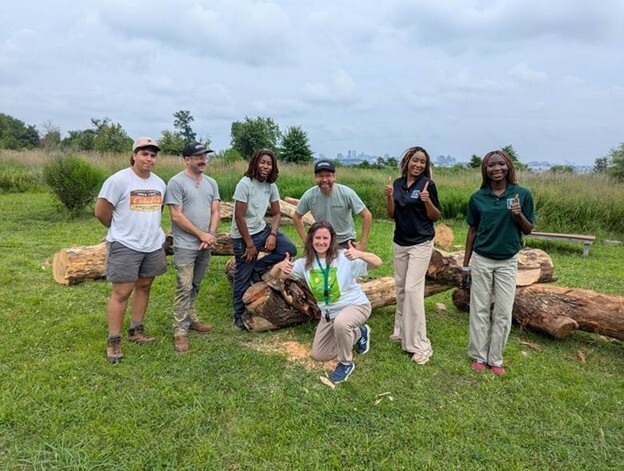 Photo (above): The 2025 MCL WildSTEM interns join Camp Small staff to celebrate the completion of the new nature playground.
Photo by Rachael Gilde/MPA
The project was made possible through strong partnerships. Baltimore City Recreation and Parks’ Camp Small provided expertise and recycled urban wood, drawing on its experience with nature-play exhibits across the city. Financial support from Brown Advisory, Mike Hankin, and Truman Semans helped turn the interns’ vision into a finished, engaging community destination.
“For me, this project ties directly to Masonville Cove’s mission,” continued Gilde. “It was built through the contributions of our interns and uses natural, recycled materials. It’s both an educational tool and a community resource, helping families connect with nature and learn through play.”
The playground is open during Masonville Cove’s regular hours, Monday through Saturday, 9 a.m. to 4 p.m.
|
|
Committee Members Enjoy Behind-the-Scenes Port Tour
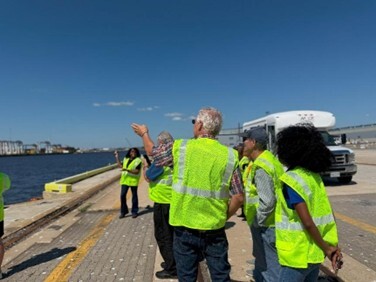
On August 22, 10 members of the Dredged Material Management Program Citizens Advisory Committee, Hart-Miller Island Citizens Oversight Committee (HMI COC), and Masonville Citizens Advisory Committee joined MPA’s Office of Navigation, Innovation, and Stewardship (NIS) staff for a special tour of the Dundalk and Seagirt Marine Terminals.
The field trip offered a rare opportunity to see the inner workings of two of the Port’s busiest terminals. Attendees took a guided van tour of the Dundalk Marine Terminal and heard presentations from port partners Ports America Chesapeake and MSC. These sessions highlighted the vital role the Port plays in keeping commerce moving efficiently through Baltimore, while also showcasing innovations in operations and environmental stewardship.
“Thank you so much for organizing such a great and informative tour!” said Cecilia Gonzalez, executive director of Action Baybrook. “I learned a lot and gained perspective about the importance of the Port of Baltimore. I look forward to continued engagement as part of the South Baltimore community.”
 |
|
“I really appreciated the opportunity to learn more about the operations of the Port and all that goes into keeping our commerce machine running. I was fascinated by the process and can’t thank you enough for giving us a behind-the-scenes glimpse of your world,” said Laura Bankey, vice president of conservation programs at the National Aquarium. |
Photo (above): Tour participants expressed a deeper appreciation of the Port’s vital role in both the local community and the regional economy.
Photo by Angie Ashley/Angie Ashley Consulting
|
|
Learning the Ropes: Orientation Held for New DMMP Committee Members
In late summer, MPA hosted a Dredged Material Management Program (DMMP) Committee Orientation, welcoming new members to the Cox Creek Citizens Oversight Committee (CC COC) and Hart Miller Island Citizens Oversight Committee (HMI COC). Six members joined CC COC, and three joined HMI COC, bringing fresh perspectives to these vital groups.
The orientation provided an overview of the DMMP’s mission and purpose: to keep the Port of Baltimore’s channels open and safe while managing dredged material in environmentally sound ways.
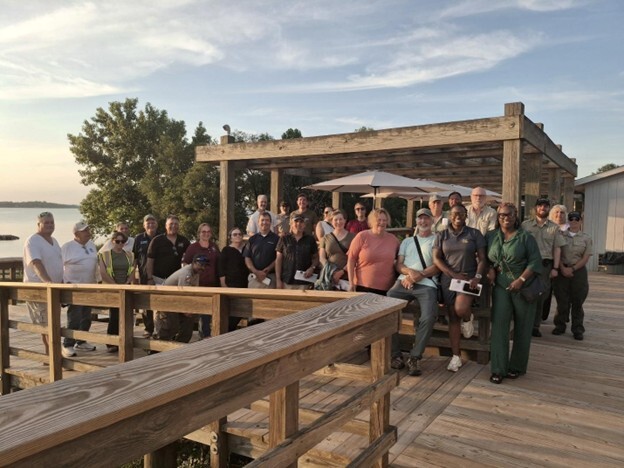 Photo (above): The HMI COC meeting at HMI, which included three new members.
Photo by Katrina Jones/MPA
As MPA's Program Manager for Education and Stakeholder Engagement, Katrina Jones explained, “Our core mission is to make sure the shipping channels are accessible. The DMMP process is the engagement tool we use to bring together regulatory agencies, environmental interest groups, and community stakeholders so we can collaborate on project implementation and minimize impacts.”
The new committee members also learned about the structure of the committees, the importance of their role in the program, and opportunities to support outreach. The orientation highlighted this summer’s successful Turner Station dredging workshop, where residents connected directly with subject matter experts to get their questions answered, a model now set to expand into other communities. A similar workshop was also held for the North Point Peninsula Community.
“I want to also thank you for the fantastic information orientation last week. I was particularly impressed with the depth and professionalism of the orientation, and it filled in a few important knowledge gaps for me. I greatly appreciate the time you took to talk with us and tour the Cox Creek DMCF and Swan Creek conservation area,” said attendee John Garofolo. |
|
 |
“To me, the greater good is building relationships with communities—that’s how you build trust. We invite people into a technical world, but we work to make it digestible and transparent,” continued Jones.
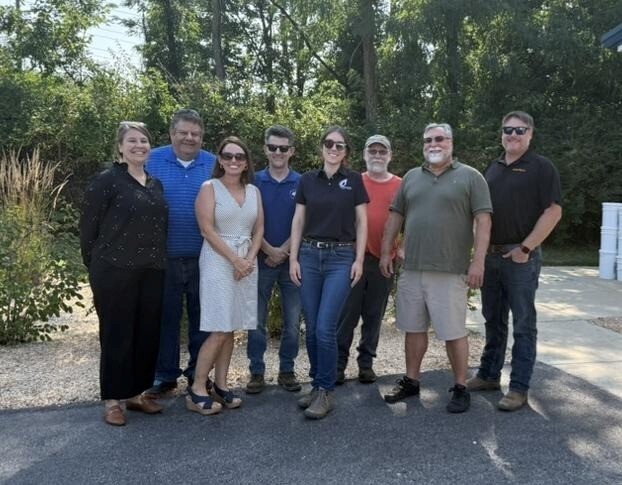
Photo (above): Four of the new CC COC members, the committee chair, MPA staff, and the facilitator.
Photo by Katrina Jones/MPA
|
|
Celebrating the Next Generation of Environmental Leaders
On August 8, the Masonville Cove Partnership celebrated the next generation of environmental leaders at the Masonville Cove Links (MCL) WildSTEM Internship closing showcase held at Brown Advisory. The event marked the grand finale of a six-week program for students from local colleges and universities, providing them with opportunities to explore careers in conservation and environmental leadership while learning from experienced mentors.
The interns presented their innovative projects and then participated in a panel discussion about their bolstered professional confidence and sense of belonging in the environmental field that was facilitated by The Nature Conservancy Maryland State Director Kahlil Kettering and MPA Outreach Coordinator Danielle Fisher.
 Photo (above): Before an audience of environmental leaders, friends, and family, the MCL WildSTEM interns showcased their projects and spoke about the skills and insights they gained during the program.
Photo by Epps Graphics Photography
A roundtable on the national benefits of outdoor recreation and its role in public health, tourism, and job creation was moderated by DNR Director of Outdoor Recreation Sandi Olek. Panelists included MPA Deputy Executive Director Bob Munroe, National Audubon Society Vice President of Habitat Conservation and Water Conservation and Interim Vice President of Coastal Conservation Julie Hill-Gabriel, Chesapeake Bay Foundation President and CEO Hilary Falk, and Pollination Managing Director J. Carter Ingram.
“As a founding partner, MPA continues to champion the Masonville Cove Links WildSTEM program, ensuring career exposure, mentoring, and opportunities that center diverse voices in conservation while building a pipeline of passionate, skilled leaders ready to steward our natural world,” said MPA Environmental Analyst Rachael Gilde.
“A special thanks goes to the Columbia (MD) Chapter of the Links, Incorporated, for partnering on soft skills program development that truly makes this 'not your average internship,’” continued Gilde.
A highlight of the event was the presentation of a Governor’s Citation to MPA Director of the Office of NIS, Holly Miller, honoring her steadfast support of the Masonville Cove Partnership and internship program.
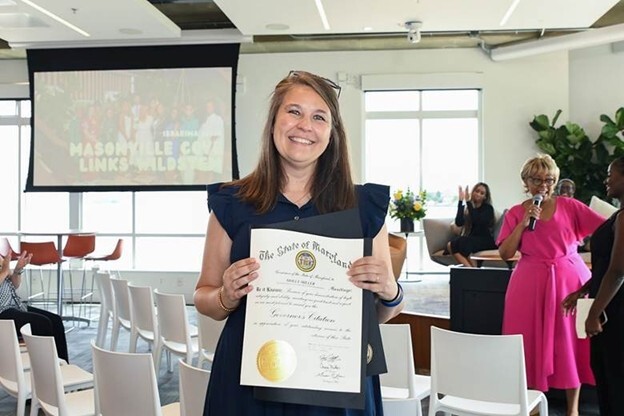 Photo (above): MPA Director of the Office of Navigation, Innovation, and Stewardship Holly Miller received a very special honor, a Governor’s Citation, from Maryland Governor Wes Moore for her support of the Masonville Cove Partnership.
Photo by Epps Graphics Photography
|
|
Geotubes at Work at the Cox Creek Open House
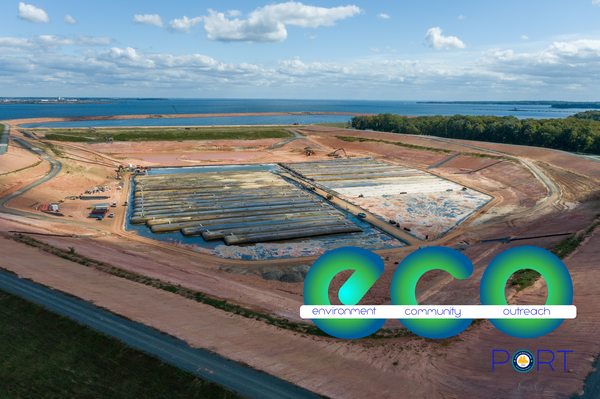
The Cox Creek DMCF on the southside of the Patapsco River in northern Anne Arundel County is a key part of Maryland’s efforts to maintain safe waterways while supporting environmental restoration. MPA took ownership of the site from the U.S. Army Corps of Engineers in 1997 and started placing dredged material there in 2005. Operations continue to this day, and the facility recently marked a significant milestone by raising the upland, perimeter, and cross dikes to +60 feet, expanding total capacity to 14.7 million cubic yards.
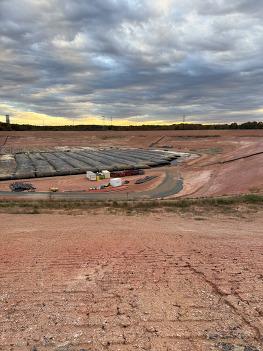
A current highlight at the facility is MPA’s use of geotextile tubes (geotubes)—massive woven fabric tubes, over 300 feet long and up to 14 feet high. Dredged material, mixed with water to aid its flow, is hydraulically pumped into the tubes, where a polymer powder accelerates the settling of solids from suspension. This results in dewatered dredged sediments ready to be reused for what MPA calls Innovative Reuse (IR) and Beneficial Use (BU) – which includes activities such as shoreline stabilization, habitat restoration, or creating a commercial product (like brick pavers).
 |
|
“Using geotubes to preserve capacity isn’t just about construction; it also supports ecosystem restoration. By efficiently dewatering material, MPA can make it available ‘on demand’ for projects like shoreline stabilization or habitat creation. These efforts contribute to tidal wetland restoration, which builds coastal resiliency and provides habitat for wildlife,” said MPA Chief of Innovative Reuse Strategy & Partnerships Kelvin Moulden.
Photo (left): Geotube field at Cox Creek DMCF
Photo by Angie Ashley/Council Fire
|
Visitors to the Cox Creek Open House on October 18 enjoyed guided tours, a view the geotube dewatering field, learned about birding at the site, and explored restored habitats with thriving wildlife. Family-friendly activities included kids’ fishing with the Pasadena Sportfishing Group, touch-a-truck fun, informational tables, and food.
The open house also offered a unique opportunity to see how dredged material, once considered a waste product, is transformed into environmental and community benefits.
|
|
MPA Releases Second Sustainability Report
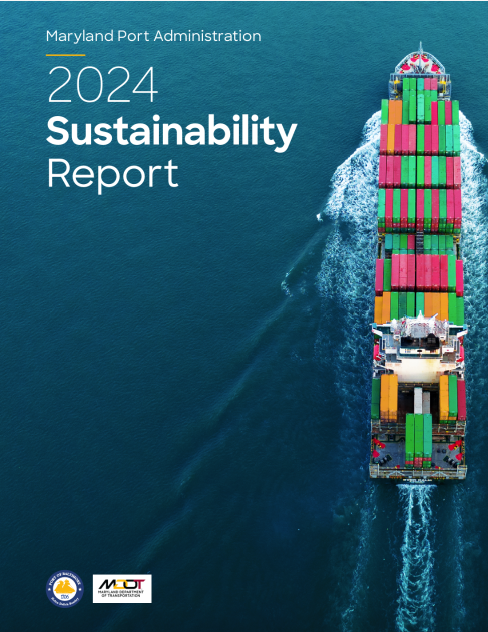
MPA recently released its second sustainability report, underscoring its ongoing commitment to environmental stewardship, economic growth, and community well-being.
“Balancing and integrating our core mission of increasing waterborne commerce through Maryland to generate economic benefits, along with providing forward-thinking environmental solutions, drives us at the Maryland Port Administration. Our determined focus on smart sustainability aligns with Governor Moore’s vision to make sure Maryland is on the right path toward a sustainable future,” stated MPA Executive Director Jonathan Daniels in his report message.
Daniels also highlighted the Port’s participation in the U.S. Environmental Protection Agency’s Clean Ports Program. Through partnerships with CALSTART, Capital Logistics, C. Steinweg Group, Ports America Chesapeake, SSA Marine, and Wallenius Wilhelmsen, the Port is purchasing 213 zero-emission vehicles, equipment, and charging infrastructure to replace aging diesel engines. These upgrades, including electrical grid improvements, are expected to reduce greenhouse gas emissions by an estimated 35% compared to 2020 levels. The Port is also prioritizing community engagement, particularly in neighborhoods historically impacted by transportation-related pollution.
With more than 20,000 direct jobs and over 273,000 Maryland jobs connected to its operations, the Port of Baltimore continues to demonstrate that environmental responsibility and economic growth can advance hand-in-hand, while supporting Maryland’s goal of achieving net zero emissions by 2045.
Read the report in its entirety here.
|
|
Port of Baltimore TERP Program Earns National Recognition
What began as a potential construction delay at Poplar Island has grown into an award-winning environmental education program that connects science, stewardship, and students across Maryland. The Port of Baltimore’s Terrapin Education and Research Partnership (TERP) was recently honored with the Lighthouse Award for Large Ports in Outreach and Education by the American Association of Port Authorities. Established in 2005 as a collaboration between the MPA’s Environmental Education team and Anne Arundel County’s Arlington Echo Outdoor Education Center, TERP now includes partnerships with William H. Schmidt Center in Prince George’s County, CHESPAX in Calvert County, National Aquarium in Baltimore, and our newest partner, Harford Glen Environmental Education Center in Harford County. This program provides Maryland classrooms with baby diamondback terrapins hatched on the Paul S. Sarbanes Ecosystem Restoration Project at Poplar Island in Talbot County. Students care for the young turtles throughout the school year before releasing them back into the restored island habitat. To date, the program has “head-started” more than 3,400 terrapins and engaged over 69,000 students, cultivating a new generation of environmental stewards while celebrating Maryland’s state reptile and the restoration of the Chesapeake Bay.
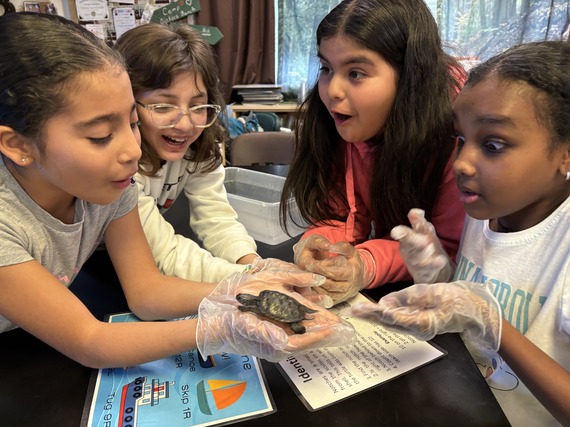 Photo (above): Students at Rockland Woods Elementary School excited to meet Skip, Port of Baltimore ambassador Terrapin.
Photo by MES
“I love sharing this powerful experience with students and seeing their excitement grow as they actively engage in the conservation of this beautiful reptile and island.”
– Katie Cole, Dorchester County Public Schools, Vienna Elementary School
"It’s been incredible to see this program grow from just 12 terrapins and a single partner 20 years ago into what it has become today. It stands as a powerful example of how the environment, economics, and education are deeply interconnected."
- Katrina Jones, Program Manager for Education & Stakeholder Engagement, MPA
To learn more about POB TERP program visit the Port of Baltimore Education website and follow our 2025-2026 Terrapin Ambassadors on Facebook and Instagram!
|
|
|
These committee meetings are open to the public, some meetings may be virtual, in-person or hybrid. Please visit maryland-dmmp.com for details and to access information for each meeting. For questions, please contact ecoport@marylandports.com.
|
|
December
2025 DMMP Annual Meeting - December 5th at 9:30 AM
In-Person Event – For more information, visit https://maryland-dmmp.com/annualmeeting/.
MedStar Harbor Hospital
3001 S Hanover St., Baltimore, Maryland, 21225
|
|
The ECOPort Newsletter is the Maryland Port Administration’s bi-monthly update of projects and programs that help the agency contribute to a thriving economy, environmental stewardship, and community partnerships. As always, we thank the many private sector businesses, government leaders, communities, and individual citizens who have helped make these achievements a reality. |
|
|
Jonathan Daniels, Executive Director
Maryland Port Administration
The World Trade Center
401 East Pratt Street, Baltimore MD 21202
1-800-638-7519 / www.marylandports.com
|
|
|
|
|