 FEBRUARY 2026
IN THIS ISSUE:
A note from the County's Climate Change Officer, Sarah Kogel-Smucker
February is off to a cold start, but conversations around the County's management of data center development are a hot topic. TONIGHT, the County Executive is hosting a Community Forum on Data Centers. You can participate in person or virtually.
Warmly,


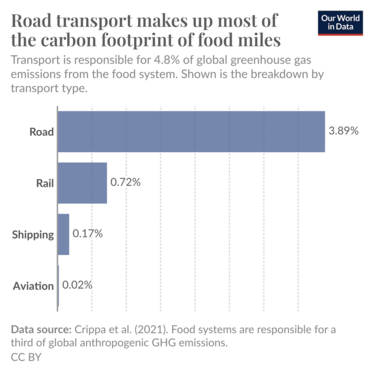
This graphic shows the percentage of greenhouse gas emissions from the food system broken down by transportation type, with road transport making up the majority of emissions from food miles.
Image Source: Our World in Data
Full calendar details of upcoming events can be found on the My Green Montgomery Community Calendar.
2/5: 6:00pm - 7:45pm Nourishing Bethesda Choice Market
Please visit the Food Assistance Resource Map for many more local food distribution locations.
2/7: 1:00pm - 3:00pm Winter Native Plant Sowing
2/10: 5:00pm - 6:30pm Recycling Volunteer Orientation
2/12: 10:30am - 2:30pm Illumination Station at Wheaton Library
2/16: 10:00am - 12:00pm Cleanup at Long Branch Park
2/17: 7:00pm - 8:00pm Home Electrification Coaching
2/18: 2:00pm - 5:00pm Manna Food Center Distribution
2/19: 1:00pm - 4:30pm Green Infrastructure Best Practices and Contractor Roundtable
2/21: 8:00am - 12:00pm Pedestrian and Driver Safety Outreach at Gaithersburg MVA
2/25: 6:00pm - 8:00pm Eco City Farms Advancing Growers Series
2/26: 10:30am - 2:30pm Illumination Station at Gaithersburg Library
Local climate news and updates from Montgomery County, the State of Maryland, and around the DMV.
Maryland is further behind its legally required climate pollution reduction goal than previously estimated, according to new modeling from the University of Maryland’s Center for Global Sustainability. Under current state and federal policies, the state is projected to cut greenhouse gas emissions about 42% below 2006 levels by 2031, short of the 60% reduction mandated by law. Researchers cite slower electric vehicle adoption, delayed renewable energy projects, rising energy demand from data centers, and federal rollbacks affecting vehicle standards as key factors. State officials say there is still time to close the gap with stronger policies and investments. Read more in Maryland Matters.
|
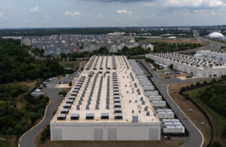
Maryland lawmakers are considering new regulations for data centers as their rapid expansion increases electricity demand and puts pressure on the regional power grid. Proposals under discussion could require state-level approval for large data center projects and establish rules to limit energy use during peak demand periods. Currently, most oversight of data centers occurs at the local level, leading to concerns about inconsistent standards and cumulative impacts on energy costs and emissions. Supporters say a statewide framework is needed to protect ratepayers, ensure grid reliability, and align economic development with climate goals. The issue is expected to be a major focus of the 2026 legislative session. Read more in Maryland Matters.
|
National and international climate change news that affects life in the U.S. and beyond.
 |
|
The U.S. District Court for the District of Massachusetts issued a judgment today declaring that the Trump administration violated federal law when it secretly formed the “Climate Working Group” (CWG) and tasked it with writing a dangerously slanted report that the administration then used as the basis of its proposal to overturn the Endangerment Finding. Read more from the Environmental Defense Fund |
Learn about Climate Champions in our community. This month, meet one of our 2025-2026 Climate Justice Fellows helping amplify community voices and advance climate equity in Montgomery County.

Hello, I am Tonia Chestnut, a retired U.S. Army Wounded Warrior continuing my service through community leadership and climate justice work in Montgomery County. I serve as President of Progressive Maryland’s Enclave Tenant Association, a Resource Committee member with Housing Justice Montgomery, and a mentor with the Wounded Warrior Mentor Program at Walter Reed National Medical Center.
As a Climate Justice Fellow with the County’s Climate Justice Co-Creation Initiative (CJCI), I learned how climate impacts are felt unevenly across communities. Renters, low-income residents, seniors, and those facing housing instability often bear the greatest burden. CJCI emphasizes listening to residents with lived experience and co-creating strategies that reflect real needs. This mirrors my tenant advocacy work: lasting solutions happen when those most affected are centered in decision-making.
Climate justice goes beyond reducing emissions. It means creating communities where people have safe homes, economic opportunities, and reliable access to healthy food, a cornerstone of resilience and well-being.
Eating and buying local strengthens community resilience, reduces environmental impact, and supports healthier outcomes for people and the planet. Locally sourced food travels shorter distances, preserving nutritional value while lowering greenhouse gas emissions. It also keeps food dollars circulating within the community, supporting farmers and workers committed to sustainable practices.
I work as a Market Manager with Seasonal Roots, an online farmers market that connects Maryland and Virginia communities with local farmers and artisans. By prioritizing local sourcing, Seasonal Roots reduces transportation emissions, supports small farms, and strengthens local economies while improving access to fresh, nutritious food.
Through this work, I have seen how consistent access to fresh, locally sourced food supports health and stability. Despite ongoing illnesses and service-related injuries, eating seasonal, nutrient-dense foods has helped me maintain my health and manage my weight. Local food systems are not just a climate solution but a public health one as well.
Supporting local farmers and mission-driven organizations strengthens neighborhoods while contributing to broader environmental goals. Small, intentional actions, when multiplied across communities, create meaningful global change. Choose local food whenever you can. Every purchase supports sustainable practices and builds resilience in your community, creating a healthier, more equitable future.
|
We are excited to share the below news and opportunities below. These important grants are offered by both local and federal funding opportunities, and are made available to local governments, universities, community organizations, businesses and individuals.
Reforest Montgomery Free Shade Tree Program: Applications for fall plantings are accepted from February 1, 2026 through February 8, 2026. Reforest Montgomery’s free tree program aims to increase tree canopy in urban and urbanizing areas of Montgomery County. Properties in Montgomery County’s priority funding areas are eligible to apply for free trees from Reforest Montgomery. Priority funding areas are home to 98% of the County’s residents, but just 36% of the County’s tree canopy. Please submit an application only if you are ready to have trees planted on your property during the planting season you are applying for.
Commercial and Canopy Solar Program: Applications due February 9, 2026. The Maryland Energy Administration grants provide direct benefits to low-to-moderate income and overburdened communities. The program offers grant funding to support implementation of solar energy installations on commercial properties, including rooftop-mounted solar systems, ground-mounted solar systems, and solar canopies over parking or bodies of water. Solar PV systems purchased by applicants and third-party owned solar energy systems are eligible for grant funding. The maximum grant is $500,000 per property owner.
Maryland Urban and Community Forest Council (MUCFC) Grant Program: Applications are due on February 15 and July 15 each year. Funding supports community-based tree planting and forestry education projects that strengthen Maryland’s urban forests. Grants are open to organizations statewide for work on public lands that improves the urban tree canopy, engages citizens, and promotes long-term environmental stewardship. Maximum award is $1,000.
Jane E. Lawton Conservation Loan Program: First-come, first-served, applications accepted through February 27, 2026. The Maryland Energy Administration (MEA) offers low-interest loans for Maryland nonprofits, schools, governments, and businesses to finance cost-effective energy efficiency and conservation projects to benefit their facilities and operations. Interest rates vary from 2% to 3%. The maximum microloan is $50,000 and the maximum traditional loan is $500,000. An application fee is required.
Frankenthaler Climate Initiative (FCI) (Implementation Grants): Applications due February 27, 2026. The Helen Frankenthaler Foundation invites nonprofit visual arts institutions to apply for assistance with undertaking sustainability and energy efficiency. Implementation Grants support ambitious, innovative, and transformative projects that directly address institutional climate impact. Applicants should have achieved organization-wide buy-in. The maximum grant is $100,000.
OPEN Energy Innovation Grant Program: Applications due February 27, 2026. Maryland Energy Administration invites businesses, nonprofits, local governments, educational institutions, and others to submit innovative and creative energy project proposals. Projects must be located in Maryland, and all subcontractors must be licensed to do business in the state. The maximum grant is typically $200,000.
Frankenthaler Climate Initiative (FCI): Applications due March 27, 2026. There are 3 unique grants: Scoping, Technical Assistance, and Catalyst Grants. The Helen Frankenthaler Foundation invites nonprofit visual arts institutions to apply for assistance with undertaking sustainability and energy efficiency initiatives that directly address carbon reduction and energy efficiency toward zero-carbon operations and a future in which the visual arts thrive while contributing to a more sustainable and ecologically conscious world. Scoping Grants support studies of energy efficiency and clean energy opportunities in facilities (Maximum grant is $25,000). Technical Assistance Grants support advanced assessments or technical specifications for energy efficiency projects (Maximum grant is $50,000). Catalyst Grants support simple standalone shovel-ready energy efficiency projects (Maximum grant is $20,000).
Kate Svitek Memorial Foundation: Applications due March 30, 2026. The primary focus is to promote and help support a range of activities and educational opportunities principally related to outdoor and wilderness exploration, study, observation, preservation, improvement, expansion, and enhancement related to land, water, or atmosphere. Maximum award is $15,000.
Exciting opportunities available for job seekers. Check out DEP’s Green Job Portal for additional climate and sustainability jobs, including these highlighted positions:
Regulatory and Compliance Engineer Supervisor (Division Chief), Maryland Department of the Environment (Baltimore, MD): The incumbent will serve as the Regulatory and Compliance Engineer Supervisor (Division Chief). The incumbent will be responsible for providing administrative and technical supervision of the Process Compliance Division within the Air and Radiation Management Administration’s Compliance Program. The Regulatory and Compliance Engineer Supervisor will oversee staff responsible for evaluating and enforcing air quality regulations, reviewing facility operations, and ensuring compliance with state and federal environmental standards. The incumbent will coordinate division activities, set priorities, and ensure consistent implementation of program goals and policies.
Program Coordinator- Restoration, Chesapeake Bay Trust (Annapolis, MD): The Chesapeake Bay Trust, a non-profit grantmaking organization, seeks a Program Coordinator for their Annapolis, MD, location. Serving on the Restoration Team, the Program Coordinator performs a wide variety of tasks to implement award programs. This role reports to the Program Manager, who oversees several restoration programs in Maryland (state, county, city) and throughout the Chesapeake Bay watershed. This is a hybrid position with an anticipated one to two days per week in the office, and the others may be remote.
Climate, Energy, and Air Quality Advisory Committee (CEAQAC), Montgomery County Boards, Committees, and Commissions (Volunteer): County Executive Marc Elrich is seeking applicants to fill eight vacancies on the Climate, Energy, and Air Quality Advisory Committee. All members must be technically knowledgeable and interested in climate change, energy, and air quality, and individuals with professional experience, education, and knowledge in these fields are particularly encouraged to apply. All members must be Montgomery County residents. Three incumbents are eligible to apply for reappointment.
Air and Climate Public Advisory Committee (ACPAC), Metropolitan Washington Council of Governments (Volunteer): The Metropolitan Washington Council of Governments is seeking applicants to fill vacancies on the Air and Climate Public Advisory Committee (ACPAC). ACPAC members provide input on regional air quality and climate change issues, advising local elected officials on environmental planning and policy. Individuals with experience or interest in climate, energy, air quality, public health, education, or related fields are encouraged to apply. Members must reside in the metropolitan Washington region.
|