Leading Locally: Standing Up for Our Community in Uncertain Times
I understand that many in our community are feeling anxious and fearful with all the chaos and uncertainty at the federal level. The past couple weeks have felt agonizingly longer as we’ve been in close communication with nonprofit service providers whose funding is in limbo, federal workers facing threats to their jobs and livelihoods, vulnerable residents fearful for their safety and access to healthcare and essential services, and concerned families who depend on programs in danger of draconian cuts.
With deep uncertainty on Capitol Hill, we remain resolute in Montgomery County in supporting our residents, our federal workers, and our nonprofit partners as we ensure our community remains a place of inclusion, acceptance, and opportunity.
Our Montgomery County Resources Page is updated regularly with key information on employment assistance, mental health support, legal services, and community programs. If you need help, we are here for you.
Especially during times of national uncertainty, strong local government is needed more than ever to provide stability, support, and solutions. The road ahead will not be easy, but we are in this together. In Montgomery County, we will stand firmly against any effort to undermine our values, threaten our neighbors, or undermine the well-being of our residents.
Despite these challenges, we will continue the work we were elected to do which is why I am pleased to introduce measures this week at the Council including a comprehensive workforce housing package to attract and retain talent and a targeted property tax credit to help older adults age in place. Together these measures will grow our local economy, maintain our quality of life, and support our efforts to reaffirm Montgomery County as an age-friendly community.
With deepest gratitude,
 Andrew Friedson
Councilmember, District 1
Montgomery County Council
Addressing Our Housing Crisis
On Tuesday, Councilmember Fani-Gonzalez and I introduced a package of housing measures called More Housing N.O.W. (New Options for Workers). Some are asking, is this package the same as the Planning Board’s Attainable Housing Strategies Recommendations (AHS)? Or something different? Please allow me to explain.
After unprecedented levels of public outreach on the Planning Board’s Attainable Housing Strategies recommendations and several months of receiving feedback from community members and housing policy experts, I took a step back to consider how we could build consensus to advance our housing goals in the most meaningful way. While the past several months were dominated by debate and discussion of the attainable housing strategies, combatting the current housing crisis is not – and was never – exclusively about these recommendations. Truly tackling our housing challenges requires a comprehensive approach to address the housing needs of our workforce, increase our housing supply, and facilitate pathways to home ownership.
The lack of housing supply and affordability is not only threatening our ability to fulfill our values as a welcoming, inclusive community, it’s having serious economic consequences and contributing to the stagnation of our economy. As identified in both the Maryland Comptroller’s State of the Economy Report and the Montgomery County Office of Legislative Oversight’s 2024 report on outmigration, people are leaving the state due to skyrocketing housing costs which hampers our ability to attract the necessary workforce to support our county’s businesses, nonprofits, and public sector agencies.
Growing our local economy and improving housing affordability and accessibility have been my top priorities on the County Council. We have made great strides in the affordable housing realm increasing housing supply for lower income households, but we have not adequately focused on workforce housing – for teachers who need to be in class before 7 am, and for police, firefighters, and nurses, who work late shifts but can often only afford housing long distances from their jobs, sometimes in other counties, and even other states.
At the end of the day, we need more housing options for more people, especially along major corridors with access to jobs and amenities.
Working with the chair of the Council’s Economic Development Committee, Councilmember Fani-Gonzalez, we introduced the More Housing N.O.W. (New Options for Workers) package with five bold steps to increase housing supply, reduce costs, and increase pathways to home ownership.
This housing package includes companion proposals to build more workforce housing, convert vacant office buildings to housing, and double the county’s investment in assistance for first-time home buyers. The legislative measures to support this package were introduced on Tuesday, February 4 and are available on the Council’s website (see items 5C, 5D, and 6A).
Focusing on strategies that provide the greatest opportunities to increase our housing supply while increasing access for our workforce, our approach increases housing options on county corridors and does not propose any zoning changes within residential neighborhoods.
I believe this is a thoughtful, significant step forward that reflects consensus and will make meaningful progress on housing availability and affordability.
The five elements of the More Housing N.O.W. packages are as follows:
Building More Workforce Housing
-
Workforce Housing ZTA: Allow more residential building types along corridors with a workforce housing requirement
- Allow through Optional Method Development (not by right) duplexes, triplexes, townhomes, and apartments in the R-200, R-90, R-60, and R-40 zones
- 1.25 FAR (floor area ratio/density)
- Maximum 40 feet height
- Corridors include five roadway classifications with qualifying attributes: Boulevards, Downtown Boulevards, Downtown Streets, Controlled Major Highways, and Town Center Boulevards that have a master-planned width greater than 100 feet and 3 or more existing travel lanes
- Require 15% of units satisfy the definition of workforce housing (70-120% of Area Median Income) with a minimum of 1 workforce housing unit for construction of 3 or more units
-
Workforce Housing Opportunity Fund: New countywide fund to incentivize & facilitate the construction of workforce units
- $4 million initial funding
- Eligible projects must provide at least 30% workforce units
- Workforce units must average 80% Area Median Income affordability
Converting Highly Vacant Office to Housing
-
Office to Housing Zoning Text Amendment (ZTA): Create an expedited approval process for projects that convert high-vacancy commercial properties to residential use
- Applies to the Commercial-Residential, NR, and EOF zones
- Retail or office building that is at least 50% vacant
- Remove residential restriction on FAR (floor area ratio/density), so that total commercial-residential FAR can be used for residential
- Must pull a building permit within 2 years of approval
-
Office to Housing PILOT Bill: Establish a payment in lieu of taxes (PILOT) for conversion of high-vacancy commercial properties to residential use
- Retail or office building that is at least 50% vacant
- 100% tax abatement for 25 years for qualifying projects
- Minimum 15% Moderately Priced Dwelling Unit (MPDU) requirement
Pathways to Homeownership
We will have opportunities for continued engagement and input on these measures, including a public hearing on March 11 (registration will be posted here), committee work sessions, and full council work sessions as we continue our work in a thorough and methodical manner. We welcome your feedback on this important topic. We are planning on offering at least two public informational sessions which will include an overview of the housing package and an opportunity for Q&A on the specifics of the legislation. More details will be available soon.
If you are interested, you can view the press conference we held where we announced this package. We were joined by a broad coalition of supporters representing teachers, firefighters, affordable housing advocacy organizations like Action in Montgomery (a nonpartisan, faith-based grassroots organization), and nonprofit affordable housing providers including Habitat for Humanity, Montgomery Housing Partnership, among others.
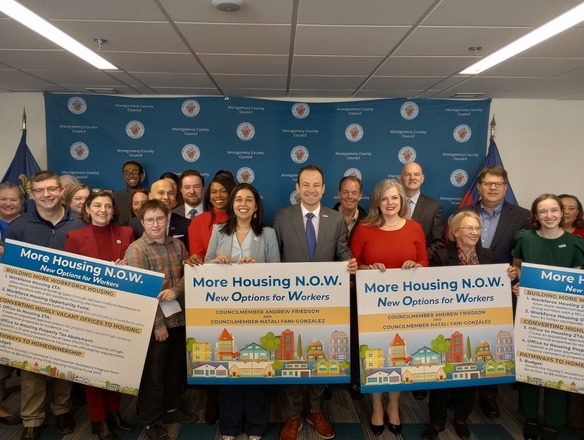 Councilmember Friedson stands with Councilmember Natali Fani-Gonzalez, cosponsors Council President Stewart and Councilmembers Luedtke, Balcombe, and Sayles, community leaders, housing advocates, teachers, and first responders at last week's press conference unveiling the More Housing N.O.W. initiative.
Supporting Seniors with an Expanded Homeowner’s Tax Credit
As property assessments continue to rise across Montgomery County, more homeowners, especially those on fixed or limited incomes, are becoming cost-burdened and in need of relief. In most cases their greatest asset, their home, is the most significant driver of their rising costs. That’s why I have consistently pushed back against property tax increases amid rising assessments and why I’ve been working on targeted tax relief to help older adults in our community age in place.
Since legislation I proposed to expand access to the property tax credit for Individuals 65 and Older and Retired Military Services Members was tabled by the Council in March 2024, I have continued my efforts to seek relief for homeowners and plan to introduce a bill to update the local supplement to the Homeowner’s Tax Credit (HOTC) alongside my Government Operations and Fiscal Policy (GO) Committee colleagues, Council President Kate Stewart and Councilmember Sidney Katz.
The HOTC is a progressive tax credit administered by the State of Maryland Department of Assessments and Taxation (SDAT) where lower income households receive a larger credit on their property taxes, so relief is targeted to residents on limited incomes who need it the most. The bill we are introducing next week will expand the credit by raising eligibility requirements for the credit, including the maximum incomes and net worths of households, as well as the assessed value of the property to which the credit applies.
You can tune in for the introduction of the bill in the morning on Tuesday, February 11. If you want to share your feedback with the Council, please consider using this webform on the Council’s website.
Apply to Join the MCPS Advisory Committee on Communications & Community Engagement
Montgomery County Public Schools is forming a new Advisory Committee on Communications & Community Engagement to strengthen collaboration between the Board of Education and the community. This committee will play a key role in ensuring that residents are informed and engaged in important school projects, including upcoming boundary studies for Crown, Woodward, and Damascus high school projects in 2025.
MCPS is seeking community leaders and communication experts who are passionate about education and outreach to serve on this committee. Members will provide valuable insights on how to enhance engagement and improve communication strategies. If you or someone you know is interested in contributing to this important work, we encourage you to apply. Learn more and apply here: https://www.montgomeryschoolsmd.org/boe/committees/communication-engagement/
Constituent Services
I encourage residents to continue to engage with my office on issues of importance to our community. We appreciate your patience and understanding as our small but mighty team works to respond to your inquiries. Please continue to engage with us by email, visiting our website, Facebook, and Twitter pages.
|