|
August 1st, 2023 | Climate Action News
(Photo courtesy NASA)
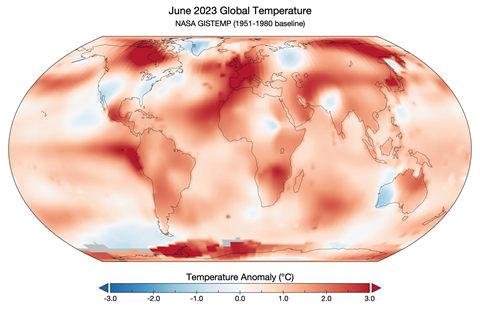
This June was measured as the hottest June ever recorded, and July is determined to follow suit. The Southwest has been baking in historic heat for weeks, with Pheonix, AZ recording 21 straight days of heat above 110oF. The town of Sanbao in China reported an all-time high of 126oF and historic landmarks in Greece and Italy have been shuttered to protect tourists from the heat. July 4th of this year was the hottest day ever recorded on Earth for the last 125,000 years. As the burning of fossil fuels rages on and human greenhouse gas emissions are at an all-time high, none of these records can be expected to last.
The summer heat wave can be attributed partially to El Niño, the periodic phenomenon that causes warm water in the equatorial pacific to travel further East and stay closer to the surface. When an El Niño event occurs, more heat is released into the atmosphere, generally causing warmer temperatures in South America and western Europe and wetter conditions in the southern U.S. and the Gulf of Mexico. An El Nino event was declared in effect in June 2023 following three consecutive years of La Nina.
While El Niño intensifies global extreme heat, human-caused climate change will continue to push temperatures to new limits in the future. Read the Climate Smart section of this month’s newsletter to see what you can do to keep cool without running your air conditioner.
(Photo courtesy Will Parson/Chesapeake Bay Program)
Scientists that aid to restore the health of the Chesapeake Bay have uncovered the reasons for the extreme changes to the Bay: Widgeongrass, a weedy plant that usually remains at low levels is becoming dominant. The plant is now overthrowing the Bay’s historically predominant eelgrass, a news article from Science News said.
Over the past four decades, warming temperatures have shifted seagrass species in the Chesapeake Bay. The total area of seagrass meadows in the Bay, expanded from 15,000 hectares in 1984 to almost 44,000 hectares in 2018.
Widgeongrass has very thin and branchy leaves, which can offer better habitat than the eelgrass for small crustaceans like amphipods and isopods, the article said. For the researchers who have been struggling to restore the Bay’s vegetation, the expansion of widgeongrass is a good thing.
However, widgeongrass has shallower roots and does not provide as much carbon storage for crabs and fish, making the habitats less stable than eelgrass, the article said. Similar shifts are occurring around the world in Tampa Bay to the English Channel.
Careful monitoring that identifies the individual species of plants, rather than the total area of vegetation, then reducing nutrient and sediment runoff reaching the most susceptible areas, can help mitigate the harm. To further protect the Chesapeake Bay, it’s important for researchers and scientists to monitor agricultural pollution from the Choptank River and in the Tangier Sound.
“If we can get the right combination of environmental conditions, we can restore mature, functioning seagrass meadows in one or two decades,” Chris Patrick, an ecologist of the Virginia Institute of Marine Sciences, said in the article. “You can’t do that with any other ecosystem.”
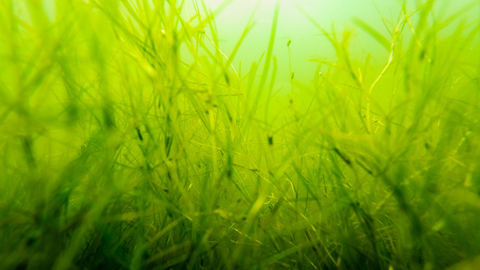
Scientists that aid to restore the health of the Chesapeake Bay have uncovered the reasons for the extreme changes to the Bay: Widgeongrass, a weedy plant that usually remains at low levels is becoming dominant. The plant is now overthrowing the Bay’s historically predominant eelgrass, a news article from Science News said.
Over the past four decades, warming temperatures have shifted seagrass species in the Chesapeake Bay. The total area of seagrass meadows in the Bay, expanded from 15,000 hectares in 1984 to almost 44,000 hectares in 2018.
Widgeongrass has very thin and branchy leaves, which can offer better habitat than the eelgrass for small crustaceans like amphipods and isopods, the article said. For the researchers who have been struggling to restore the Bay’s vegetation, the expansion of widgeongrass is a good thing.
However, widgeongrass has shallower roots and does not provide as much carbon storage for crabs and fish, making the habitats less stable than eelgrass, the article said. Similar shifts are occurring around the world in Tampa Bay to the English Channel.
Careful monitoring that identifies the individual species of plants, rather than the total area of vegetation, then reducing nutrient and sediment runoff reaching the most susceptible areas, can help mitigate the harm. To further protect the Chesapeake Bay, it’s important for researchers and scientists to monitor agricultural pollution from the Choptank River and in the Tangier Sound.
“If we can get the right combination of environmental conditions, we can restore mature, functioning seagrass meadows in one or two decades,” Chris Patrick, an ecologist of the Virginia Institute of Marine Sciences, said in the article. “You can’t do that with any other ecosystem.”
|
 |
(Photo courtesy Montgomery Community Media)
Montgomery County Executive Marc Elrich along with Councilmembers Gabe Albornoz and Sidney Katz broke ground on the 6th district County Police station at the end of June after 20 years of planning.
The station is planned to become the County’s first public Net zero, sustainably designed building in accordance with the 2018 International Green Construction Code requirements. The building will achieve carbon neutrality by operating off its own microgrid powered by solar panels that meets the new building energy performance standards mandated in the County’s Climate Action Plan. The microgrid technology will also enable the station to continue supporting its 178 member staff and serving the community when electric or power failures occur.
“All of our new buildings will be Net-zero” promised David Dise, director of the Department of General Services. “This [police station] will be the first that is actually constructed,” but “it’ll be followed by many others.”
The station is scheduled to be operational in Spring of 2025.
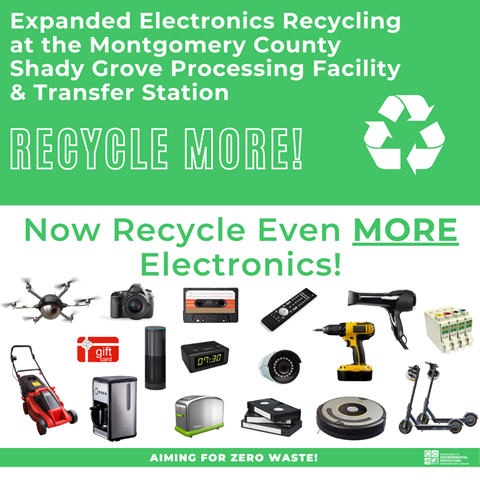
Check again before throwing it out! Montgomery County recently expanded the items that are accepted for recycling at the Shady Grove Processing Facility and Transfer Station. Acceptable items now include cameras, clocks, drones, printer ink cartridges and more. Click here to view the complete list of products accepted and instruction for recycling at the transfer station.
The expanded recycling program supports the “Zero Waste” objective of the County’s Climate Action Plan. Recycling and waste reduction are important aspects of limiting carbon emissions because they alleviate the often carbon-intensive need to extract, refine, and transport materials for consumption. The County has established partnerships with nonprofits and recycling facilities that will refurbish electronics for reuse or disassemble them for parts. Montgomery County guarantees that no personal information is stored on recycled items, although it is still recommended to clear data on computers and other electronics prior to drop-off.
Note: it is not appropriate to put these items in standard curbside recycling, they must be brought to the transfer station.
(Photo courtesy Ulyssess Moñoz/The Baltimore Banner)
Vice President Harris visited Coppin State University in Baltimore to announce $20 billion in federal funding to create a clean energy network that will expand new projects to reduce pollution, according to a press release from mid-July.
The funding is part of the EPA’s Greenhouse Gas Reduction Fund through President Biden’s Inflation Reduction Act to confront the climate crisis. The funding will be used in two ways to ensure clean energy sweeps across the nation:
The $14 billion National Clean Investment Fund (NCIF) will provide grants to support up to three institutions that will partner with the private sector to provide accessible and affordable funding for clean technology projects with at least 40% of funds for low-income communities.
“We also frankly have to make up for lost time,” Harris told The Baltimore Banner. “By dramatically accelerating our work, we know we can lower emissions.”
The $6 billion Clean Communities Investment Accelerator (CCIA) will work with NCIF to provide grants to up to seven non-profit organizations that will provide funding and technical assistance to communities working on clean energy technology projects.
“The climate crisis is real and it is here,” Baltimore Mayor Brandon Scott said. “You only have to stand outside to know it’s true.”
Where you get your food matters. Our food productions systems are known for inefficiencies and unsustainable practices. The Intergovernmental Panel on Climate Change estimates between 21-37% of global greenhouse gas emissions come from food production and transportation.
You can minimize your impact from food consumption by purchasing locally and sustainably grown foods. Fortunately, there are several local farms and orchards in Montgomery County that prioritize just that.
-
East Rivendell Farm: Devoted to using GMO & chemical free products, raising grass-fed beef and producing organic eggs.
-
Red Wiggler Community Farm: Nonprofit farm committed to organic agriculture, promoting watershed and habitat protection, and reducing carbon footprint. They employ people with and without developmental disabilities and distribute 50% of organic produce to low-income households.
-
Rock Hill Orchard: Practices Integrated Pest Management, meaning they avoid the use of pesticides in favor of natural means of controlling pests. They use drip irrigation, which is significantly more efficient than other irrigation methods, thus promoting water conservation. They also practice no-till agriculture, which enhances soil’s ability to sequester carbon.
Can you think of a sustainable and climate-friendly business that needs a shoutout? Let us know!
|
 |
Climate Smart is a Montgomery County Program encouraging residents to live more sustainably, save money, and help Montgomery County achieve net-zero emissions by 2035. Each newsletter, we will explore one of the focus areas as well as other ways to minimize your carbon footprint.
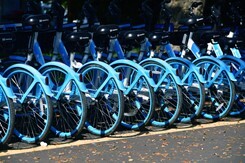
This month's spotlight is Transportation:
Before the Industrial Revolution, human travel had little impact on Earth’s climate. That changed once humans started burning fossil fuels to power trains, boats, cars, trucks, buses and planes. Transportation generates about a fourth of global carbon dioxide emissions. Reduce carbon emissions through transportation by:
- Downloading the Ride on Trip Planner. This app features multiple modes of public transportation throughout Montgomery County. Using public transportation is an environmentally friendly way to travel.
- Riding a bike: Bikeshare stations are available throughout the county
- Joining the electric vehicle purchasing co-op: the County offers incentives from local dealerships. Make a pledge to make your vehicle electric and help the County work toward the goal of zero emissions by 2035.
|
How to beat the heat!
Extreme heat events are projected to become more severe and frequent as climate change intensifies. To stay cool, it’s common to run the AC more often. For most, that air conditioning is powered by fossil fuels, meaning that your comfort comes at the expense of releasing more greenhouse gases into the atmosphere that can result in making next year’s summer more intense. That’s why it’s imperative to employ strategies to cool your home without air conditioning:
- Cover and Insulate Windows: windows are one of the biggest culprits when it comes to heat entering your house. As the sun rises, cover windows with shutters, awnings, blinds, curtains, etc.
- Smart Fan Placement: fans only move air around, so maximize their effectiveness by placing them in a spot where they can draw from the coolest air. Fans are effective tools for cooling you if the indoor air temperature does not exceed 95o
-
Manage Humidity: Use a dehumidifier to keep humidity in check. Humidity makes hot temperatures feel more unbearable by decreasing the rate at which sweat evaporates.
- Minimize daytime appliance use: avoid using the oven, washing machine, or even lightbulbs during the day because they generate excess heat. Additionally, replace incandescent lightbulbs with LEDs because they are more efficient and generate less heat.
- Open windows at night: let the cool night air in.
- Insulate: Close doors, weather-strip, and insulate your house so that no cold air escapes outside and no heat enters. Explore the Montgomery Energy Connection website to see how you can save money insulating your house.
- Lighter Colors: opt for lighter colors that on the exterior of your home that reflect more solar radiation, i.e. a cool roof.
- Vegetation: planting vegetation around a building can shelter the walls from solar radiation and suck away heat through evaporative cooling.
|
“Energy Express” for Youth
August 1st @ 11:00 a.m - 12:00 p.m. | Aspen Hill Library
“Energy Express” for Youth
August 1st @ 2:00-3:00 p.m. | Silver Spring Library
Conscious Cocktails: Environmental Sustainability
August 3rd @ 5:00-7:00 p.m. | Columbia, MD
Bonkers for Bats
August 5th @ 8:30-9:30 p.m. | Maydale Nature Center
Butlers Orchard Sunset Berry Picking
August 5th, 11th, 12th @ 5:00 p.m. | Germantown
“Ecowise” Hazardous Waste Drop Off
Every Wednesday @ 1:00-5:00 p.m. | Shady Grove Transfer Station
Montgomery County Agricultural Fair
August 11th – August 19th | Agricultural Fairgrounds, Gaithersburg
Macroinvertebrate Samplling with EPA
August 12th @10:00 a.m. - 12:00 p.m | Maydale Nature Center
Weed Warrior Workday
August 12th and 13th @ 9:00-11:00am | Rock Creek Park
How Do We Achieve "Responsible" Fashion?
August 14th @ 3pm-4:30pm | Bethesda Green
The Role of Green Infrastructure in Sustainable Urbanization
August 16th @ 3pm-4:30pm | Bethesda Green
Local Food Procurement Policy Working Group
August 17th @ 10:00-11:30 a.m. | Zoom Meeting
Using Artificial Intelligence and Machine Learning for the Climate
August 24th @ 3pm-4:30pm | Bethesda Green
Foodie Fridays- Speaker Series
August 25 @ 6:30-8:30 p.m. | North Bethesda
Weed Warrior Workday
August 26 @ 8:00-10:00 p.m. | Sligo Creek Park, Silver Spring
|