|
To: All DHS Staff
From: Human Resource Development and Training (HRDT)
DHS Family,
Your response to the DHS COVID-19 Employee Survey was both impressive and gratifying. We truly appreciate that over 2200 DHS employees took the time to help us get better as we manage our response to COVID-19. As always, when asked, the DHS team responded with enthusiasm and a candor that is greatly appreciated.
In order to maintain transparency on the insights that you shared, we are providing information regarding the results of the survey. When analyzing the survey, we looked at the percentage of responses rated 3 (Agree), 4 (Mostly Agree) or 5 (Strongly Agree) to determine our success in achieving the goal of each surveyed statement.
THE RESULTS:
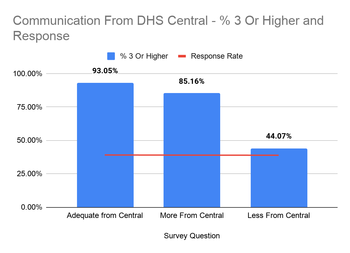
Statements: 1. The amount of communication I have received from DHS Central regarding the Department's response to COVID-19 has been adequate; 2. I would like to hear more from DHS Central regarding the Department's response to COVID-19; 3. I do not need as much communication from DHS Central regarding the Department's response to COVID-19.
Conclusion: DHS Central has been largely successful in the communication that has been sent out to date, and staff would like the flow of communication to continue. Based on this information, DHS Central intends to keep the flow of communication open and will make every effort to communicate new information as it is received.
|
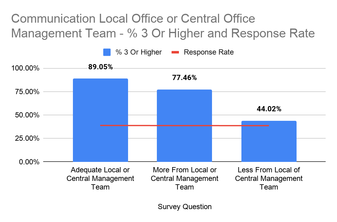
Statements: 1. The amount of communication I have received from my Local DSS or DHS Central Administration Leadership Team regarding the response to COVID-19 has been adequate; 2. I would like to hear more from my Local DSS or DHS Central Administration Leadership Team regarding the response to COVID-19; 3. I do not need as much communication from my Local DSS or DHS Central Administration Leadership Team regarding the response to COVID-19.
Conclusion: DHS Local and Central Office Leadership teams have generally been successful in the communication that has been sent out to date, and staff would like the flow of communication to continue. Local DSS Offices and Central Office Directors are committed to continuing to ensure the flow of communication to staff.
|
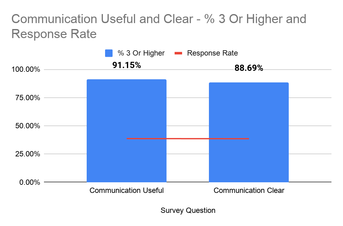
Statements: 1. The communication that I have received has provided important information that has helped me understand more about the response to COVID-19; 2. The communication that I have received has been clear and useful to me.
Conclusion: In general, staff agree that communication that has been received to date has been clear, effective and provided useful information regarding the Department’s response to COVID-19. Keeping in mind the conclusions above, the Department should continue to keep channels of communication open and continue our communication strategy to clearly communicate information that is useful and relevant to our team.
|
Despite the general agreement that the Department has been successful in communicating with staff through the COVD-19 crisis, the survey did reveal certain specific areas in need of additional attention. This graph shows areas of concern identified by more than one (1) respondent as a topic they would like to hear more about:
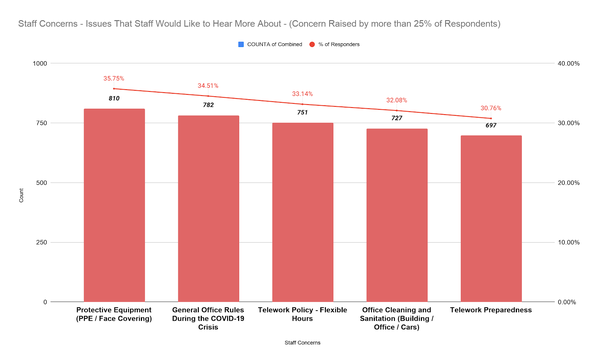 Each of these areas of concern are addressed more fully below:
PROTECTIVE EQUIPMENT (PPE / FACE COVERING):
PPE Information:
The Department is aware of the concerns that staff have expressed regarding the need for Personal Protective Equipment (PPE). Like you, as we manage the impact of COVID-19 our priority continues to be the protection of the health and safety of the DHS family. To that end, the Department has been consistent in taking all necessary steps to follow the advice of the Centers for Disease Control and Prevention (CDC).
Although the CDC has not yet made a recommendation that would indicate the need for PPE for all DHS staff, we understand the anxiety surrounding this issue. In order to relieve some of that anxiety and ensure that the Department has the resources necessary to meet the needs of our staff, the following steps have already been taken:
- The Department has been proactive in seeking masks, gloves and hand sanitizer starting in late February.
- Although shipment of those initial orders was delayed due to the international shortage of PPE items, the Department has received initial shipments and distributed PPE go-bags for staff who may be required to conduct home visits and/or who are performing duties where the use of PPE would be recommended by the CDC.
- Additional orders for PPE remain pending, based on national and international supply chain issues.
- As soon as additional PPE is received, it will be distributed.
Face Coverings:
As the COVID-19 crisis has evolved, the CDC has updated its advice regarding wearing a cloth face covering in public settings. Further Governor Hogan has issued a requirement that individuals in Maryland must wear some form of face covering over the nose and mouth when in public settings. As we move forward it is important that we all understand the difference between PPE and the type of cloth face covering being recommended by the CDC and now required for Marylanders in public places. In order to provide that clarification, we are sharing the following from the CDC website:
Recommendation Regarding the Use of Cloth Face Coverings, Especially in Areas of Significant Community-Based Transmission
CDC continues to study the spread and effects of the novel coronavirus across the United States. We now know from recent studies that a significant portion of individuals with coronavirus lack symptoms (“asymptomatic”) and that even those who eventually develop symptoms (“pre-symptomatic”) can transmit the virus to others before showing symptoms. This means that the virus can spread between people interacting in close proximity—for example, speaking, coughing, or sneezing—even if those people are not exhibiting symptoms. In light of this new evidence, CDC recommends wearing cloth face coverings in public settings where other social distancing measures are difficult to maintain (e.g., grocery stores and pharmacies) especially in areas of significant community-based transmission.
It is critical to emphasize that maintaining 6-feet social distancing remains important to slowing the spread of the virus. CDC is additionally advising the use of simple cloth face coverings to slow the spread of the virus and help people who may have the virus and do not know it from transmitting it to others. Cloth face coverings fashioned from household items or made at home from common materials at low cost can be used as an additional, voluntary public health measure.
The cloth face coverings recommended are not surgical masks or N-95 respirators. Those are critical supplies that must continue to be reserved for healthcare workers and other medical first responders, as recommended by current federal CDC guidance.
This recommendation complements and does not replace the President’s Coronavirus Guidelines for America, 30 Days to Slow the Spread, which remains the cornerstone of our national effort to slow the spread of the coronavirus. CDC will make additional recommendations as the evidence regarding appropriate public health measures continues to develop.
Source: CDC Website:https://www.cdc.gov/coronavirus/2019-ncov/prevent-getting-sick/cloth-face-cover.html
|
|
Drawing the distinction between the face covering and PPE is critical in ensuring that we are not contributing to the international shortage of PPE.
To that end, there are a number of great ideas on social media and other websites that give instructions on how to make your own cloth face cover. Below, is a video from the CDC featuring the Surgeon General making a cloth face covering for himself.
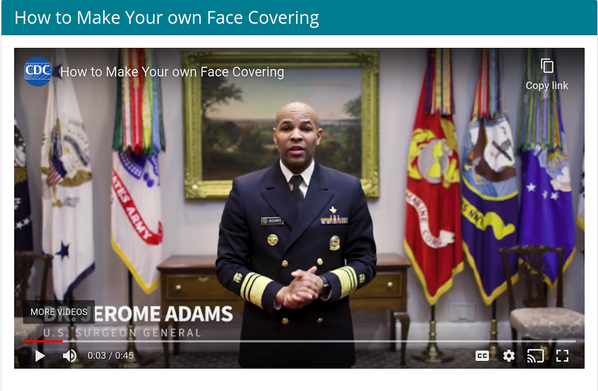 We encourage all DHS staff who must come into the office to wear a face cover and to wash your hands frequently. Based on CDC guidance, these measures, coupled with following screening protocols, are the best way to protect ourselves from the virus.
Finally, the Department has sought a supply of face covering surgical masks and gloves to be distributed to staff reporting to DHS offices. We anticipate that some of these resources will be distributed by the end of the week of April 27, 2020. As the Department builds its resources, we will make every effort to provide additional face coverings and gloves for staff who must report to the office to perform mission critical functions.
GENERAL OFFICE RULES DURING THE COVID-19 CRISIS
General Expectations:
The Department’s expectation that staff maintain the highest level of professionalism and apply the principles of Gold Standard Customer Service remain in place. All provisions of the DHS Employee Handbook remain in place. CLICK HERE to access the DHS Employee Handbook.
Move to Telework:
Since March 13, 2020, the day Governor Hogan implemented the Elevated Level II response to COVID-19, the Department has been focused on taking all reasonable steps to prepare staff to telework (See more details in Telework Preparedness - Below). In the absence of equipment necessary to telework, the Department has placed staff who are not performing mission critical duties on paid Administrative Leave.
We note that staff who are on Administrative Leave can be reactivated at any time. In order to ensure that staff on Administrative Leave are receiving critical communications, those staff must check email and voicemail daily.
General Office Protocols During COVID-19:
As we continue efforts to move staff to telework, we are aware that there are staff who must continue to report to DHS offices to perform mission critical functions. We continue to make every effort to minimize the number of staff reporting to offices. For staff who must report to the office the following general protocols apply:
- DEPARTMENTAL RESPONSIBILITIES:
- The general public is prohibited from entering any DHS facility.
- All employees entering a DHS facility must be screened using the screening tool approved by the Department of Budget & Management (DBM) in consultation with the Department of Health. To access the screening questionnaire, CLICK HERE.
- Maintain regular cleaning of all DHS facilities with emphasis on high touch surfaces (See more details in Office Cleaning and Sanitation (Building / Office / Cars) - Below).
- Help ensure that staff can engage in proper social distancing.
- STAFF RESPONSIBILITIES:
- Maintain proper social distancing - staff should make all reasonable efforts to avoid close contact with other employees and maintain a distance of six (6) feet from each other.
- Staff should immediately bring any hindrance to maintaining social distancing to the attention of their management team.
- Frequently wash hands with soap and water for at least 20 seconds, and/or use a hand sanitizer that contains at least 60% alcohol.
- Staff should immediately bring any challenges to maintaining proper hand sanitization to the attention of their management team.
- Cover your coughs and sneezes
- Wearing a cloth facial covering (see above) is the best way to protect others from your coughs and sneezes
- In the alternative, cover with a disposable tissue, or cover in the bend of your arm.
- Avoid touching your face, especially around your eyes, nose, and mouth.
- Stay home if you are sick or have been exposed to someone who is sick.
- For CDC Guidelines, CLICK HERE.
- STAFF MAKING HOME VISITS:
- DHS is committed to ensuring that staff doing home visits are both protected from the virus and protecting others from the virus. The first step in that process is ensuring that staff are following the DBM COVID-19 Guidance for Home Visiting Staff which can be found by CLICKING HERE.
- In addition, the Department is providing PPE push packs to staff conducting home visits.
- The Department received authorization to provide Response Pay to staff in job classifications that complete home visits during the time when those visits are being completed.
- Finally, and most important, the Department has provided clear guidance that in home and face to face visits should only be conducted whether the best interests of the health and safety of a child or at risk adult require such a visit, and there is no technological alternative available to interact with the client.
Time and Attendance Policy:
The Department’s Time and Attendance policy is guided by the Department of Budget and Management (DBM). The following are the Time and Attendance policies relevant to staff during COVID-19:
- Pandemic Flu and Other Infectious Disease Attendance and Leave Policy - CLICK HERE
- Advanced Sick Leave Policy - CLICK HERE
- Emergency Paid Sick Leave and Expanded Family and Medical Leave Under the Families First Coronavirus Response Act - CLICK HERE,
In addition, the Department has sent timesheet competition instructions to all staff for each pay period that has ended during the COVID-19 crisis. The most up to date instructions can be found by CLICKING HERE.
TELEWORK POLICY - FLEXIBLE HOURS
Staff who have been issued the necessary equipment and have been approved to telework should have signed the COVID-19 Response - Interim Telework Agreement - CLICK HERE to access. The Agreement allows for flexible hours while teleworking to allow staff to care for children or other adults. Although there may be some duties that require a set work schedule, supervisors are encouraged to work with staff to accommodate the flexibility envisioned in the Agreement.
OFFICE CLEANING AND SANITATION (BUILDING / OFFICE / CARS)
Cleaning and usual janitorial functions continue in all facilities as contracted. During the time of COVID-19 response, janitorial vendors have offered to provide additional cleaning to frequently touched surfaces and areas with an enhanced concentration disinfecting solution. If there is credible evidence of a COVID-19 infected employee being in a facility, the facility is immediately closed and decontaminated pursuant to the recommendations set forth by the Centers for Disease Control. To access the DHS SOP for Facility Closure for Specialized COVID-19 Cleaning - CLICK HERE.
Cleaning of State cars is handled by fleet management at the Local DSS Offices. Local Offices are encouraged to ensure that State vehicles receive regular cleaning consistent with CDC cleaning guidelines.
Staff are encouraged to report any specific concerns regarding office cleaning/sanitation to their management team immediately.
TELEWORK PREPAREDNESS
The Department has made consistent efforts to allow staff to telework. In order to accomplish this goal, the Department first identified existing resources and deployed to as many critical staff as possible. In addition, OTHS tools steps to streamline the process of authorizing and processing VPN access. Finally, the Department has ordered a total of 2,780 laptop computers. To date, 1,280 laptops have been delivered, OTHS will distribute at least 500 within the next week. As more laptops are received they will be distributed as quickly as possible.
CONCLUSION
We hope that this communication addresses most of the concerns that staff have regarding the management of the COVID-19 crisis. We will continue to keep the lines of communication open and answer as many of your concerns as we can.
The Department continues to make the health and safety of our staff its first priority. Our team is second to none and the work that has been accomplished under very difficult circumstances has been nothing short of heroic.
Our success as we move forward will be dependent upon the continuation of open communication, respect, and understanding of the challenges that we will all face as individuals and that the Department is facing in its role of serving at risk populations in the State.
|