|
A Beginner’s Guide to Vessel Terminology
Vessel terms can be a challenge to understand by people outside and inside of the maritime industry. These terms are frequently used incorrectly, which can lead to confusion or just plain embarrassment. In this edition of Ship to Shore, we’ll tell you the meaning of some of the most common maritime terms and demystify parts of the ferries you probably never thought about.
|
|
-
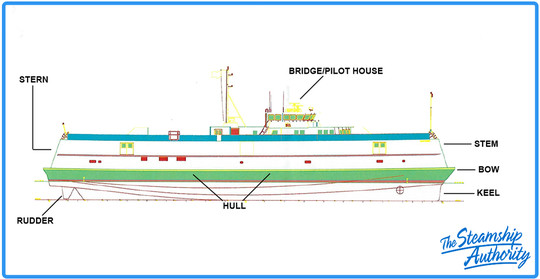
Bow Thruster: a propulsor installed near the bow that faces sideways; when they are turned on, they push the bow or stern of a boat sideways through the water in either direction
-
Bridge/Pilot House: the main control center of a vessel from where the captain is able to run the entire operations of the vessel.
-
Crews' Quarters: where the personnel who work on the vessel sleep.
-
Engine Room: this is a very important area that contains the vessel machinery that talks to the pilot house and in an emergency could take control of the ship.
-
Hold: this is the level below the main deck, typically comprised of the engine room and sometimes crew quarters.
-
Hull: the watertight body of a vessel that may be open or partially covered with a deck and provides strength and buoyancy
-
Keel: the main structural backbone of the ferry, running along the center of the bottom of the hull from front to back. The keel prevents the vessel from being blown sideways by the wind, and it holds the ballast that keeps the boat right-side up.
-
Propeller: a rotating fan-like structure that is used to propel the ship by using the power generated and transmitted by the main engine of the ship.
-
Rudder: a swinging flat frame hung from the stern of a vessel. A rudder works by deflecting water flow: when a captain turns the rudder, the water strikes it with increased force on one side and decreased force on the other. As the rudder goes, so goes the stern, and the boat turns.
-
Stem: the front-most part of a vessel’s bow.
|
|
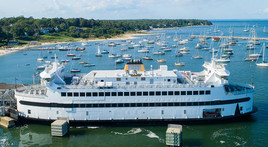
An exception to the vessel terms above is in reference to a double-ended ferry with two bridges, such as the M/V Island Home. This particular ferry style does not have a true bow, stern, port or starboard; nor does the captain have to turn the ferry around upon arrival at its destination port. Vehicles can be driven straight onto the auto deck and drive off in the same direction. In this case, the Steamship Authority crew members refer to the “front facing the island” (bow) and the “back facing the mainland” (stern).
|
Ferry Fun Fact
“Seaspeak” is the official language of the seas and is used to enable clear communication , regardless of the navigator’s native tongue. English was the principal language chosen by a panel of linguists and shipping experts in 1983. The International Maritime Organization made Seaspeak the official language of the seas in 1988.
Seaspeak defines the rules of communication using the ship's radio. All messages begin with a message marker that indicates the nature of what follows. The message markers are Advice, Answer, Information, Instruction, Intention, Question, Request, and Warning.
|
|
General Areas and Directions of a Vessel |
|
-
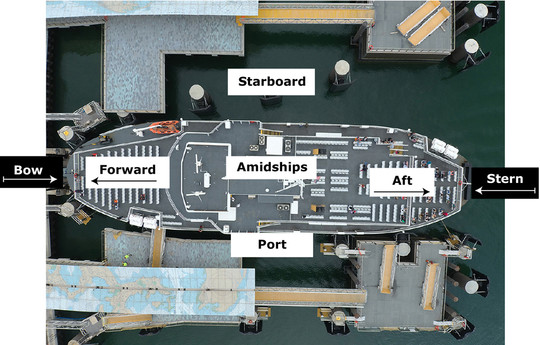
Aft: the inside (on board) rear-most part of a vessel.
-
Amidship: the center of a vessel with reference to either its length or breadth – the middle of the vessel.
-
Beam: the width of a vessel, measured at its widest point that supports the deck and/or strengthens the hull.
-
Bow: the outside (off-board) front part of the vessel.
-
Forward: the inside (on-board) forward-most part of a vessel
-
Port: the left side of a vessel when one is facing the bow. Historically, ships that came into a port needed to dock keeping the steering oar safe on the outside, away from the dock. So, the "port" side referred to the left-hand side of the ship when facing forward, the side tied to the dock once the ship pulled into the dock. (Helpful hint to remember which is which: “port” and “left” have the same number of letters!)
-
Starboard: the right side of the vessel when one is facing the bow. Derived from the term "steerboard,” this reference goes back to very early ships that were steered by a steering oar on the right-hand side of the ship — in the days before ships had rudders on their centerlines.
-
Stern: the outside (off-board) rear part of a vessel.
Ferry Fun Fact
The Steamship Authority’s fleet is comprised of 10 vessels, including five passenger/vehicle ferries, four freight ferries, and one high-speed ferry. Each ferry has unique features and background story. To learn more about our vessels, visit https://www.steamshipauthority.com/about/vessels. And while you are there, check out our GPS vessel tracker that shows the current locations of our vessels on a real-time map.
|
|
|
Do you have questions, comments or suggestions for Ship to Shore? Have an idea for a future edition? You can reply directly to this email and it will be delivered directly to our communications and marketing team, or write to enews@steamshipauthority.com. We look forward to hearing from you!
For suggestions, compliments or complaints about our service, please use the customer feedback form located on our website, or click the link below.
|
|
|
Woods Hole, Martha’s Vineyard and Nantucket Steamship Authority
228 Palmer Avenue, Falmouth, MA 02540
Mashpee Reservation Office: (508) 477-8600
7:30 a.m. - 4:00 p.m. daily
(Closed on Thanksgiving, Christmas Day and New Year’s Day.)
You have received this e-mail because you selected Nantucket Residents and/or Nantucket Travelers when you signed up for the Steamship Authority’s eNews. You can change your account information or unsubscribe from this list by clicking the appropriate link below.
Steamship Authority Privacy & Security Policy: www.steamshipauthority.com/about/legal.
Granicus Privacy Policy: support.granicus.com/s/article/Privacy-Statement.
|
|
|
|