|
October 2025
Igniting A Spark in Engineering
 For almost everyone -- it's easy to think highway projects begin when the orange barrels are placed and the flashing lights turn on. For engineers, though, the project begins earlier... sometimes even years earlier!
For every project you see, there are a series of files, folders, and a complex mesh of references and models. Kentucky Transportation Cabinet (KYTC) engineers work as a team to create these models and review data. As a transportation engineer, we know it's our job to create a safer world... and that starts with a safer design.
So... Where do you begin?
Starting on a blank slate can be intimidating. For transportation engineers, it all starts with addressing a key problem. Common areas KYTC engineers look to solve often include:
- Reducing congestion
- Eliminating causes of crashes
- Improving current infrastructure
- Improving safety for road users (motorists, pedestrians and bicyclists)
To do this, we must evaluate data to find the source of any issues. For example, if the problem is related to crashes -- reports and pictures will be analyzed to find what specific factors are causing them.
There isn't a one size fits all solution.
Engineers will come up with multiple ideas to solve the problem. All of these different ideas are called 'alternatives'. Design software and helpful manuals are used to create models and plans for each alternative.
Take the example pictured below: using engineering software, KYTC engineers can review improvements that can be made at a specific intersection as part of a realignment project. The goal of the project is to improve safety by reviewing sightlines to reduce crashes.
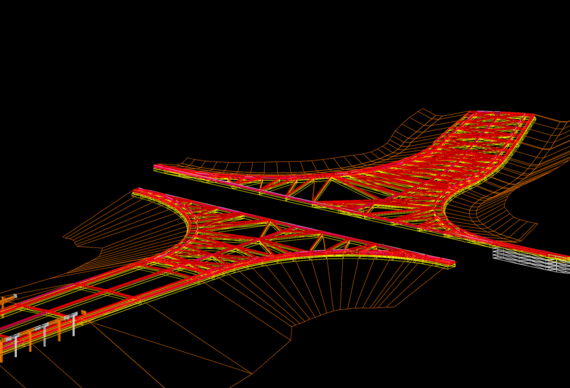 Once they are ready, the engineer will present each design in a meeting where other KYTC staff are able to analyze different alternatives. The team will analyze the alternatives to find the solution that maximizes safety and efficiency, while also minimizing cost and construction time (when applicable). Public input is also a critical role during design. KYTC is committed to robust public involvement to gain insights and receive feedback as part of the project development process.
These steps are necessary to ensure everyone is on the same page as we keep the project rolling toward construction.
So you want to be a transportation engineer?
Learning good computer skills is a must! Most of the work a transportation engineer is does is on the computer. Some of the applications and tools that are used can simulate real-world events like traffic flow and flooding. These tools are critical aid in their design -- as they can predict how a project will handle specific critical scenarios.
You'll also need to be creative. The aforementioned tools may predict what can happen, but they cannot tell you how to avoid those situations. Instead, that's up to the engineers and their team to resolve.
The design of a project is a composite of all the work performed not only by a design engineer, but also a large group of team members that helped along the way. Every project is reviewed by hundreds of sets of eyes before a construction truck rolls on to the site.
Each design is a composite of all the work done not only by the design engineer, but also all of the team members that helped them on the way. So the next time you're driving along a road -- consider all of the decisions that shaped the landscape to make that project possible. Most importantly, never forget that you too can become an engineer that can help shape the transportation network of the future!
 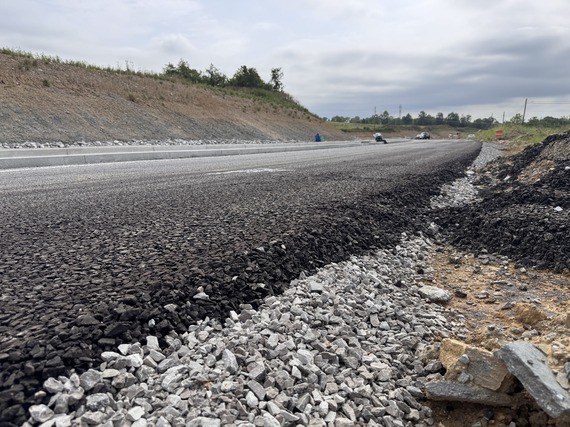 Asphalt. Base failures. Subgrade.
These are all words/phases you might hear when you read an article about an upcoming resurfacing project. They're all vital to ensuring a smooth driving surface for all Kentuckians.
...But what you see when driving is only a small portion of how a road actually works. Think of it like the tip of an iceberg. What's underneath is just as critical, if not more, to ensuring the road surface you drive on stays in good shape!
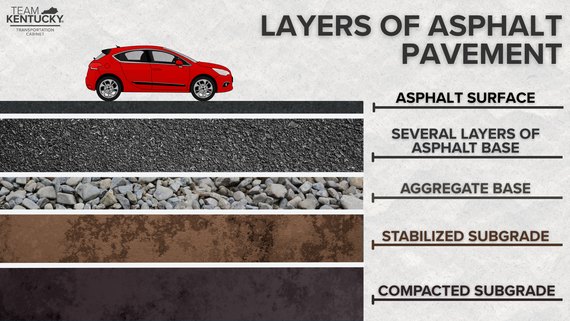 Hungry? Think of the road as if it's a layered cake: the top is the smooth icing you see, but the strength comes from everything built underneath. Here’s a look at the different layers that went into building the new pavement:
-
Compacted Subgrade – Think of this as the foundation of the road. It’s the layer of soil underneath everything else, packed tightly so it can hold the weight of the road and traffic above it.
-
Stabilized Subgrade – Not always needed, but when added, this layer improves poor soil conditions, improves drainage, and gives the road extra strength by keeping soil from pushing up into the pavement.
-
Aggregate Base – Think of this as the support beams of the road. It's made of strong materials like angular crushed stone that locks together in a matrix and helps spread the weight of traffic evenly while letting water drain away from the surface.
-
Asphalt Base – These layers make up most of the pavement’s thickness, most often including several layers of asphalt base. It’s built to handle heavy loads and pass that weight down to the aggregate base layer. It’s not as smooth as the final driving surface, but it’s strong.
-
Asphalt Surface – This is the smooth, blacktop you actually drive on. It’s made from high-quality asphalt and provides traction, a comfortable ride and protection from water damage.
The end result? A strong, layered roadway designed to handle traffic safely and smoothly for years to come.
So next time you're driving on a state route or highway... Remember — you’re not just rolling across asphalt. You’re driving on a carefully engineered system built from the ground up.
 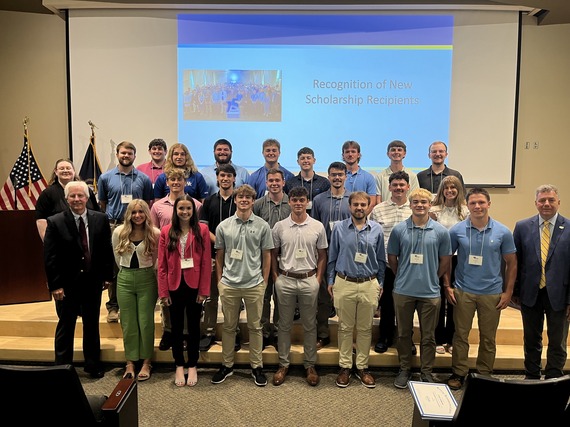 KYTC welcomed our new class of scholarship students on June 24, 2025. This year we received 114 applications, and we are proud to announce that 27 outstanding students were selected for the 2025-2026 program. Here is our class, congratulations!
CIVIL ENGINEERING:
Jacob Oates – Muhlenberg County - Murray State University
Anna Marr – Barren County - Western Kentucky University
Jacob Rowland – Ohio County - Western Kentucky University
Cassidy Schrock – Logan County - Western Kentucky University
Lucas Romine – Warren County - Western Kentucky University
Logan Boone – Hart County - University of Kentucky
Carter Peace – Larue County - University of Kentucky
James Slone – Shelby County - University of Kentucky
Camren Martin – Jefferson County – University of Louisville
Benjamin Johnson – Franklin County - University of Kentucky
Allison Jones – Kenton County - University of Kentucky
Mitchell Harden – Campbell County - University of Kentucky
Gary “Trey” Downs – Campbell County - University of Kentucky
Cade Robinson – Madison County – University of Kentucky
Natalie Langdorf – Fayette County - University of Kentucky
Cole Andrews – Boyle County - University of Kentucky
William Rhody – Anderson County – Western Kentucky University
Simon Spillman – Pulaski County - University of Kentucky
Benjamin Baker – Laurel County - University of Kentucky
Jaden Taylor – Knox County - University of Kentucky
Matthew Cochrane – Laurel County - University of Kentucky
Kolten Crum – Floyd County - University of Kentucky
Ryan Justice – Pike County - University of Kentucky
CONSTRUCTION MANAGEMENT
Kynedee Mauney – Mason County – Morehead State University
Reece Collins – Johnson County – Morehead State University
Bryson Sergent – Johnson County – Eastern Kentucky University
CIVIL ENGINEERING TECHNOLOGY
Kylie Branham – Pike County – BSCTC
 |
|
Following the orientation ceremony, our current students participated in specialized training sessions designed to equip them with essential skills for their future roles within the Cabinet. |
|
The application period for the 2026-2027 year will open on November 1, 2025. Interested students can find more information on our website. The application deadline is February 1, 2026. For additional assistance, please contact Marianne Sullivan, Scholarship Coordinator, at 502-564-4970 or via email at marianne.sullivan@ky.gov.
|
|
 |
|