 Friday, July 25, 2025
Mosquitoes carrying West Nile virus found
in additional Jefferson County ZIP codes
 This week, the Louisville Metro Department of Public Health and Wellness (LMPHW) found mosquitoes infected with West Nile virus in surveillance traps in five additional neighborhoods: Old Louisville (40208), Irish Hills 40206), California (40210), Iroquois (40214) and Churchill Downs (40215). To decrease the risk of infection and decrease the mosquito population, the department performed mosquito fogging in those areas. Mosquitoes with West Nile virus were found previously in the Tyler Park area and neighborhoods surrounding it.
Fogging is an effecting measure to reduce or eliminate adult mosquito populations in an area, thus reducing the possibility of biting mosquitoes’ ability to spread disease. Fogging occurs in the early evening hours. LMPHW uses an ultra-low volume fogging machine that disperses Zenivex an insecticide that is very low in toxicity and odor. The U.S. Environmental Protection Agency and Kentucky Department of Agriculture recognize the product as safe to use without posing unreasonable risks to human health.
Though West Nile virus has been detected in mosquitoes this year, so far, no human cases have been reported in Jefferson County.
LMPHW works year-round to control the mosquito population
- To prevent mosquitoes from breeding or hatching we apply pretreatment larvicides to 385 areas known to hold water around the county including wet wooded areas, swampy areas, areas that frequently flood, right of ways, drainage easements, and vacant properties.
- At least three times a year, we apply larvicides to approximately 14,500 Metropolitan Sewer District (MSD) catch basins. By design, catch basins hold water to prevent sewer odors from escaping from the sewer Because these catch basins hold water, they provide an excellent breeding habitat for disease-carrying mosquitoes which is why we prioritize treating them.
- We place numerous mosquito traps around the community which attract different types of mosquitos. The mosquitoes are speciated and tested for disease. When mosquitoes carrying West Nile virus or other diseases are found in those traps, it triggers fogging.
-
Gambusia, a small native fish, is found in most creeks and permanently wet ditches in Louis These fish are voracious eaters of mosquito larvae and pupae. We transplant them into creeks, decommissioned wastewater treatment plants, ponds, lakes, water retention areas, untreated swimming pools, and ditches where mosquito breeding is found.
Mosquito prevention resources
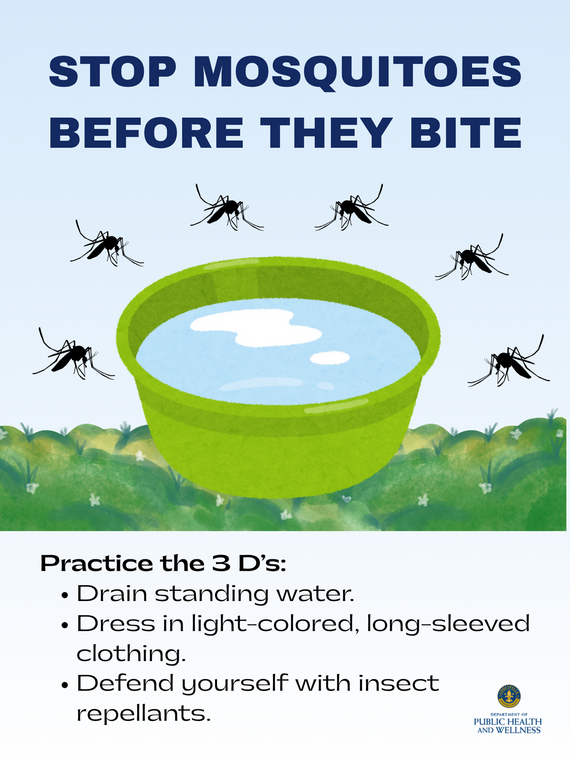
- Here are ways to protect yourself from mosquito bites.
-
Watch this video to learn how to reduce mosquito breeding sites around your home.
- Learn more about mosquito fogging by watching this video.
- To see areas that have been fogged or if your area will be fogged, visit our website or call the mosquito fogging hotline, 502-574-6641.
- To make a complaint about mosquitos in your neighborhood call Metro311 by dialing 311 or 502-574-5000.
- To be alerted by text message when mosquito fogging will occur in your neighborhood, opt-in for LENSAlerts with your cell phone. Text “LENSALERT” to 67283 to start receiving fogging notifications in your area.
Accessing local air quality information
 What is air quality? Air quality measures how much pollution is in the air. Air pollutants, like vehicle emissions and wildfire smoke, impact public health and the environment.
Understanding the United States Air Quality Index (AQI)
The United States Air Quality Index (AQI) is a national tool used to communicate about outdoor air quality and health. The AQI runs from 0 to 500, with higher numbers indicating worse pollution and greater health risks.
What to know about AQI:
- An AQI level less than 50 is ideal, but anything below 100 is considered acceptable.
- Levels of 100-150 are considered dangerous for certain groups.
- Levels higher than 150 are unhealthy for all groups, and levels over 300 are considered an emergency and require action.
Daily AQI reports are required for metro areas with a population of over 350,000 people. However, other areas also report AQI as a public service. Daily AQI measurements are available on AirNow.gov and Louisville Metro Air Pollution Control District.
Who should take extra precautions when AQI is over 100?
- People with heart or lung diseases.
- People with diabetes.
- Older adults (older than 60 years old).
- Children (less than 18 years old).
Routine and emergency protections against harmful air quality Certain safety measures can protect you and your family from the harmful effects of air pollution:
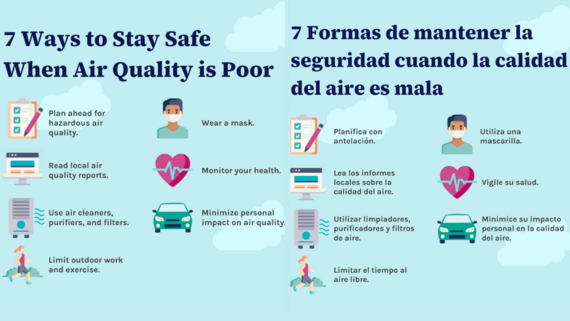
Read local air quality reports. Stay up to date on local information. Air quality levels can change quickly, and local officials can provide the most up-to-date and accurate information to keep you safe.
Use air cleaners, purifiers, and filters. Choose an air cleaner or purifier that has an appropriate clean air delivery rate (CADR) and use high-efficiency particulate air (HEPA) filters to help keep your space clean. Existing furnaces and HVAC systems can filter the air when operating for long periods and using upgraded filters. Use the Guide to Air Cleaners in the Home for information on choosing the right equipment for your space.
Limit outdoor work and exercise. To decrease the amount of exposure to unhealthy air particles, limit, pause, or reschedule outdoor activities when air quality is poor.
Wear a mask. If you must go outside when air quality is unhealthy, properly fitted high filtration masks such as N95s, KN95s, and KN94s provide the best protection.
Monitor your health. Stay up to date on routine health screenings and notify your healthcare provider of any concerns, symptoms, or health changes you experience.
Minimize personal impact on air quality. Your actions can help reduce pollution. Avoid burning materials outdoors, choose public transportation, when possible, plant and care for trees that filter the air, and switch from gas-powered to electric lawn equipment.
Courtesy of Public Health Collaborative
"Let's Talk" will provide insight
into Black men's mental health
 Black men of all ages are invited to participate in a meaningful gathering to share stories, break stigmas and build connections across generations. "Bridging Generations Through Conversations OG's to Young Men: Let's Talk" will be held at 5:30 p.m. on Thursday, July 31 at Roots 101 African American Museum, 124 N. 1st St.
Parents are welcome to attend with middle and high school students. Dinner will be provided.
For more information and to register, please contact Ricky Owens, Ricky.Owens@louisvilleky.gov or Aubrey Williams Aubrey.Williams2@jefferson.kyschools.us. You can also call (502) 313-4700.
Are you a parent or caregiver?
Face It Movement wants to hear from you
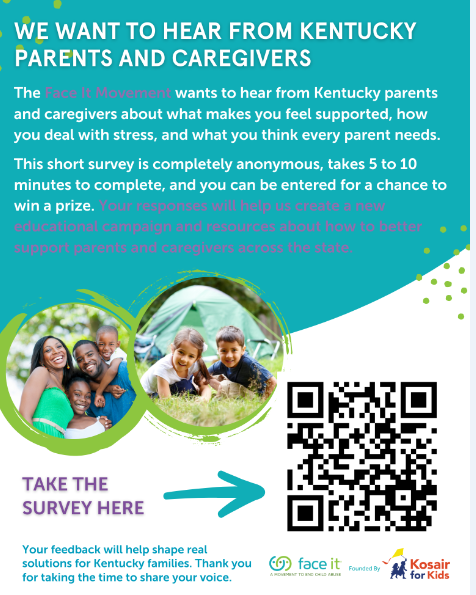
The Face It Movement wants to hear from Kentucky parents and caregivers about what makes you feel supported, how you deal with stress and what you think every parent needs.
Please scan the QR code above or use this link to take a short anonymous survey, and you can be entered for a chance to win a prize. Your responses will help provide ideas for a new educational campaign and resources about how to improve support for parents and caregivers across the state.
|