 Friday, March 1, 2024

Learn how to add
safe dining to your menu
|
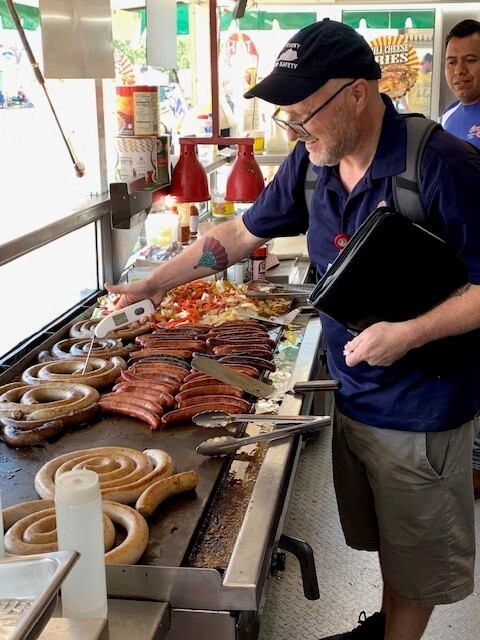
File photo
Public Health and Wellness' Food Inspector Scott Nethery checked the temperatures of the food at one of the vendors at the Kentucky State Fair.
Inspections by the food safety team at the Louisville Metro Department of Public Health and Wellness are intended to make sure establishments know and follow the best practices to keep their diners safe from foodborne illnesses such as E. coli or salmonella.
What do those letter grades in the restaurant window mean?

A placard – This grade acknowledges safe food handling practices were observed and designates that the restaurant meets the requirements of the Kentucky State Food Code without priority violations at the time of inspection. There can be a few non-priority violations, and the facility will still pass.
|

B placard – This grade indicates the facility has passed the most recent follow-up inspection. Prior to this, however, it failed two consecutive inspections. The B placard may also represent that a facility was recently closed due to imminent public health violations, then re-inspected and opened after passing a follow-up inspection. This is why a restaurant can score 100 and still have a B grade.
|

C placard – This grade indicates that a food-service facility has failed to meet the minimum requirements of the Kentucky State Food Code upon the most recent inspection. Because the score for this grade represents priority violations, they must be corrected immediately or within seven to 10 days, depending on the severity. Once corrected, they can return to an A or B rating.
|
What are the most common violations inspectors see?
There are two types of common violations -- priority and non-priority:
-
Priority (or critical) violations are actions or food preparation practices that can lead to a high risk of foodborne illness. Our data shows the top three priority violations, resulting in a C grade placard are:
- Improper food temperatures (in the danger zone between 41-135 degrees F)
- Cross contamination (i.e., food contact surfaces, equipment not clean)
- Poor staff hygiene (i.e., eating, drinking while preparing customer food)
-
Non-priority violations are items that are related to a lack of general sanitation and facility maintenance. These must be corrected but do not pose a critical threat to food safety and public health. The top three non-priority violations we find are:
- Physical facilities are not maintained or clean. (i.e., floors, walls, waste containers)
- Nonfood-contact surfaces (such as storage shelves) are not clean.
- A certified food protection manager is not present.
What might cause a food safety inspector to shut down a restaurant?
The main reason a food inspector would shut down a restaurant is because of an “imminent health hazard” such as fire damage, flooding, disruption to water or power supply, sewage backup/exposure, insect, or rodent infestation. The establishment remains closed until that hazard is corrected.
When going out to eat, what are three tips for a diner to look out for?
There are several things that can indicate how well a restaurant is observing food safety. Check the posted letter grade and previous inspection history, using our Inspection Score Lookup Tool. The letter grade placard includes the past three inspection scores.
- Observe food handlers:
- Are they sick?
- Washing hands properly?
- Eating and drinking while preparing food?
- Is your hot food served hot? And cold food cold?
- Check for cleanliness:
- Do the bathrooms have soap and towels for handwashing?
- Does the dining area have greasy tables, old food waste on floors?
For more food safety tips and information, visit FoodSafety.gov. Information for food service operators such as how to obtain permits, inspection information and certified manager training can be found at our Food Safety Program website.
Learn more about who we are and what we do
Free community workshop series
focuses on mind and body wellness
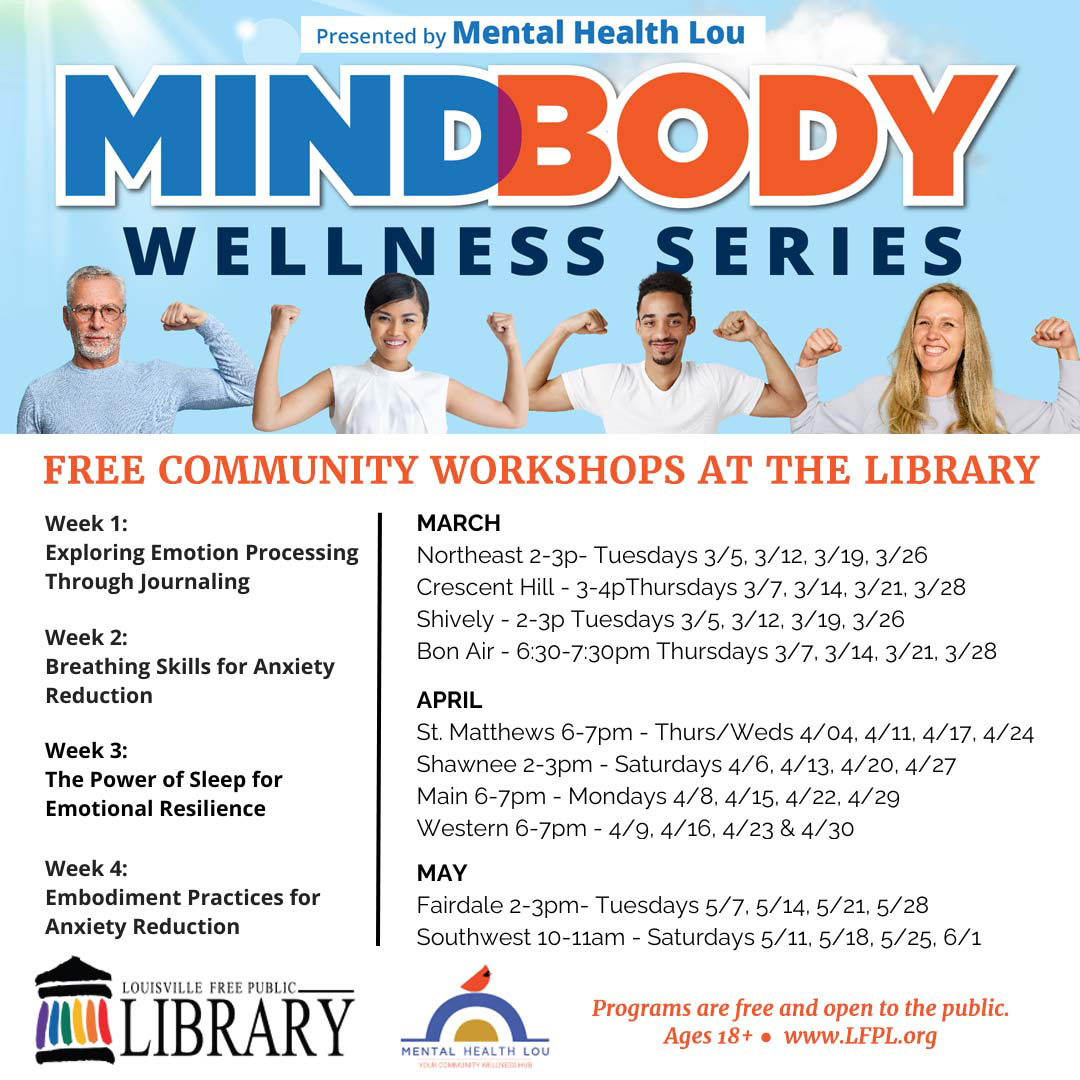 Mental Health Lou and the Louisville Free Public Library (LFPL) will offer free workshops for adults focused on mental health and wellness, kicking off at 2 p.m. on Tuesday, March 5 at the Northeast Library, 15 Bellevoir Circle. Participants will learn ways to reduce anxiety, journaling and the power of sleep for emotional resilience.
Taught by licensed experts from Mental Health Lou’s partner groups and providers, the series will be offered at library locations: Northeast, Crescent Hill, Shively, Bon Air, St. Matthews, Shawnee, Main, Western, Fairdale and Southwest.
Each workshop in the series addresses a different topic:
Week 1: Exploring Emotion Processing Through Journaling: In this interactive workshop, participants will discover the therapeutic power of journaling as a tool for processing emotions. Journaling provides a safe and private space to explore thoughts and feelings, helping to gain insight and clarity.
Week 2: Breathing Skills for Anxiety Reduction: This workshop will focus on teaching participants practical breathing exercises that can be used to calm the nervous system and reduce anxiety.
Week 3: The Power of Sleep for Emotional Resilience: Participants will learn about the relationship between sleep and emotions, and how to optimize their sleep habits for better mental health.
Week 4: Embodiment of Practices for Anxiety Reduction: This workshop will guide participants through somatic and mindfulness practices to cultivate a deeper connection with their physical selves.
Click here to learn more details about this community series.
Mark your calendar: Bring your resume
to the Metro Government career fair
 Please join Louisville Metro Government at the career fair from 10 a.m. to 6 p.m. on Monday, March 11 at the Norton Healthcare Sports and Learning Complex, 3000 W. Market. Over 30 agencies will be attending, and it will be a great time to have conversations about the various positions.
|