 Friday, December 4, 2020
Top COVID-19 Takeaways from the Week
'Be there for us, so we can be there for you' Louisville nurses plea
 Delanor Manson, nurse and Chief Executive Officer of the Kentucky Nurses Association.
COVID-19 has drastically altered the lives of many in Louisville and continues to impact the capacity of our hospital systems. Through it all, nurses have been a constant stable presence in taking care of our community.
Dr. Ruth Carrico, past president of the Kentucky Nurses Association (KNA) Board of Directors and an infectious disease nurse and researcher at University of Louisville Health said nurses that treat severely ill patients in hospitals and ICUS for long shifts during COVID-19 get very discouraged and stressed when they see people out in the community not wearing masks or socially distancing.
Delanor Manson, a nurse and Chief Executive Officer of KNA, said part of their responsibilities include educating nurses in the state so they have up-to-date accurate information about COVID-19 including the safety and efficacy of a vaccine. This way they feel comfortable taking the vaccine and sharing the information with their communities.
"As an African American, I hear a lot of hesitation about the vaccine in the Black community and I understand it," Manson said. "What I'm here to say is we must take the vaccine if we're going to increase our ability to stave off COVID-19."
Manson and Carrico advised the city of Louisville and its residents to support them in making a difference by following all the COVID-19 health and safety protocols.
"In order for every nurse to continue to do this and to be there for every patient, we need the community to be there for us," Dr. Carrico said.
Jefferson County sets record for third consecutive week
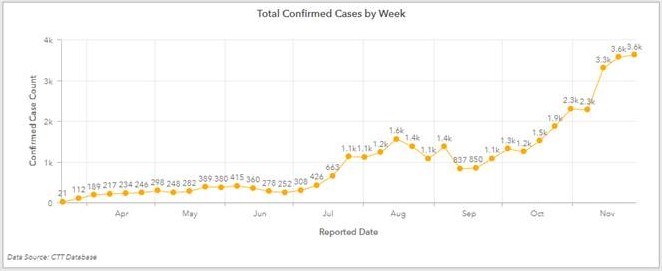 Louisville's Chief Health Strategist Dr. Sarah Moyer repeated concerns about COVID-19 cases ramping up at an alarming rate.
For the third consecutive week, the city surpassed 3,000 cases. Furthermore, Dr. Moyer added that of the 3,730 cases opened between Nov. 15 and Nov. 29, 1,548 reported venturing out to public spaces such as schools, retail stores and bars and restaurants while infectious.
"We all have a personal responsibility to slow the spread of the pandemic and eliminate the virus. It's imperative that we take an effective, fact-based approach by limiting where we go and who we're around," Dr. Moyer said. "Let's do what needs to be done now, so we can return to a strong economy and day-to-day activities."
Watch Dr. Moyer’s weekly update on COVID-19 HERE. To see Louisville’s COVID-19 data dashboard, including total number of cases, deaths, testing locations and more, click HERE.
Contact Tracing
 Contact tracing has shown to be a useful mitigation strategy to reduce the overall burden of this disease.
However with COVID cases rising exponentially, it has exceeded our public health system capacity presenting challenges. They include contact tracers reaching individuals who may have been exposed in a timely manner.
Additionally, information shared with contact tracers such as where an individual traveled while infectious or who they may have been in contact with is not always complete.
Which is why the Louisville Department of Metro Health and Wellness is encouraging people to alert their contacts as soon as they learn they've tested positive, and also to be as transparent and detailed as possible with regards to mobility in our community to help us track the spread of COVID-19.
We encourage people not to wait for us to call them, but to call our COVID-19 LOU HEALTH Helpline at 502-912-8598. We want to help you:
- Know what your next steps are
- Learn how to safely isolate at home
- Alert your contacts
- Assist with any essential needs you may have.
Don't hesitate, call the helpline! If LOU HEALTH appears on your caller ID, answer the call.
For more information on COVID-19 resources, click HERE. For information on how to identify close contacts, click HERE. To understand how to safely isolate or quarantine at home, click HERE.
|