 Casey Bill Signed Into Law on Monday, July 9, 2018
Approximately 2.6 million children are being raised by their grandparents or other relatives and experts say this number is rising as the opioid epidemic devastates communities across the country. Senators Collins and Casey introduced the Supporting Grandparents Raising Grandchildren Act in the Senate in May 2017 after an Aging Committee hearing during which witnesses testified about the need for grandparents to have easy access to information about resources available to assist them.
“Throughout history, grandparents have stepped in to provide safe and secure homes to their grandchildren, replacing traumatic pasts with loving and hopeful futures. With so many parents struggling with addiction, grandparents are increasingly coming to the rescue and assuming this role. It is essential that we do all that we can to help these families,” said Senator Collins. “Our legislation will help ensure that grandparents who have taken on this caretaker role have access to the resources they need.”
"Generations United applauds Senators Collins and Casey for championing the Supporting Grandparents Raising Grandchildren Act, which has now passed the House and the Senate. This important legislation will result in improving the lives of the 2.6 million grandparents who are raising grandchildren, more and more of whom are being called on because of the opioid crisis," said Donna Butts, Executive Director of Generations United. "As a result of the Senators' compassionate leadership, efforts to support relative caregivers will be better coordinated at the federal level and critical gaps in services will be identified and filled."
"AARP is proud to support the Supporting Grandparents Raising Grandchildren Act and is pleased to see it signed into law," said Nancy LeaMond, Executive Vice President and Chief Advocacy & Engagement Officer at AARP. "Already, more than 2.6 million grandparents are raising their grandchildren, and that number will only continue to grow as our nation struggles with an ongoing opioid epidemic. These grandparents need information and assistance on issues dealing with legal custody, available social services, mental health counseling, and other vital programs. This law will help to achieve that goal by creating a federal advisory council that will serve as a much-needed centralized source of information and resources for grandparents."
“As the opioid epidemic continues to contribute to rising numbers of children entering foster care, it is critical to support the relatives who care for them, known as kinship caregivers,” said American Academy of Pediatrics President Colleen A. Kraft, MD, MBA, FAAP. “Supporting kinship caregivers helps maintain a child’s connection to family, and is essential to alleviating the trauma children face when they enter foster care as a result of their parents’ substance use disorder. The American Academy of Pediatrics thanks Congress for enacting the Supporting Grandparents Raising Grandchildren Act, and looks forward to supporting its effective implementation.”
“I am thrilled that the Supporting Grandparents Raising Grandchildren Act has been signed into law! The new advisory council will help make it easier for grandparents and other relative caregivers to find important information about resources available to them,” said Dr. Sharon McDaniel, Founder, CEO and President of A Second Chance Inc., located in Pennsylvania. “I am grateful for the leadership of Senators Casey and Collins on this issue and hope that we can all continue to work together to provide much needed help for grandfamilies.”
The Supporting Grandparents Raising Grandchildren Act has received support from 40 older adult and child advocacy groups including AARP, American Academy of Pediatrics, and Generations United.
__________________

Also, recently passed Senate Bill 6
went into effect as of July 14, 2018 and requires pharmacies to teach patients
proper medication disposal techniques. Consumers may see signage on the doors
of pharmacies or at the prescription counters. The following language is noted:
Safe
Disposal of Medicines
To
help reduce the chance that others may accidentally take or intentionally
misuse unneeded or expired medications, you should dispose of them promptly
when they are no longer needed.
Options
include:
- Medicine take-back programs
- Permanent collection sites
- Sequestration or deactivation devices
- Home disposal options under specific circumstances
For
additional information on your best choices for disposal options visit the
FDA’s Safe Disposal of Medicines website.
Medicine take-back programs - may also
be known as drug toss, expired drop toss, usually hosted by various community
groups when the required law enforcement personnel can be on site. National
Drug Take Back days are usually hosted twice yearly April and October.
Permanent collection sites – May also
be known as Drug Disposal Drop off centers, many of which are located at local
police stations or health departments. Locations can be researched by county here.
Sequestration or deactivation devices -
Bags of special compounds to which consumers add unused and unwanted
prescription drugs. When added together with water, the mix creates “goo” that
makes the drugs impossible to use. The bag once activated with water and drugs
can be thrown in the trash to breakdown safely.
Home
disposal options under specific circumstances - Certain medications
require specific disposal for patient and environment safety. For specific
information, visit this link or ask the pharmacist providing you with the
medication.
__________________
 __________________
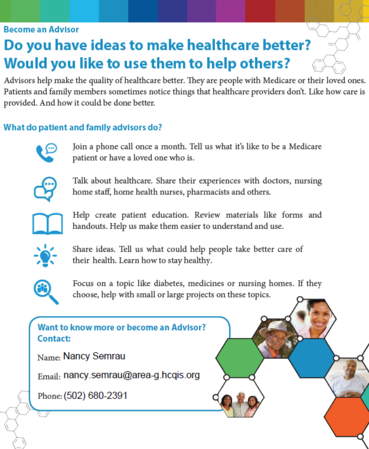
Seeking Input From Individuals with Medicare and/or Their Families
 __________________
This Month, the National Institute on Aging Offers Advice On:
When you are planning
for a doctor's visit, these are some ways you can make the most of your
time there:
1. Be Honest
It is tempting to say what you think the doctor wants to hear, for
example, that you smoke less or eat a more balanced diet than you really do.
While this is natural, it's not in your best interest. Your doctor can suggest
the best treatment only if you say what is really going on.
2. Decide What Questions
Are Most Important
Pick three or four questions or concerns that you most want to
talk about with the doctor. You can tell him or her what they are at the
beginning of the appointment, and then discuss each in turn.
3. Stick to the Point
Although your doctor might like to talk with you at length, each
patient is given a limited amount of time. To make the best use of your time,
stick to the point. For instance, give the doctor a brief description of the
symptom, when it started, how often it happens, and if it is getting worse or
better.
4. Share Your Point of
View About the Visit
Tell the doctor if you feel rushed, worried, or uncomfortable. If
necessary, you can offer to return for a second visit to discuss your concerns.
For example, you could say something like: "I know you have many patients
to see, but I'm really worried about this. I'd feel much better if we could
talk about it a little more."
5. Remember, the Doctor
May Not Be Able to Answer All Your Questions
Even the best doctor may be unable to answer some questions. Most
doctors will tell you when they don't have answers. They also may help you find
the information you need or refer you to a specialist. If a doctor regularly
brushes off your questions or symptoms as simply a part of aging, think
about looking for another doctor.
Visit our website for more
strategies to help you communicate
with your doctor.
__________________
Local Program Helps Kentuckians
Take Control of Their Health
A new initiative seeks to empower individuals to
take control of their own health and positively influence the health of others.
The Institute for Sustainable Health & Optimal Aging at the
University of Louisville has launched a health education effort in Kentucky
called the Microclinic Program, created by Microclinic International.
The microclinics
are designed to empower individuals to lead healthier lives and manage chronic
disease. Participants learn how to decipher nutrition labels, cook healthy
meals, take part in group fitness activities and reach health goals.
The institute recently held a facilitator training for
community and health care industry workers. They will lead small group microclinics
with patients, friends and family at community centers, workplaces, churches,
senior seniors, hospitals, health clinics, extension offices and schools.
The facilitators are members of the Kentucky Coalition for
Healthy Communities, a community coalition supported by the institute’s Geriatrics
Workforce Enhancement Program grant and other community organizations. The
first cohort of trainees includes representatives of UofL, Aetna, Area Agencies
on Aging, Care Source and Anthem, along with Bullitt, Henry, Jefferson,
Trimble, and Franklin counties in Kentucky.
The institute plans to offer additional trainings for individuals
in counties surrounding Jefferson County and those near the Barren River area.
To schedule a microclinic
or facilitator class, and to learn more about the program, contact Mona Huff at
503-845-6849 or rjhuff01@louisville.edu . Learn more about the
Institute for Sustainable Health & Optimal Aging at www.OptimalAgingInstitute.org
__________________
 __________________
Fern Creek/Highview United Ministry Hiring-
Social Services Worker:
Non-profit, community ministries emergency assistance program seeks flexible, out-going, caring individual comfortable with ecumenical ministry setting. Position involves interviewing and assessing clients, working with volunteers, data entry, completing reports, networking with other social service agencies, local government, landlords and utility companies. Applicant must be physically capable of lifting and unloading food boxes. Social service education and experience helpful but not required. Great team environment. 30 hrs./wk., M-F, 9:00a.m.-3:00p.m. Sick leave, generous holidays and vacation, retirement option. $11.83/starting. Send resume by August 31, 2018 to: FCHUM 9300 Beulah Church Road, Louisville, KY 40291 ATTN: Renee Bryant or fax 762-9609.
Email: ifacdir@fchum.org or call 762-9611 for more info.
__________________
Kentucky Career Center offers Federal Bonding
Program to encourage employers to hire at-risk job applicants
The Kentucky Career Center is now offering a $5,000 six-month
fidelity bond at no cost to employers or job seekers through a U.S. Department
of Labor program that encourages hiring of hard-to-place applicants in eight
categories, such as individuals with criminal records or those with poor credit
records.
The
Federal Bonding Program (FBP) allows employers to insure their business against
theft, forgery, larceny or embezzlement if they hire at-risk job seekers who
cannot get private coverage. The bond covers the first six months of employment
and has no deductible so there is no out-of-pocket expense for businesses that
participate. Employers also can purchase continued coverage if the worker
demonstrates job honesty.
The bond
does not cover liability due to poor workmanship, job injuries or work
accidents, bail, contract or performance bonds, or license bonds for
self-employment.
People in
the following categories are eligible for the program:
- individuals with criminal records;
- individuals in recovery from substance use disorders;
- public assistance recipients;
- individuals with poor credit records;
- economically disadvantaged youth and adults who lack
stable work histories;
- individuals dishonorably discharged from the military;
and
- anyone already employed who needs bonding to prevent
termination or secure a transfer or promotion.
Bonds can
be issued as soon as the applicant has a job offer and a scheduled start date.
Workers must be paid wages with federal taxes automatically deducted from pay.
Part-time and temporary workers are eligible for the program but not
self-employed persons.
Bonds can
be applied to any employer, employee or job, including people hired by
temporary staffing agencies.
For more
information or to apply for the bond, contact your local Kentucky Career Center
at https://kcc.ky.gov/Pages/Locations.aspx.
You may also visit the FBP website at www.bonds4jobs.com.
Contact:
Holly Neal
502-782-3172
holly.neal@ky.gov
|