|
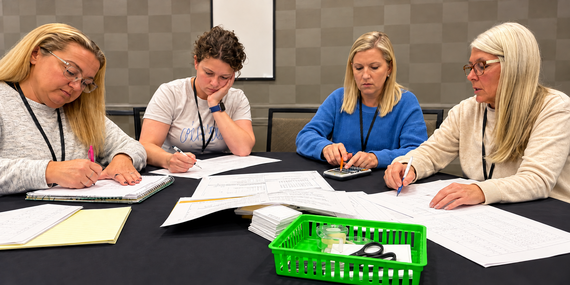
Teachers engage with mathematics as learners, working through tasks their students will encounter. This preparation helps them examine the reasoning behind a solution, anticipate where students may struggle and consider questions that will help students develop understanding.
The professional learning continues throughout the school year. A2A content managers provide ongoing content support and support teachers in examining how mathematics concepts develop across grade levels. The Middle Grades Fall Forum offers additional opportunities for teachers to deepen grade-level content knowledge and collaborate with colleagues.
Together, these experiences connect summer learning with the instructional decisions teachers make throughout the year.
Connecting Professional Learning to Classroom Practice
A2A content managers also work directly with districts and schools to support implementation of high-quality instructional resources (HQIRs). Their knowledge of Kentucky’s mathematics standards, Foundations for Teaching and Learning and districts’ adopted resources helps teachers strengthen alignment across lessons, grade levels and courses.
This work includes examining standards, pacing guides and instructional progressions to develop pathways that prepare more students for Algebra I in grade 8. Content managers also help teachers incorporate supplemental lessons where needed in their HQIR to support increased standards alignment and provide hands-on experiences.
Classroom visits keep that support connected to daily instruction. Depending on a school’s needs, content managers may observe lessons, model instructional strategies, assist teachers or co-teach. Participation in vertical team meetings helps teachers coordinate expectations and understand how their instruction builds on earlier learning and prepares students for subsequent coursework.
A2A’s Mentorship Program further provides new teachers with content and planning assistance, classroom visits and regular check-ins. Algebra Assist connects middle school Algebra I teachers through in-person and virtual cohort meetings, collaborative projects and statewide networking.
Developing Leaders to Sustain the Work
A2A also invests in the leaders responsible for supporting implementation. Its one-day Leader Assembly helps school leaders understand the initiative, guide implementation and make effective use of available support.
By including leadership development alongside teacher professional learning, A2A helps schools build the capacity to sustain their work over time. Leaders can connect professional learning, classroom support and collaboration across grade levels to the school’s broader mathematics goals.
Funding for classroom mathematics supplies, student review sessions and PSAT 8/9 testing provides additional support for implementation.
Examining Teacher Confidence and Student Outcomes
Teacher feedback collected after summer training points to increased confidence and a stronger foundation for mathematics instruction. Participants describe the training and ongoing support as helping them make mathematics more approachable, engaging and meaningful.
One anonymous participant who previously struggled with mathematics reported leaving the training with new instructional strategies, greater confidence and a renewed perspective on teaching. The teacher emphasized how the instructor built understanding and created a positive learning environment.
AdvanceKentucky also reports encouraging student mathematics outcomes. Among students who took the PSAT 8/9 in both grade 7 in the 2024-2025 school year and grade 8 in the 2025-2026 school year, mathematics scores increased by an average of 35 points. This analysis included only students who tested in both years.
A separate program-wide comparison found that 32% of participating 8th-graders met the mathematics college-readiness benchmark in the 2025-2026 school year, compared with 30% of participating 8th-graders in the 2024-2025 school year.
These findings provide two perspectives on student performance: growth among the same students across two years and benchmark attainment among successive groups of participating 8th-graders.
Exploring a Partnership
Schools interested in A2A can submit an application and meet with AdvanceKentucky staff to discuss their goals and determine whether the partnership is a good fit. New cohorts are selected each December.
District administrators and middle school mathematics leaders can learn more through the Access to Algebra program webpage or contact Annette Williams, Access to Algebra director.
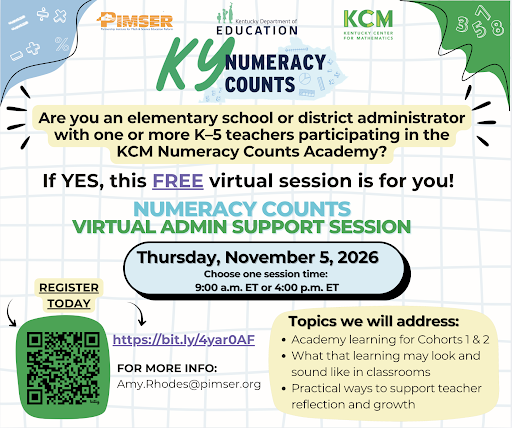
PIMSER/KCM/KDE Joint Session for Cohort 1 and 2 Teacher Academies Support and Cohort 3 Interest
This free virtual session will help elementary school and district administrators recognize and support the instructional practices teachers are developing through the Kentucky Center for Mathematics (KCM) Numeracy Counts Academy.
Administrators will explore Academy learning for Cohorts 1 and 2, consider what implementation may look and sound like in K-5 classrooms and practice supportive ways to engage teachers in conversations that encourage reflection and growth. Administrators interested in Cohort 3 also are invited to participate.
-
Date: Thursday, Nov. 5, 2026;
-
Time: Choose either 9 a.m. ET or 4 p.m. ET; and
-
Format: Free virtual session.
Register for the Numeracy Counts virtual administrator support session.
For more information, contact Amy Rhodes.
Kentucky Numeracy Counts K-3 HQIR Grant
The Kentucky Department of Education’s (KDE’s) Office of Teaching and Learning has issued a request for application (RFA) for the Kentucky Numeracy Counts K-3 HQIR grant.
Kentucky public school districts, along with the Kentucky School for the Blind and Kentucky School for the Deaf, are eligible to apply. Districts that previously received other KDE high-quality instructional resource (HQIR) grants for mathematics also may apply for funds.
The RFA is available on the Competitive Grants from KDE webpage.
As specified in KRS 158.843, the Kentucky Numeracy Counts Fund grant shall be used only to purchase approved, high-quality research- and evidence-based curricula aligned with academic standards in mathematics for kindergarten through grade 3 and to pay for curriculum-based professional learning to implement a new curriculum.
Per KRS 158.8402 (5)(b), “Each superintendent or public charter school board of directors shall adopt an evidence-based curriculum along with high-quality instructional resources for mathematics that is determined by the department to be reliable, valid, and aligned to Kentucky academic standards for mathematics required by KRS 158.6453 for kindergarten through grade three (3).”
This grant opportunity will provide $70,000 to each of up to 50 districts to purchase mathematics HQIRs or support curriculum-based professional learning for grades K-3.
KDE hosted a technical assistance webinar on Sept. 3. The recording is available on the Competitive Grants from KDE webpage. Applications are due by 4 p.m. ET on Nov. 17.
|