Beginning-of-Year Infinite Campus Updates for McKinney-Vento Students
As the school year begins, local homeless liaisons play a critical role in ensuring that students experiencing homelessness are accurately identified and properly reported in Infinite Campus.
Per the Kentucky Department of Education’s Data Standard for Homeless Children and Youth, liaisons should review the prior year's QA Homeless Report at the start of each school year and evaluate the current homeless status of all students listed. Because McKinney-Vento eligibility is determined annually, a new program participation record must be created each school year for every student who continues to qualify for homeless services.
Liaisons should also verify that each eligible student's Primary Nighttime Residence is accurately recorded on Infinite Campus based on the student's living situation at the time the student is identified for homeless services during the reporting year. The available designations include:
- S: Shelters and Transitional Housing
- D: Doubled Up
- U: Unsheltered (Inadequate Housing)
- HM: Hotels/Motels
While a student's living situation may change throughout the school year, the Primary Nighttime Residence designation should remain based on the student's status at the time of identification for reporting purposes.
Finally, liaisons should ensure that all students identified as experiencing homelessness are marked in Infinite Campus to receive free lunch benefits, even if the district currently participates in a program that provides free meals to all students. Maintaining this designation is important for state and federal reporting purposes and helps ensure accurate data collection.
Annual Training Reminder: 2026-2027 Homeless Liaison Professional Learning Options
As we begin the 2026-2027 school year, Kentucky's homeless liaisons are reminded that annual KDE-approved training is required under 704 KAR 7:090 and must be completed by Dec. 31, 2026. This training ensures liaisons remain current on McKinney-Vento requirements, student identification, dispute resolution procedures, data and reporting requirements, and best practices for supporting children and youth experiencing homelessness.
If you have not already done so, please take a few minutes to register for your preferred annual training option using the KDE 2026-2027 Homeless Liaison Professional Learning registration form. KDE strongly recommends participation in the Statewide Homeless Liaison Training on Oct. 26 in Lexington, which will feature promising practices from districts across the Commonwealth. That training will also offer a voluntary second day of training where liaisons have an opportunity to earn Adult Mental Health First Aid certification.
Attending only the first day of training will satisfy annual training requirements through KDE. Liaisons also may fulfill the annual training requirement through the free McKinney-Vento.org self-paced training or by participating in the 2026 National Association for the Education of Homeless Children and Youth (NAEHCY) Annual Conference, either in person or virtually. While only one option is needed to meet the requirement, liaisons are encouraged to take advantage of multiple professional learning opportunities throughout the year if possible.
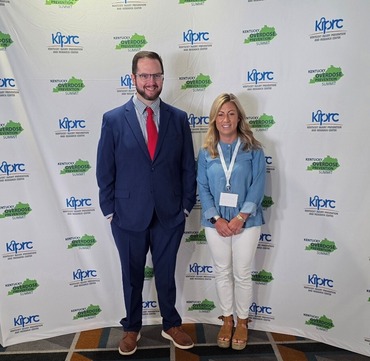 KDE state Homeless Coordinator Zach Stumbo, and KDE Education Consultant Jennifer White attended the Kentucky Overdose Prevention Summit in Louisville. Photo courtesy of the Cabinet for Health and Family Services.
Kentucky Overdose Prevention Summit Highlights
In July, Kentucky Department of Education consultants Zachary Stumbo and Jennifer White attended the Kentucky Overdose Prevention Summit to learn more about statewide efforts, resources and partnerships addressing substance use and overdose prevention. The conference provided valuable information about prevention, treatment, recovery and family support services that may benefit children and youth experiencing homelessness.
As part of the summit, Stumbo and White presented a session highlighting opportunities for collaboration between McKinney-Vento homeless education programs and substance abuse prevention and recovery initiatives. The presentation focused on how schools, community organizations and service providers can work together to remove barriers to enrollment, attendance and academic success for students experiencing homelessness, while connecting families to critical support services. The session emphasized the importance of cross-system collaboration to ensure vulnerable students receive comprehensive support that addresses both educational and non-academic needs.
|