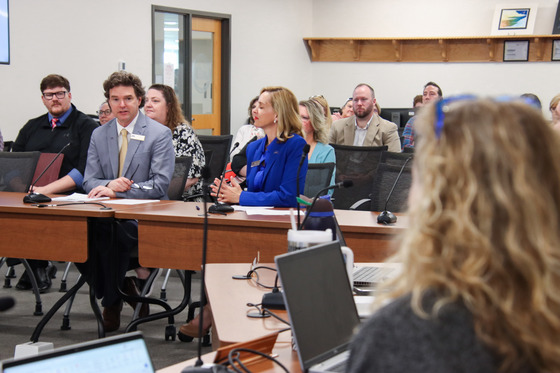
 Tyler Saylor, left, an English language arts teacher at Harlan High School (Harlan Independent) and GoTeachKY Ambassador, talks with members of the Education Professional Standards Board about teacher retention. Photo by Joe Ragusa, Kentucky Department of Education, April 21, 2026
(FRANKFORT, KY) – Members of the Education Professional Standards Board (EPSB) spoke with GoTeachKY Ambassadors about interviews they conducted to learn more about why educators decide to stay in the classroom during the EPSB meeting on April 21.
Three ambassadors – Tyler Saylor, an English language arts teacher at Harlan High School (Harlan Independent); Kaitlyn Kelly, a 5th-grade teacher at Coventry Oak Elementary School (Fayette County); and Chrystel Blair, a special education teacher at Hartstern Elementary School (Jefferson County) – spoke about this year’s GoTeachKY Ambassador project. The ambassadors asked teachers in their district a series of questions about why they decided to stay in education.
Saylor said many of the educators he spoke with listed the students they teach as a major reason for why they come back to the classroom.
“It's definitely an adventure every day,” Saylor said. “(The educators) talked about the humor (of their students), the unpredictability and the growth.”
Saylor said among the things driving teachers away were a lack of autonomy and too much testing.
“But hopefully, though, with a new accountability model, that will help alleviate some of the testing,” Saylor said.
Saylor also talked about how the perspective as to why some teachers stayed shifted as teachers progressed in their careers, with younger teachers expressing a desire to grow and older teachers focusing more on their legacy as they see more of their former students out in the world.
Blair said many of the teachers she spoke with at her school are motivated by making a difference and working with children as they learn.
“Some stated that they had such a love for learning at a young age. They wanted to ignite that fire in other children and beginning learners,” Blair said.
And among some of the things Blair said educators said they wished the community knew more about was just how much they care for the children in their classroom.
“The teachers in our school put in a lot of effort to build relationships and create meaningful learning experiences for students, and I wish people did not take that for granted,” one teacher told Blair.
Blair also heard from many educators about the need for more support, including more access to professional learning communities and professional development, more behavioral support, including counseling for students, and more consistency from administrators.
Kelly said many of the educators across each grade level focused on the importance of a strong culture within the school and community.
“Teachers talked about how much they leaned on their grade-level teams – and if you have a bad team, it just makes or breaks your whole year – and how important is to maintain a positive, supportive team culture,” she said.
Educator Certification Work Group Recommendations
EPSB members signed off on a series of recommendations for potential reforms with educator certification.
Todd Davis, division director in the Kentucky Department of Education’s (KDE’s) Office of Educator Licensure and Effectiveness, provided an overview of the Education Certification Structure Workgroup, which began work in December 2024 and is made up of principals, teachers, school counselors, human resource officers, leaders from Kentucky’s universities, state lawmakers and other educator stakeholder groups.
Members of the work group analyzed current grade bands and credential structures to see if they meet districts’ needs. The workgroup reviewed state and national data and identified that some of the challenges within the current system could be addressed by modifying the existing certification grade bands and certification permissions.
The workgroup narrowed down a list of recommendations in June 2025, taking into consideration how other states operate and discussions with district leaders in Kentucky. Workgroup members then sought input from several groups, including the Local Superintendents Advisory Council, to finalize the recommendations
The workgroup’s recommendations for the certification grade bands are:
- Keep preschool and kindergarten certification the same for early childhood educators, but consider an optional endorsement for grades 1-3;
- Expand elementary certification to kindergarten through 6th grade instead of the current K-5 arrangement;
- Expand middle grades certification to grades 4-9; and
- Expand secondary level certification to grades 7-12.
The workgroup also made recommendations related to specific fields:
- Expand permissions for middle school math grades 5-9 for Algebra I and geometry;
- Add a secondary general science certificate, with potential flexibilities for people who have earned certain science certifications, credentials or special permissions; and
- Keep the current system of specialized certificates for special education teachers.
Davis said following the EPSB’s approval of the recommendations, the next steps would be to work with staff members in KDE’s Office of Educator Licensure and Effectiveness to revise the regulation on teacher certification, 16 KAR 2:010, and develop plans to work on science certification with the educator preparation programs.
EPSB Vice Chair CJ Fryer was among several board members who thanked Davis and the workgroup for coming up with the recommendations and working with stakeholder groups.
“I think we made these recommendations without lowering the bar,” Fryer said. “Which I think there’s always that societal pressure of like, how can we get more people in and make things easier? We didn't make things easier. We did commonsense, thoughtful recommendations.”
 Tim Simpson, left, department chair at Morehead State University, speaks alongside Dean Nicola Mason while presenting to the Educator Professional Standards Board. Photo by Joe Ragusa, Kentucky Department of Education, April 21, 2026
Educator Preparation Program Spotlight: Morehead State University
The EPSB continued highlighting educator preparation programs at universities that prepare the next generation of teachers for the classroom. Representatives with Morehead State University spoke about the university’s Volgenau College of Education.
Tim Simpson, department chair at Morehead State University, went over the history of the university, which was founded in 1887. This year marks the centennial of when the university’s teachers’ college was founded and authorized to certify teachers in all grade levels.
“We were founded to serve the people of eastern Kentucky, and from the very beginning, service has been at the heart of our institution,” Simpson said.
Nicola Mason, dean of Morehead State University’s College of Education, shared other highlights of the educator preparation program, including accreditation awarded by the Association for Advancing Quality in Educator Preparation in January.
“It represents our commitment to continuous improvement, and it's evidence of the quality of our programs and the graduates of Morehead State University,” Mason said.
Mason also detailed many of the programs available at the university, including bachelor’s, master’s and doctoral programs. This includes the MSU Teach program which allows students to major in a STEM (science, technology, engineering, and math) content area while also earning a teaching certification in secondary education.
Mason also went over several community partnerships the university has with education stakeholders, including KDE, the Kentucky Community and Technical College System, and Teach for America to bolster the opportunities for their students.
Educator Preparation Program Spotlight: Spalding University
Leaders with the Spalding University College of Education shared information about the university’s educator preparation program.
Spalding University is a private Catholic school that was founded 100 years ago with education and nursing as its two original programs. The Louisville-based university focuses on liberal arts and professional studies.
“Our mission and vision are based on the idea that all educators are leaders and that all educators act as such for the holistic growth of all students,” said Kristen Harris, chair of the Spalding University College of Education.
Harris explained the different degree programs and certification pathways Spalding offers. Harris also explained how the university work with Jefferson County Public Schools and the Archdiocese of Louisville to help meet the educator workforce needs of schools in the area, including collaboration with surrounding universities, the Ohio Valley Educational Cooperative and Teach Kentucky.
Glenn Baete, an assistant professor and director of advanced programs at Spalding University, detailed the university’s Leader Tracking System that helps visualize key performance indicators for the education college, including admissions, program performance and program impact.
Both Spalding and Morehead State went over data showing where their graduates end up teaching and next steps the universities plan to take to strengthen their programs, including new programs and continued work with the EPSB and KDE.
|