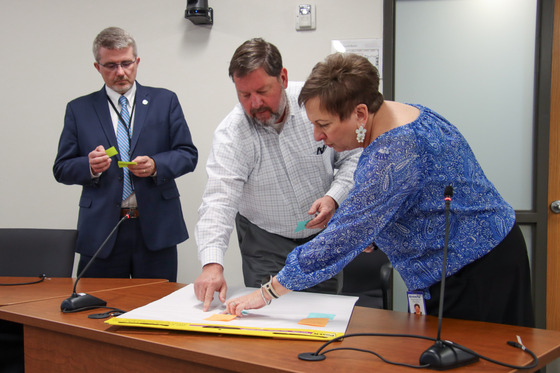
 Lu S. Young, right, a member of the Kentucky High School Transformation Work Group and Kentucky Board of Education vice chair, leads an activity where work group members sort through input they have received from education stakeholders and look for emerging themes. Jon Ballard, center, a member of the Kentucky Senate majority leadership staff, places a note on an emerging theme he noticed as Commissioner of Education Robbie Fletcher awaits his turn. Photo by Joe Ragusa, Kentucky Department of Education, April 8, 2026
(FRANKFORT, KY) – Members of the Kentucky High School Transformation Work Group met for their third meeting on April 8, where they discussed how districts can enhance their local assessment and accountability systems and continue to transform high school experiences.
The National Association of State Boards of Education (NASBE) invited the Kentucky Board of Education (KBE) to participate in its High School Transformation State Network, which builds the capacity of state boards to enable rich student experiences that foster content mastery and durable skills.
Work Group Chair Juston Pate, who also serves on the KBE, said the work group is focused on transforming high school experiences for Kentucky students through exploration of best practices and identification of barriers that may be impeding transformation.
“(We are) identifying ways of sharing best practices and connecting school districts to look at those barriers that exist,” Pate said. “Ultimately we are considering what policy implications could there be to either support the best practice of innovation or remove barriers to best practices and innovation,” he said.
Commissioner of Education Robbie Fletcher shared about the Kentucky Innovation Guide, a Kentucky Department of Education resource for districts and communities focused on personalized learning. He reviewed an element of the guide that details how local assessment and accountability innovation drives personalized education.
“The guide engages families and it celebrates what truly matters in education,” Fletcher said. “Unlike traditional high stakes summative tests used to rank schools and students, the guide provides information concerning personalized systems that emphasize timely ongoing feedback to guide learning and instruction.”
The guide also explains how districts can create their own portrait of a learner, a vision that outlines the essential skills, knowledge and dispositions that every student needs.
“We believe students are much more than a test score, and they should have opportunities to demonstrate learning beyond a multiple-choice test,” Fletcher said. “While an assessment and accountability system must include foundational components in reading and mathematics, it should also offer additional ways for students to show what they know, such as defenses of learning and portraits of a learner already underway in districts.”
Fletcher also updated work group members about House Bill 257, which has been signed by the governor. Sponsored by Rep. J.T. Payne, an assistant principal at the Henderson County Career and Technical Center, the bill encourages districts to work more closely with their communities to establish priorities for their schools and help ensure all students have access to vibrant learning experiences.
HB 257 was influenced by the work of the Kentucky United We Learn Council – an inclusive working group of students, educators, families, community members, legislators and other education stakeholders – that was tasked with reimagining what the Commonwealth’s assessment and accountability systems could look like. Fletcher said the bill divides assessment and accountability into state accountability measures that meet federal requirements and local accountability, which defines success for local districts.
KDE is also releasing a series of videos highlighting several districts’ efforts to reimagine local assessment and accountability in their schools. The videos document the work done by KDE, the Kentucky United We Learn Council and districts across the Commonwealth to explore new ways of incorporating vibrant learning experiences into the classroom while emphasizing collaboration with the community and innovation on approaching assessments.
Work group members watched the videos on local assessment and accountability innovation featuring Rockcastle County and Shelby County during their meeting. They learned how Rockcastle County uses a seven-pillar framework that focuses on student achievement, student readiness, student support, safety and wellbeing, community engagement and family partnership, professional learning and quality staff, fiscal systems and operational systems. They also learned how Shelby County includes their own portrait of a graduate, defenses of learning and a community dashboard in their approach to assessment and accountability.
KBE Vice Chair Lu S. Young, who also participates on the work group, asked the group to consider what “high school success” looks like in Kentucky and led members through a sorting activity to prioritize feedback about high school transformation. The datasets included input regarding barriers, best practices, and potential policies for reimagined high schools collected at the work group’s previous meeting, as well as input from Kentucky United We Learn Council members at their last meeting in January.
Young asked work group members to identify what surprised them about the feedback, what they want to know more about and what jumped out as the most pressing issue to transforming high schools
Following the sorting activity, Young said the work group’s review of high school transformation feedback clustered a handful of main topics including: how to push beyond the status quo; building and sustaining community trust; and building a system for vibrant learning for every learner.
Chris Sanders, executive director of the Office of Educational Programs at the Kentucky Education and Labor Cabinet, said he was surprised by the number of notes about needing more community trust to transform the high school experience and someone to lead that effort. He also said he would like to know more about why people brought up teacher training as a topic.
“I'd love to know more about some of the comments around the teacher training and preparation aspects,” Sanders said.
Jon Ballard, former superintendent of Elizabethtown Independent and current senior policy analyst for the Kentucky Senate Majority, said he found it surprising that one barrier to reimagined high schools included in the feedback was sparking innovation in credit systems and how credits toward high school graduation are awarded.
“(Standardized credit systems) seems to be the status quo, which was another one of the barriers I think that probably needs addressing is how do we how do we spark that innovation?” Ballard said.
Young said that current regulations allow for innovation in credit systems and that she believes more high schools could take advantage of it.
The next meeting of the work group will be June 3.
|