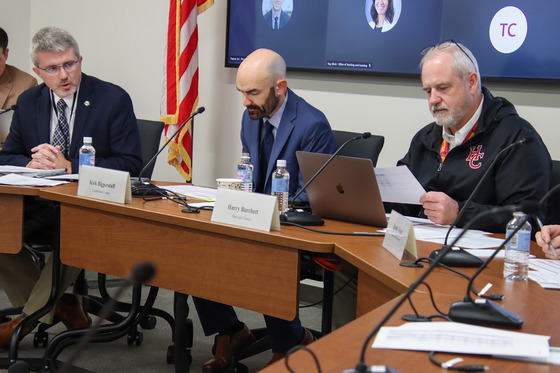
 Commissioner of Education Robbie Fletcher speaks with members of the Local Superintendents Advisory Council, including Cumberland County Superintendent Kirk Biggerstaff, middle, and Harrison County Superintendent Harry Burchett. Photo by Joe Ragusa, Kentucky Department of Education, Nov. 25, 2025
(FRANKFORT, KY) – Members of the Local Superintendents Advisory Council (LSAC) recommended approval of revisions to 702 KAR 3:130, regulations for internal accounting for school activity funds, during their meeting on Nov. 25.
As mandated by KRS 156.007, LSAC is charged to “advise the chief state school officer and the Kentucky Board of Education (KBE) concerning the development of administrative regulations and education policy.”
The regulations LSAC members recommended approval of are known as the Redbook, according to Kentucky Department of Education (KDE) Associate Commissioner Matt Ross. He said the last time the Redbook was updated was in 2019, before the COVID-19 pandemic and before a lot of societal changes to the use of technology.
“There are no real big changes; nothing real controversial, but I think there are some things in here that you’ll recognize as probably benefits; things that your districts do already, but now we’ve got a better way to account for them,” Ross said.
Ross and Steve Lyles, assistant director of KDE’s Division of District Support, explained that KDE convened a team of district finance officers to examine the regulations, take in the feedback from school leaders that has been received over the last several years and recommend changes.
Lyles said there were 31 changes in the recommended revisions, although several of them are minor in nature.
“Last time around, we made a lot of wholesale changes, but this is more just refining it, as Matt said, with the times,” Lyles said.
One of the changes involves ticketed events, such as athletic events and theater performances. Two people are required to take paper tickets at events and collect money – which Lyles emphasized is still required for events with paper tickets – but with electronic tickets where an event worker is simply scanning a ticket, only one person needs to be involved.
Another change involves big purchases made by external boosters and booster clubs, which are organizations made up of parents and other community members who help the school. Lyles pointed to an example of a booster purchasing a semi-trailer to haul band equipment around, and under current regulations, that property goes straight to the district and the district is responsible for maintenance. Under the proposed changes, the district may allow the booster club to maintain possession of the item and be responsible for maintaining it.
Other changes in the recommended revisions:
- Districts may move interest from school bank accounts into a district activity fund;
- School activity funds may now be used for library books or to cover damaged technology fees;
- School activity funds may be used to pay third parties who handle the hiring of referees and officials for athletic events;
- School activity funds may not be used for tickets to state athletic tournaments unless the school’s team is participating;
- District and school employees will not be allowed to use their personal accounts on Venmo, PayPal, Cash App or similar online payment platforms for anything tied to a school activity fund;
- Allowing districts to have a bank account for a school activity fund at the district level instead of just the school level;
- Any amount of money received over $250 must be deposited that day, increasing the limit from the previous rule of anything more than $100; and
- External booster clubs must provide monthly bank statements to principals of schools, if requested.
Special Education
LSAC members also recommended approval of revisions to 707 KAR 1:002 and 707 KAR 1:350 as it relates to special education placement decisions, including revisions to clarify how maximum class sizes should be determined.
KDE Associate Commissioner Gretta Hylton and KDE Division Director Carol Ann Morrison explained the changes. The revisions include a reference to KRS 157.360, which authorizes the commissioner of education to enforce special education maximum class sizes set by administrative regulations adopted by KBE.
Other revisions include adding a definition for special classes and clarifying how maximum class sizes should be determined when there are students from more than one disability category in a special class; in those situations, the district should use the disability category of the majority of the students in the special class to make decisions about class size.
The recommended changes also include revisions that align with the current waiver submission process outlined in KRS 156.161 and authorized by KRS 157.360, allowing superintendents or local school councils to request a waiver relating to maximum class sizes for special classes.
LSAC members also recommended approval of revisions to 704 KAR 3:370, the Kentucky framework for personnel evaluation, moving the required evaluation period from three years to five years in line with changes made by House Bill 48 (2025). The four regulations reviewed by LSAC will next be considered by the KBE at its meeting in December.
|