Spotlight on Oldham County: Aligning Professional Learning with High-Quality Instructional Resources
When Oldham County launched its district-wide effort to implement high-quality instructional resources (HQIRs) K-5 in English/Language Arts, leaders knew that deep, curriculum-based professional learning would be essential to ensuring success. Through intentional planning, cross-role collaboration, and ongoing feedback loops, the district created a coherent system to support teachers with meaningful professional learning tied directly to their instructional resources.
Shared Vision and Instructional Priorities
Before rolling out the new HQIRs, district leaders brought principals and coaches together to develop a shared framework for literacy instruction. Elizabeth Dant, Elementary Level Director said, “We had a vision statement and a framework that coaches and principals created together with the critical attributes for literacy instruction.”
With this shared vision in place, the district team developed specific success criteria aligned to each commitment. These criteria defined what successful implementation would look like and provided a clear way to measure progress. Throughout the year, district leaders monitored these indicators to ensure schools were on track and receiving the support they needed to implement their HQIRs effectively.
Elevate Conference: Grounding Professional Learning in the Resource
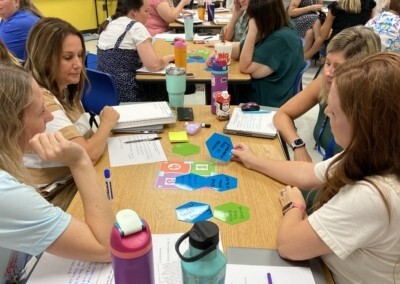
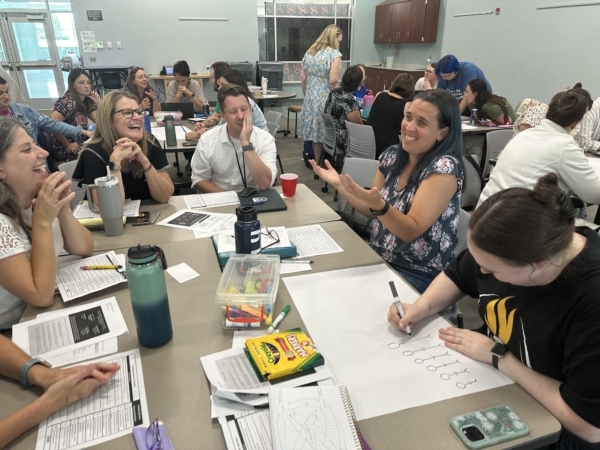
Together, the district team, principals and coaches determined four critical instructional strategies that all literacy instruction should be based on. These four strategies formed the foundation for a district-wide professional learning event: the Elevate Conference. All elementary teachers participated in sessions focused on the identified strategies, each one adapted to their specific HQIR.
“Every session was tailored to include their HQIR as the application in the session,” Sarah Whitt, Oldham County’s Instructional Support Coordinator said. “If it was about text-dependent questions, we tailored the session to include the text-dependent questions from that HQIR.”
The district was intentional about sequencing the learning. “We designed it to be the day before the HQIR vendor came in. Here’s what they’re going to talk about—close reading, text-dependent questions, text complexity—so teachers were ready to make connections,” Whitt described.
Coaches worked closely with vendors to ensure alignment. “The vendors definitely tailored their training to our district focus,” Whitt noted. “The coaches connected with the vendors ahead of time to ensure they were hitting on what we needed in order to ensure teachers felt supported and prepared to launch their HQIR.”
Implementation Supports for Leaders and Teachers
The district created a detailed implementation plan using KDE tools and resources from other states. “Sarah and I drafted it over the summer and then we got feedback from principals before school started,” Dant recalled. “We said, this is our roadmap. We’re not going to stick to it rigidly if we need to make adjustments.”
Throughout the year, principals and coaches met regularly. “We had principal meetings and coaches meetings on the same day,” Dant explained. “Then we would all meet together so when we were talking about HQIR work, everyone was hearing the same thing.”
The partnership between school leaders and instructional coaches was central to the effort. “I feel like the partnership with principals and coaches and keeping them all on the same page was critical,” Whitt emphasized.
Building PLC Leadership and Growing Teacher Capacity
To gradually release ownership to teachers, the district designed a structure to build PLC leadership. Coaches led the unit internalization protocol early on, with the goal of transitioning that responsibility to PLC leads. “That’s a work in progress,” Dant noted. “Some schools are in different places but all are working toward this goal.”
Each PLC lead participated in quarterly virtual meetings with others using the same HQIR. “They would meet virtually once a quarter to talk about successes, struggles, next steps, and what do you need?” Feedback from these meetings helped district leaders adapt professional learning and coaching support as needed.
As the year progressed, the district moved into a lesson study-inspired model. “The coaches identified one teacher who would teach a lesson, and the other PLC members would come to observe,” Whitt shared. “They didn’t need to be perfect; it was about learning together.”
The district encouraged honest reflection. “The coaches didn’t over-facilitate. They stepped out so the team could talk candidly, and we made sure there were no administrators present,” Dant explained. “They were pretty candid on their feedback forms, which was nice because we could then reflect on the feedback.”
Impact on Teachers and Students
Although some teachers were initially hesitant, feedback has been overwhelmingly positive. “I loved listening to the interviews of them saying, ‘This is so much better. My life is easier. The kids are enjoying it,’” Whitt said. “Some who struggled the most with shifting to HQIR were saying that at the end of the year.” New teachers also found value in having a strong curriculum. “There was a new teacher who said, ‘This is great. It was hard at first and I didn’t understand, but now I do.’”
Parents noticed the difference as well. “They’ve commented a lot. Some of the knowledge-building stuff is really interesting and unique. Kids haven’t learned about that yet,” Dant shared. “They loved that their child could come home and share stories.”
Schools also hosted literacy nights to help families understand the changes. The district team created a base slide deck for schools to use and then add to based on school specific needs. Students talked about their ELA year and shared their work with families.
Looking Forward: Writing, Internalization, and Sustainability
Based on ongoing teacher feedback, the district will focus on writing, lesson internalization and student work analysis protocols for the upcoming year. “We’re not district-wide on lesson internalization yet,” Whitt admitted. “Some PLCs use protocols to look at student work, but it varies. This is a goal for the upcoming school year.”
Through shared vision, aligned leadership, and responsive professional learning, Oldham County has created the conditions for meaningful instructional transformation. “It’s not about the resource; it’s about the teachers championing what they’re teaching and being excited about it,” Dant shared. “And having really great instructional practices to support it.”
Resource Spotlight: Support HQIR Implementation with Intellectual Preparation
The Kentucky Department of Education (KDE) Office of Teaching and Learning developed the Intellectual Preparation Guidance document to support effective implementation of a strong local curriculum anchored in high-quality instructional resources (HQIRs). Intellectual preparation is a foundational aspect of curriculum-based professional learning (CBPL) and refers to the process through which teachers work collaboratively to deepen understanding of the HQIR and develop content knowledge and pedagogical skill in order to provide high-quality instruction to all students.
The guidance document provides an overview of the four core processes that make up intellectual preparation, which include unit and lesson internalization, lesson rehearsal and student work analysis. For each core process, the guide also includes content-specific versions of protocols to support the work.
NEXT DEL Virtual Office Hours: Tuesday, October 14
The next DEL Virtual Office Hours will be held on Tuesday, October 14, from 9:30 A.M. ET/8:30 A.M. CT - 11 A.M. ET/10 A.M. CT. Voices from the Field will be shared by State Literacy Coaching Specialist Brittany Jones for the first thirty minutes, featuring Intellectual Preparation through Internalization. Intellectual preparation is key to deepening the instructional impact of a high-quality instructional resource. Through the lens of internalization, participants will explore how literacy leaders can thoughtfully engage teachers with content, anticipate student thinking and align instructional moves with learning goals. The remainder of the session will focus on learning, networking and problem-solving alongside fellow educators from across the state. Flexible breakout rooms will be available for targeted discussions based on participant needs.
To join, register for DEL Office Hours here.
Resources for Building Knowledge About Early Literacy and Supporting Evidence-Based Early Literacy Instruction in Kentucky
Literacy At a Glance Collection
Key Actions for Meeting the Needs of ALL K-3 Readers and Writers
K-3 Foundational Literacy Instructional Practice Guide
K-12 Comprehension in Reading/Writing Instructional Practice Guide
Don't Miss the Early Literacy Newsletter
Did someone share this newsletter with you? Sign up to receive the Early Literacy Newsletter each week.
Did you miss last week's Early Literacy Newsletter? You can access all previous editions of the newsletter on the Early Literacy webpage.
|