Strengthening the School Counselor/ Principal Relationship
When you think about dynamic duos, who comes to mind? Batman and Robin or Harry Potter and Hermione Granger? Or maybe Buzz and Woody pops into your mind or you instantly think of Lucy Ricardo and Ethel Mertz. We love dynamic duos because it takes some pressure off knowing that we do not have to do everything alone. We can find the Ying to our Yang to make magic happen!
In our careers, our dynamic duo is (or can be) our school principal. Hear me out on this. The school counselor–principal relationship is one of the most powerful partnerships in education. When principals and counselors work together with shared goals, schools see improvements in student achievement, climate and overall support systems. Principals bring the vision for the school, while counselors provide the tools and strategies to help students thrive academically, socially and emotionally.
Research consistently shows that when principals and counselors collaborate, schools are better equipped to address barriers and create environments where both students and staff feel supported.
So, as you reflect on your own dynamic duos, ask yourself: how strong is your school counselor–principal partnership? Are you both leaning into your strengths, supporting each other’s growth, and working in sync for the good of your students? Building this duo isn’t about dividing tasks—it’s about multiplying impact!
We will dive into this more at our first School Counselor Summit on Oct. 2! Make sure to see the registration information below.
In Service,
Michelle Sircy
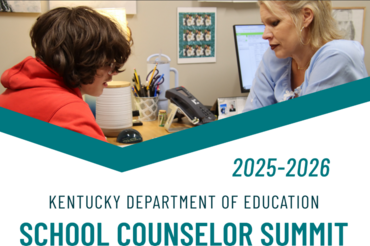
School Counselor Summit for 2025-2026
We are pleased to announce the dates for the upcoming 2025–2026 School Counselor Summits, designed intentionally with school counselors in mind.
The dates for the summits are Oct. 2, Dec. 4, Feb. 5 and June 4. All sessions are virtual, held from 9 a.m. to noon ET, and provide three Effective Instructional Leadership Act (EILA) hours for each summit you attend (following the completion of an evaluation).
This Year’s Theme: Living in the 60s
In Kentucky, legislation requires school counselors to spend 60% of their time on direct student services. But what does that look like in daily practice, especially for school counselors with high caseloads? How can you effectively achieve this benchmark and advocate for the time you need to meet student needs and the legislative requirement?
This year’s Summits will focus on:
-
Defining what qualifies as direct services
-
Practical strategies to meet the 60% requirement
-
Tools and approaches for advocating for your role and time
Mark your calendars and register now to ensure you don’t miss this valuable and timely professional development opportunity.
School Mental Health Professional Use of Time Report-Due Nov. 1, 2025
Per KRS 158.4416(3)(f), superintendents must report to the Kentucky Department of Education (KDE), no later than Nov. 1 of each year, the number of school-based mental health service providers, the position held, placement in the district, certification or licensure held, the source of funding for each position, a summary of the job duties and work undertaken by each school-based mental health service provider, and the approximate percent of time devoted to each duty over the course of the year.
At the link provided, there is a "Read Me First" tab which gives instructions on how to best complete this process. An instructional video has also been created to assist school districts in completing the Use of Time Survey. Please submit your spreadsheet to the Use of Time Survey Sharepoint site. For technical questions or assistance, please contact Leslie McKinney. If you require clarification or have any questions regarding the survey, please contact Michelle Sircy.  Kentucky Center on Trauma and Children
Staying Inside the Window of Tolerance: An Advanced Training on STS and Resilience
In this training, we will explore how working in schools where students and staff may be impacted by trauma can affect your own well-being. We will use the Window of Tolerance (WOT) framework to better understand regulation and dysregulation, and to consider practical strategies for widening your window of tolerance as an educator. Together, we will practice tools to help you recognize stress responses, stay grounded and maintain resilience in the face of secondary traumatic stress (STS).
This session will also highlight the role that schools and districts can play in supporting staff well-being. By strengthening both individual coping strategies and organizational practices, we can create learning environments that support educators as well as the students they serve. For additional information and to register, visit Inside the Window of Tolerance at the University of Kentucky Center of Trauma and Children.
|