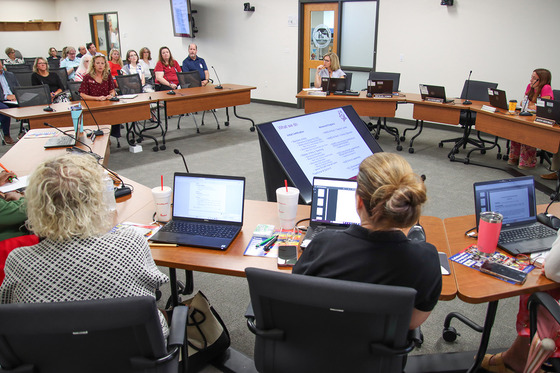
 Elizabeth Dinkins, dean of the Annsley Frazier Thornton School of Education at Bellarmine University in Louisville, makes a presentation about the university's educator preparation program to the Education Professional Standards Board. Photo by Joe Ragusa, Kentucky Department of Education, Aug. 19, 2025.
(FRANKFORT, KY) – The Education Professional Standards Board (EPSB) has added a new standing item to spotlight Kentucky’s educator preparation programs and highlight the innovative practices occurring within these programs across the commonwealth.
During the EPSB meeting on Aug. 19, Elizabeth Dinkins, dean of the Annsley Frazier Thornton School of Education at Bellarmine University in Louisville, served as the inaugural presenter.
“We are very mission motivated. We want educators who can teach and lead, and we really think about leading as a key component of that, because whether you're an initial certified teacher or you're a principal in training or you're a veteran teacher who's come back to build their capacity, you're leading,” she said.
Dinkins also explained the university’s efforts on literacy and numeracy. For literacy, Dinkins noted that university faculty completed the Language Essentials for Teachers of Reading and Spelling (LETRS) training and the university now has three literacy methods courses that are focused on building the content knowledge, the assessment knowledge and the pedagogy that new teachers need.
In numeracy, Bellarmine has been active in the statewide numeracy workgroup with other educator preparation program faculty members and has increased the focus on building elementary education majors’ content knowledge, pedagogical knowledge and sense of efficacy in mathematics.
Dinkins’ presentation focused on current key initiatives underway at Bellarmine including the development of partnerships to address the teacher shortage and ongoing efforts to provide continuous improvement for educators.
Bellarmine also plans to pursue ways to directly support the mentorship of new teachers and hopes to engage in a unit-wide examination of artificial intelligence in K-12 education.
“We are an incredibly collaborative state when it comes to (educator preparation programs), and so we are all unified in wanting to prepare the best teachers we can for Kentucky students,” Dinkins said. “And in that sense, we’re unified with (the EPSB) mission. So, I am looking forward to hearing what other (educator preparation programs) are doing.”
EPSB Vice Chair CJ Fryer also expressed his enthusiasm and appreciation for Kentucky’s educator preparation programs.
“I’m really, really excited to have (educator preparation programs) as a standing part of our meeting,” he said. “To all of our (Kentucky Association of Colleges for Teacher Education) friends and (educator preparation program leaders) in the room, just know how eternally grateful we are for you. Our profession does not exist without you all doing the incredible work you do.”
Occupation-Based Certification
Representatives from KDE’s Office of Career and Technical Education presented proposed changes to 16 KAR 2:020, the regulation for occupation-based career and technical education certification.
Lauren Graves, policy advisor in the KDE Office of Career and Technical Education, explained many of the amendments are for clarity, but the most significant changes involve efforts to address barriers for those seeking occupation-based certification following conversations with state lawmakers.
“Specific reference was made to three occupation areas, which is electricity, plumbing and HVAC,” Graves said. “It was provided that recruitment and retainment of these individuals, who are experts in their field but then required to obtain an associate’s degree to teach students knowledge and skills which they have demonstrated expertise in through their careers, was a challenge.”
The proposed amendments would allow individuals working in electricity, plumbing and HVAC who hold a current Kentucky-issued master license, earned through proper assessment, to no longer be required to hold or earn an associate degree to retain their teaching certificate. Graves said these specific educators will come into the profession as a Rank III, and if they choose to earn an associate degree in a relevant content area, they will be promoted to Rank II.
These educators will still be held to other requirements, including completion of the two-year New Teacher Institute program, a KDE initiative designed to provide professional support and training to those seeking occupation-based career and technical education teaching certification.
|