Countdown to Cohort 4: Register NOW for Kentucky Reading Academies LETRS Professional Learning
Registration for the fourth Language Essentials for Teachers of Reading and Spelling (LETRS) cohort of the Kentucky Reading Academies opened May 1, 2025, and will remain open through Aug. 22, 2025.
The Kentucky Department of Education (KDE) will continue the exciting partnership that brings the LETRS professional learning to educators across the Commonwealth, called the Kentucky Reading Academies. This course of study was chosen because of its demonstrated success on a national scale in bringing significant increases in literacy achievement.
The Kentucky Reading Academies is a comprehensive no-cost professional learning opportunity open to all K-5 public school educators. More than 6,000 Kentucky educators and administrators have participated or are currently participating in the LETRS professional learning opportunity.
Two different courses are being offered through the Kentucky Reading Academies: LETRS for Educators and LETRS for Administrators. Descriptions of each are following:
-
LETRS for Educators Cohort 4: This course is recommended for K-5 teachers, interventionists, reading specialists, instructional coaches and anyone providing reading instruction or intervention supports to early readers.
-
LETRS for Administrators Cohort 4: This course is recommended for instructional coaches who have completed LETRS for Educators, district leaders and building administrators.
Interested educators and administrators can register on the Kentucky Reading Academies webpage beginning May 1. Registrants will indicate which course they are enrolling in when completing the registration form.
PLEASE NOTE: Limited licenses are available for Cohort 4. Registration will be first come, first served. Once we reach capacity, registrants will be placed on a waitlist and invited as licenses become available. Registration does not guarantee enrollment into the professional learning. Registrants will receive an email from Christie Biggerstaff indicating their enrollment status mid to late August.
Also of note: Cohort 3 participants will not need to register for Cohort 4 as they are already enrolled in the professional learning.
Find out more about the Kentucky Reading Academies on the Kentucky Reading Academies webpage.
For questions about the Kentucky Reading Academies, please email KDE Director of Early Literacy Christie Biggerstaff.
District Spotlight: Redefining Learning: How JCPS is Aligning Vision and Resources to Transform Student Literacy
Jefferson County Public Schools (JCPS) is on a mission to transform what teaching and learning look like for every student. At the center of this work is Journey to Success, an initiative that goes beyond access to grade-level content and empowers students to actively engage in their learning, demonstrate their growth, and develop the skills to thrive as prepared and resilient learners, productive collaborators, emerging innovators, effective communicators, and globally and culturally competent citizens.
Through Journey to Success, JCPS envisions vibrant, student-centered experiences where learners show what they know in multiple ways; from painted essays and math discourse to formal defenses of learning in grades 5, 8, and 12. But turning that vision into reality requires aligned high-quality instructional materials, tools and systems that support teachers in bringing that kind of learning to life.
The district began its transformation with a focused effort on early literacy, recognizing that foundational skills are the gateway to long-term reading success. “This isn’t just about incremental improvement,” says Chief Academic Officer Terra Greenwell, Ed.D. “It’s about setting a strong, early foundation that will propel students’ literacy journey for years to come.”
As the district’s momentum grew, so did its commitment to knowledge-building using rich, grade-level text; strengthening adolescent literacy; building coherence across grade levels; and deepening professional learning for educators. To bring this vision to life, JCPS adopted KDE-approved high-quality instructional resources (HQIRs) for literacy across all K–12 classrooms, ensuring that the instructional resources are tightly aligned with the district’s strategic priorities and student-centered goals.
These resources were selected through a rigorous, collaborative process, including third-party vetting, school site-based decision-making consultations and input from a 50/50 stakeholder committee representing teachers, administrators, union leaders, and specialists from high-needs schools, ECE, and ML programs. Shauna Evans, Middle School ELA Specialist in JCPS says, “We were looking for a resource that was closely aligned with our systems and pillars - equity, student engagement and culture and climate.”
Professional Learning That Builds Capacity and Community
In order to build capacity and ensure success for their teachers, JCPS paired their HQIR adoption with robust curriculum-based professional learning systems. Teachers and leaders participated in two years of onboarding training focused on effective HQIR use. Academic coaches and administrators received regular professional learning, including walkthroughs with feedback aligned to use of their HQIR. Educators were also offered the opportunity to dive deep into the science of reading through the Kentucky Reading Academies LETRS training. LETRS participants were supported by stipends, peer communities, and visible leadership participation. Finally, the district introduced a three-part series on adolescent literacy and started the quarterly academies for continued educator development.
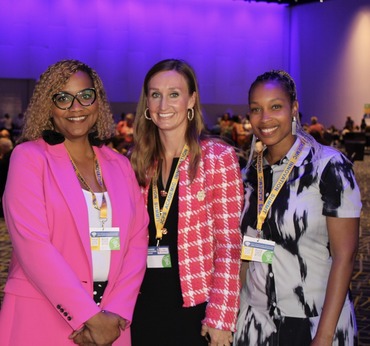 This year, the district is shifting ownership. Teachers and principals led summer trainings through the Academic Innovation Summit, with more than 3,000 educators registered to learn from peers who are successfully implementing the materials. Greenwell says, “Now, in year three, we've focused intensely on cultivating capacity and leadership within our teaching staff, empowering them to become the architects of this ongoing transformation. The recent 2025 Academic Innovation Summit served as a powerful testament to this, with nearly every session — from concept to delivery — led by our own talented classroom teachers and principals. This teacher-led professional development reflects a new level of confidence in the classroom, where educators are leveraging progress monitoring in truly meaningful ways to meet the diverse needs of their students.”
Student Empowerment
Schools are using Journey to Success as a framework to empower students to reflect on and showcase their learning. A shared rubric for determining high-quality student artifacts of learning supports both teacher coherence and student ownership, reinforcing that learning is not just about mastering content—it’s about applying knowledge in meaningful ways. By intentionally selecting high-quality instructional resources (HQIRs) that naturally support artifact creation, the district ensures that learning is both rigorous and relevant, with students actively owning and sharing their learning journeys.
Joy Billops, Principal at Greenwood Elementary says, “The implementation of the early literacy work was a natural extension of our Journey to Success mission. The literacy HQIR gave us a concrete, research-based framework to bring that mission to life in classrooms every single day. Students are not only learning content, but also they are learning how to learn, how to reflect, how to lead, and how to persevere. High quality literacy resources and Journey to Success work hand in hand to create a learning environment where all students can find purpose, voice and a path forward.”
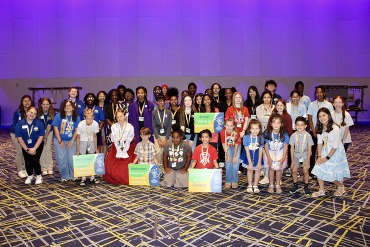 During the Academic Innovation Summit, the district included a student artifact gallery. Evans says her favorite part was seeing how students are connecting their learning to their local community and current events. She said, “Our students really latched on to the Harlem Renaissance unit and recognized that the themes in the Harlem Renaissance are relevant to our lives now. One student took a Langston Hughes poem about rivers and expanded on the importance of rivers in our city, and the importance of a journey, the importance of having hope, no matter what the situation is. This curriculum has really impacted them as students, and it has been absolutely wonderful to see.”
By selecting HQIRs aligned to a bold student-centered local vision, JCPS is increasing access to grade-level learning and creating the conditions for authentic, empowered learning experiences that will carry students beyond the classroom.
Billops says, “Our students have learned to LOVE reading! They see themselves as researchers, writers and experts in their topics. Student work lines the halls of our building - writing that shows real growth and pride. The literacy work in JCPS has truly changed our school for the better. It has reignited a passion in teachers, empowered our students and created a culture where deep learning and high expectations are becoming the norm.”
Early Literacy Resource Highlights:
As you prepare for the 2025-2026 school year, we are highlighting key resources for early literacy instruction in your district and school. Take time to explore the following resources and share them with others that could benefit, as well.
Text-Based Writing Across Disciplines may Support Teachers in Connecting Reading and Writing Instruction when Implementing HQIRs
Text-Based Writing Across Disciplines intends to show more precisely how to ensure opportunities for students to engage in discipline-specific literacies or learning that uses reading and writing skills specific to each field to teach content knowledge, demonstrate content knowledge and publish learning. Text-based writing grounds students in complex, grade-level texts, or “anything that communicates a message” (Interdisciplinary Literacy Practice 1), meaning that students engage with a wide range of multimodal texts across disciplines and grade levels.
This resource includes 40 text-based writing tasks that engage K-12 students in responding to a variety of texts as disciplinary experts do. Use Text-Based Writing Across Disciplines to support the implementation of existing High-Quality Instructional Resources (HQIRs). The tasks should not replace adopted HQIR but should serve to supplement instruction towards the full depth and rigor of the Kentucky Academic Standards.
See the Text-Based Writing Across Disciplines webpage for samples in:
- Writing to Learn,
- Writing to Demonstrate Learning and
- Writing for Publication.
Samples are available for:
- Reading and writing,
- Mathematics,
- Social studies,
- Science and
- Visual/performing arts.
ICYMI: Early Literacy Assessment Flowchart
The Early Literacy Assessment Flowchart is designed to help educators navigate the who, what, when and why of early literacy assessments. This comprehensive tool guides educators through the process of assessing students' literacy development, ensuring students receive the appropriate interventions and support at the right time.
Don't Miss the Early Literacy Newsletter
Did someone share this newsletter with you? Sign up to receive the Early Literacy Newsletter each week.
Did you miss last week's Early Literacy Newsletter? You can access all previous editions of the newsletter on the Early Literacy webpage.
|