Bright Spot: Third Grade Students at Flat Lick Elementary are More Engaged in Their Learning and Taking Ownership
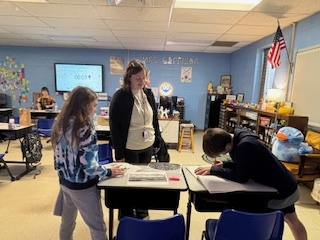 This spring, Mrs. Garrison’s third grade class at Flat Lick Elementary in Knox County, kicked off a study of the earliest known residents of North America with an engaging gallery walk to spark curiosity and initial student interest, also referred to as priming for learning. The unit is part of the high-quality instructional resource (HQIR) Core Knowledge Language Arts (CKLA) adopted by the district in 2024. The gallery walk allowed students to examine and make predictions about artifacts representing different Native American tribes.
Mrs. Garrison has noticed her students’ interest in learning growing all year, and this experience was no different. The eagerness her students showed for learning more after the gallery walk was the most she had ever witnessed.
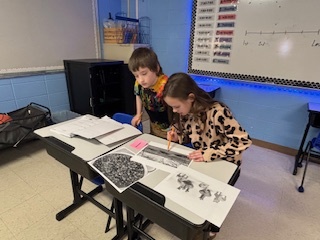 By incorporating total participation techniques like "Turn and Talk" and "Think-Pair-Share," Mrs. Garrison fostered a positive learning climate where all students confidently engaged in discussions, allowing them to experience deeper learning. “Where some once saw being called on as a punishment, they now feel excited to share,” she noted. These strategies have not only increased participation but also have allowed her to introduce higher-order questioning.
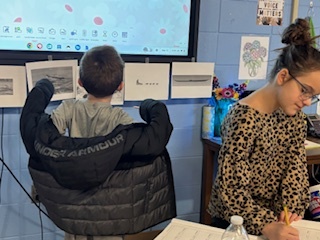 Garrison expressed her students are taking greater ownership of their learning—embracing challenges, sharing insights and showing pride in their work. As Mrs. Garrison reflected, "With many of the artifacts being things we still use today, students enjoyed getting to see where the objects came from as well as the people who brought them to North America. Getting a small glimpse into the earliest known settlers has piqued their interest into how they lived once they arrived, how they adjusted to different environments, how tribes were formed with other people who shared similar languages, customs, beliefs and traditions, etc."
Increased engagement and ownership of learning reflect what we want for all Kentucky students. The instructional process Mrs. Garrison used during this unit aligns with the core principles from learning science which include essential deeper learning components that are necessary for vibrant learning. HQIR implementation can support teachers in integrating deeper learning as it is embedded within the HQIR, strengthening Tier 1 instruction. For more information, a series of modules is available to help educators make sense of Integrating Deeper Learning and HQIR.
Registration Now Open for Kentucky’s Read to Succeed Summer Conference
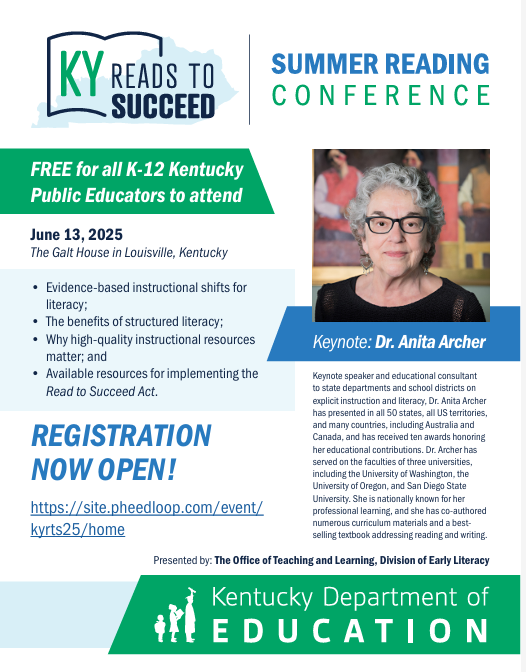 The Kentucky Department of Education (KDE) Office of Teaching and Learning (OTL) Division of Early Literacy invites you to register for the second annual Kentucky Reads to Succeed Summer Conference on June 13, 2025, at The Galt House in Louisville, Kentucky.
Keynote speaker and educational consultant to state departments and school districts on explicit instruction and literacy, Dr. Anita Archer has presented in all 50 states, all US territories, and many countries, including Australia and Canada, and has received ten awards honoring her educational contributions. Dr. Archer has served on the faculties of three universities, including the University of Washington, the University of Oregon, and San Diego State University. She is nationally known for her professional learning, and she has co-authored numerous curriculum materials and a best-selling textbook addressing reading and writing.
The conference, which will require registration but will be FREE to Kentucky K-12 public educators, will offer focused learning pathways to meet the needs of teachers and administrators. Attendees will learn from KDE Office of Teaching and Learning consultants and partners about:
- Evidence-based instructional shifts for literacy;
- The benefits of structured literacy;
- Why high-quality instructional resources matter; and
- Available resources for implementing the Read to Succeed Act.
Mark your calendar for this June 13 event!
UNCOVERING THE TRUTHS THAT DRIVE THE “KEY ACTIONS”
Common Misconception: Leveled texts are the best texts for increasing reading comprehension and should be used during small groups.
Have you been told that leveled texts are the key to small group reading success? While they are often used to support students at different stages of reading development, they do not necessarily provide the best opportunities for decoding practice or comprehension growth.
The truth is, the instructional activities for small group instruction and the materials and texts used should match students' learning goals as determined by diagnostic and curriculum-based assessments. When small group instruction is focused on foundational skills, decodable or connected text aligned to skills that have already been taught is required (Foorman et al., 2016). When the focus is on development of language comprehension, grade level complex text is the optimal choice. High quality reading and writing instructional resources grounded in structured literacy and aligned to the Kentucky Academic Standards (KAS) for Reading and Writing are recommended as these resources are designed to ensure all students have access to grade-level appropriate, complex text as well as explicit and systematic foundational skills instruction (KDE, 2019).
Leveled texts do not offer opportunities for applied practice with foundational skills such as decoding (Moats, 2020; Moats & Tolman, 2009). Non-decodable, “predictable” leveled texts encourage guessing based on context or the beginning letters of a word or illustrations rather than phonetically decoding the entire word (Moats & Tolman, 2009; Seidenberg, 2017). This impedes reading development. Additionally, neither leveled nor decodable text are optimal for comprehension growth. Generally, neither are sources of academic language or knowledge building. Thus, the simplistic structure and word choice do not necessitate a natural use of comprehension strategies, nor do they include strong examples of elements such as theme, character development, reasons and evidence to support a claim, etc.
Leveled text, however, may be an effective choice when the purpose is to build students’ knowledge about a topic. Once students have reached Ehri’s consolidated phase, which happens typically sometime in grade two, leveled text could be a choice for independent reading practice as long as students are not limited to selecting texts within a specific level.
To learn about other common misconceptions that may have led to ineffective literacy practices and how to shift to evidence-based structured literacy practices, see Key Actions for Meeting the Needs of ALL K-3 Readers and Writers.
Don't Miss the Early Literacy Newsletter
Did someone share this newsletter with you? Sign up to receive the Early Literacy Newsletter each week.
Did you miss last week's Early Literacy Newsletter? You can access all previous editions of the newsletter on the Early Literacy webpage.
|