Registration Now Open for Kentucky’s Read to Succeed Summer Conference
 The Kentucky Department of Education (KDE) Office of Teaching and Learning (OTL) Division of Early Literacy invites you to register for the second annual Kentucky Reads to Succeed Summer Conference on June 13, 2025, at The Galt House in Louisville, Kentucky.
Keynote speaker and educational consultant to state departments and school districts on explicit instruction and literacy, Dr. Anita Archer has presented in all 50 states, all US territories, and many countries, including Australia and Canada, and has received ten awards honoring her educational contributions. Dr. Archer has served on the faculties of three universities, including the University of Washington, the University of Oregon, and San Diego State University. She is nationally known for her professional learning, and she has co-authored numerous curriculum materials and a best-selling textbook addressing reading and writing.
The conference, which will require registration but will be FREE to Kentucky K-12 public educators, will offer focused learning pathways to meet the needs of teachers and administrators. Attendees will learn from KDE Office of Teaching and Learning consultants and partners about:
- Evidence-based instructional shifts for literacy;
- The benefits of structured literacy;
- Why high-quality instructional resources matter; and
- Available resources for implementing the Read to Succeed Act.
Mark your calendar for this June 13 event, and please stay tuned for registration information coming soon.
UNCOVERING THE TRUTHS THAT DRIVE THE “KEY ACTIONS”
Common Misconception: When the Kentucky Academic Standards (KAS) reference grade-level appropriate texts, it is referring to a certain Lexile level or the student’s “instructional level.”
Have you been determining what books a student gets to read based on their “instructional reading level” or Lexile level? While it may seem logical to match students with texts they can mostly read on their own but that will require teacher support to accurately decode and understand, the KAS for Reading and Writing emphasize the importance of engaging with grade-level appropriate, complex texts—regardless of a student’s current decoding ability.
The truth is, Lexile level refers to the quantitative complexity of a text, but it does not indicate a text’s full complexity nor grade-level appropriateness. A student’s “instructional level” may or may not reflect grade-level appropriate complexity. Grade-level appropriateness is determined using a combination of quantitative and qualitative measures and requires reader and task considerations. Implementing a high-quality reading and writing instructional resource grounded in structured literacy and aligned to the KAS for Reading and Writing is recommended as these resources include texts that have been measured for quantitative and qualitative complexity appropriate for the grade level. These resources also include accompanying tasks designed to scaffold instruction, providing ample opportunities for all students to engage in comprehension and analysis of grade-level appropriate, complex text. Restricting students to reading and interacting with texts only on their “instructional level” may prohibit progress of overall reading development.
Regardless of a student’s “instructional reading level,” the use of complex grade-appropriate texts and purposeful building of academic vocabulary is non-negotiable. Scaffolding reading instruction is key to preparing students to read independently and proficiently by the end of the school year and, ultimately, by the end of grade three.
When a student is unable to read grade-level appropriate texts independently and proficiently, grade level comprehension is still the goal. Students unable to decode grade-level appropriate text independently and proficiently must still engage in comprehension and analysis of grade-level texts, and, therefore, may require a scaffolded approach. Read-alouds, assistive technology or other means may be necessary while the student receives targeted instruction to strengthen decoding skills, which may include the use of decodable text to practice those skills and develop fluency.
Whatever the case, foundational reading skills must be taught while also offering equitable access to grade-level appropriate, complex texts, which high-quality instructional resources (HQIRs) provide (sometimes referred to as the listening, read aloud, comprehension or knowledge portion). The Quantitative and Qualitative Analysis module is available for those seeking more information about text complexity (Foorman et al., 2016)
To learn about other common misconceptions that may have led to ineffective literacy practices and how to shift to evidence-based structured literacy practices, see Key Actions for Meeting the Needs of ALL K-3 Readers and Writers.
ICYMI: New Resources Available
Master Schedule Resource: It’s about time! Understanding the importance of the master schedule in improving literacy outcomes
Would you agree time is one of the most valuable resources in education, yet it’s often overlooked as a driver of change? Dr. Ashley Hill, Assistant Director of Early Literacy for the Office of Teaching and Learning’s Division of Early Literacy (DEL), explored how intentional scheduling can transform literacy outcomes and create conditions for teacher and student success in her recent EdCamp 2025 presentation. You can view the recording and access the slide deck to learn more about how time can work for your school.
Early Literacy Assessment Flowchart
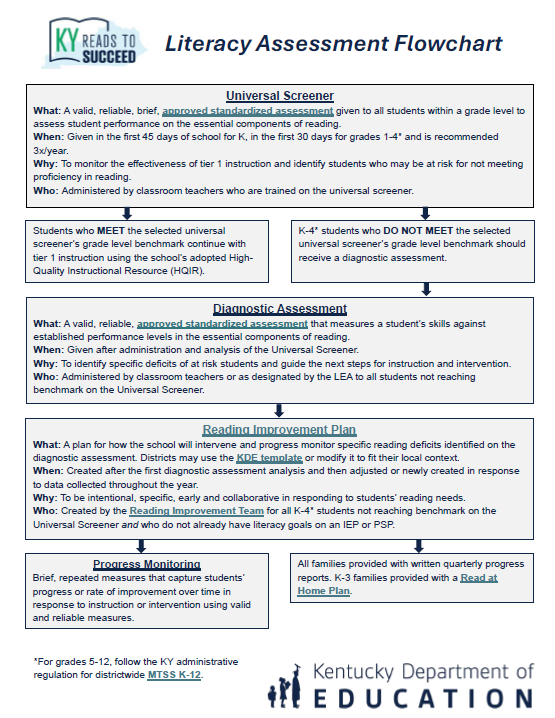 The Early Literacy Assessment Flowchart is a new resource designed to help educators navigate the who, what, when and why of early literacy assessments. This comprehensive tool guides educators through the process of assessing students' literacy development, ensuring students receive the appropriate interventions and support at the right time.
The flowchart outlines the sequence for administering assessments and helps educators identify the next steps in the assessment process. Additionally, the flowchart includes embedded links to related Kentucky Department of Education (KDE) resources, offering quick access to materials and additional support to enhance understanding of the assessment process.
This valuable resource supports data-driven decision-making and targeted interventions, ultimately helping all students achieve literacy success.
Don't Miss the Early Literacy Newsletter
Did someone share this newsletter with you? Sign up to receive the Early Literacy Newsletter each week.
Did you miss last week's Early Literacy Newsletter? You can access all previous editions of the newsletter on the Early Literacy webpage.
|