Bright Spot: Teachers at Lebanon Elementary Say They've Gone from Overwhelmed About Teaching Reading to Thriving
Lebanon Elementary School (LES) in Marion County, KY, is in its first year of implementing the Core Knowledge Language Arts (CKLA) Listening and Learning Strand for grades K-3, emphasizing language comprehension through engaging, content-rich read-alouds.
Teachers at LES are seeing increased student engagement and deeper connections between content and real-world experiences. Students are demonstrating growth through knowledge-based discussions, higher-order questioning, and cross-curricular integration with science and social studies. CKLA’s structured, research-based framework has provided teachers with what they say they need to transform literacy instruction, equipping students with essential skills for long-term success.
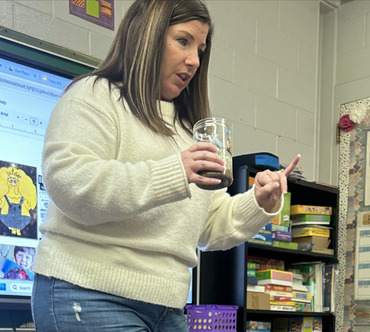 Misty Kehm, Kindergarten Teacher
2nd-grade teacher Paula Watson notes, "Using CKLA's high-quality instructional materials has transformed my teaching by allowing students to engage more deeply with the standards. These resources have made content more accessible and understandable for all learners, leading to stronger learning outcomes. My students actively engage each day, building valuable knowledge that sticks."
Misty Kehm, a Kindergarten teacher, reflects on the program's impact in her second year of teaching: "My first year was spent scrambling for resources and creating assessments, but CKLA provides everything I need—rigorous vocabulary, thought-provoking questions, and engaging content. My kindergarteners have made incredible connections to real life, pointing out deciduous trees at recess and discussing seasonal changes. Culminating activities like a pop-up petting zoo and Olympic Day have meaningfully reinforced their learning. I can’t express enough how much of a lifesaver CKLA has been!"
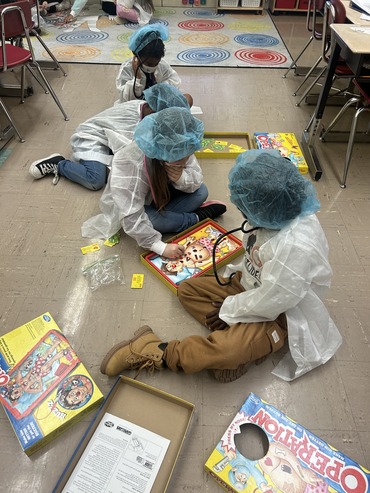 Students in Lisa Alford's 1st-grade class
3rd-grade teacher Lena Murphy appreciates the structured support CKLA provides. Murphy says, "Using a high-quality instructional resource has given me rigorous lessons that ensure both engagement and alignment with standards. CKLA includes strong vocabulary, higher-order thinking questions, writing activities, and built-in assessments. With everything at my fingertips, I can focus on delivering effective, high-quality instruction without the added stress of planning from scratch."
Karyn Spalding, a 1st-grade teacher, shares how CKLA has rejuvenated her teaching. "CKLA has given my teaching a renewed sense of purpose. It clearly defines my role as a facilitator, helping me build students’ knowledge, vocabulary, and reading abilities in an engaging way. The cross-curricular content seamlessly integrates science and social studies, enriching my instruction. Most importantly, it has reignited a joy for reading in my classroom—my students look forward to every lesson!"
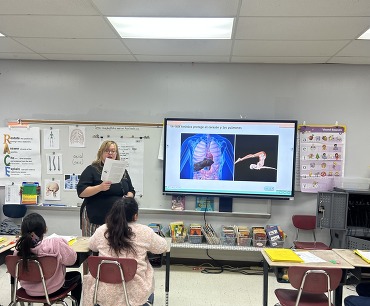 Kindergarten teacher Santana Alvarez adds, "For years, teaching reading felt overwhelming—piecing together stories, questions, and activities from various sources. Since implementing CKLA, that stress has disappeared. My students are captivated by the stories, and their listening comprehension has skyrocketed. The comprehension questions encourage critical thinking and meaningful discussions, while turn-and-talk activities help my kindergarteners build communication skills and confidence in expressing their ideas. It truly provides everything I need to deliver high-quality, effective instruction. The structured lessons, engaging content and embedded assessments have made planning seamless. My students thrive on the routine and depth of learning, allowing me to focus more on supporting their growth rather than searching for resources. This curriculum has truly elevated my teaching and my students' learning experiences."
The implementation of CKLA at Lebanon Elementary School has proven to be a transformative experience for both educators and students. The use of this HQIR has not only enhanced literacy instruction but also fostered deeper connections between classroom learning and the real world. Teachers across all grade levels have expressed how the resource has allowed them to streamline their lesson preparation and strengthened student engagement. Evidence of these instructional improvements is visible in the data. Kindergarten classrooms are consistently seeing 80% or more of their students achieving mastery on the CKLA domain assessments. Vocabulary has also increased throughout the year on both domain assessments and district screenings compared to last year for all of K-2 from fall to winter.
Registration Now Open for Kentucky’s Read to Succeed Summer Conference
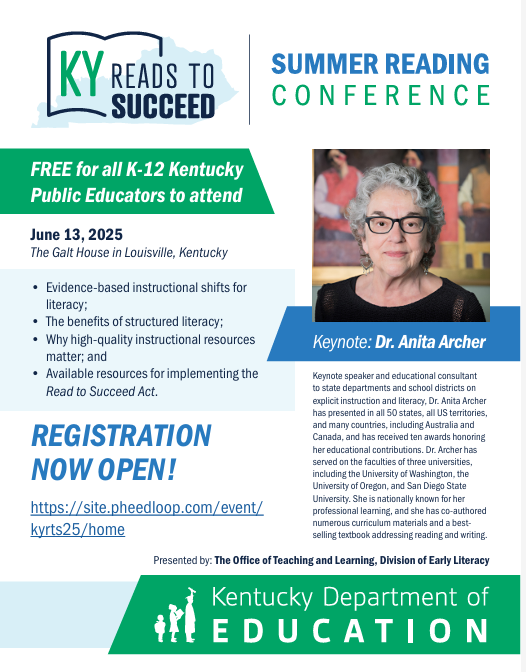 The Kentucky Department of Education (KDE) Office of Teaching and Learning (OTL) Division of Early Literacy invites you to register for the second annual Kentucky Reads to Succeed Summer Conference on June 13, 2025, at The Galt House in Louisville, Kentucky.
Keynote speaker and educational consultant to state departments and school districts on explicit instruction and literacy, Dr. Anita Archer has presented in all 50 states, all US territories, and many countries, including Australia and Canada, and has received ten awards honoring her educational contributions. Dr. Archer has served on the faculties of three universities, including the University of Washington, the University of Oregon, and San Diego State University. She is nationally known for her professional learning, and she has co-authored numerous curriculum materials and a best-selling textbook addressing reading and writing.
The conference, which will require registration but will be FREE to Kentucky K-12 public educators, will offer focused learning pathways to meet the needs of teachers and administrators. Attendees will learn from KDE Office of Teaching and Learning consultants and partners about:
- Evidence-based instructional shifts for literacy;
- The benefits of structured literacy;
- Why high-quality instructional resources matter; and
- Available resources for implementing the Read to Succeed Act.
Mark your calendar for this June 13 event, and please stay tuned for registration information coming soon.
UNCOVERING THE TRUTHS THAT DRIVE THE “KEY ACTIONS”
Common Misconception: Comprehension instruction is about the strategy we’re practicing, not the content of the particular text we’re reading.
Have you ever spent weeks focusing on a single comprehension strategy, hoping it would help students become better readers? While strategies like “visualizing” or “questioning” can support comprehension, research shows that true reading growth happens when students build knowledge by reading, discussing and analyzing complex texts.
The truth is, spending weeks at a time on learning about and practicing a comprehension strategy, such as "asking questions" or "making inferences," was once considered the most effective approach to teaching students how to make sense of text. Currently, the understanding is that dedicating extended periods of time to building knowledge about a particular topic is more beneficial for increasing reading comprehension (Catts & Kamhi, 2017; Fordham Institute, 2016; Lesaux & Harris, 2015; Wexler, 2019).
When students engage with complex texts through reading and discussion, comprehension abilities grow (Fordham Institute, 2016). Comprehension abilities grow when students engage with reading, discussing and understanding complex texts. Students must have opportunities to build knowledge and language comprehension by interacting with complex text (Wexler, 2019). Using text sets that build knowledge about a shared topic can build students' surface and conceptual knowledge.
In Kentucky, text sets include a range of types of complex text as Interdisciplinary Literacy Practice 1 states, “Text is anything that communicates a message (KDE, 2019).” Text sets contain print, such as articles, stories, poems, letters, lyrics, speeches or billboards, and may also include non-print text, such as artwork, graphics or sculptures. Importantly, text sets put texts and the rich world of ideas within them- at the center of instruction (Catts & Kamhi, 2017; Fordham Institute, 2016; Lesaux & Harris, 2015; Wexler, 2019). The focus is not for students to demonstrate mastery of isolated comprehension strategies, but for students to understand the text and build their knowledge (Wexler, 2019).
One way this is achieved is when teachers model reading for meaning (through intentional thinking aloud) in a variety of texts and in a variety of ways, equipping students to use comprehension strategies flexibly and as a means to understand what they read, thus building their knowledge (Catts & Kamhi, 2017; Fordham Institute, 2016; Lesaux & Harris, 2015). This approach abandons spending weeks at a time learning about and practicing "asking questions" or "making inferences" and focuses on spending weeks at a time learning about topics such as fairy tales and tall tales or civil rights and equality, for example. Instead, reading skills and strategies are taught and practiced in tandem with each other to make meaning and deepen students’ understanding (Catts & Kamhi, 2017; Fordham Institute, 2016; Lesaux & Harris, 2015; Wexler, 2019).
To learn about other common misconceptions that may have led to ineffective literacy practices and how to shift to evidence-based structured literacy practices, see Key Actions for Meeting the Needs of ALL K-3 Readers and Writers.
ICYMI: New Resources Available
Master Schedule Resource: It’s about time! Understanding the importance of the master schedule in improving literacy outcomes
Would you agree time is one of the most valuable resources in education, yet it’s often overlooked as a driver of change? Dr. Ashley Hill, Assistant Director of Early Literacy for the Office of Teaching and Learning’s Division of Early Literacy (DEL), explored how intentional scheduling can transform literacy outcomes and create conditions for teacher and student success in her recent EdCamp 2025 presentation. You can view the recording and access the slide deck to learn more about how time can work for your school.
Early Literacy Assessment Flowchart
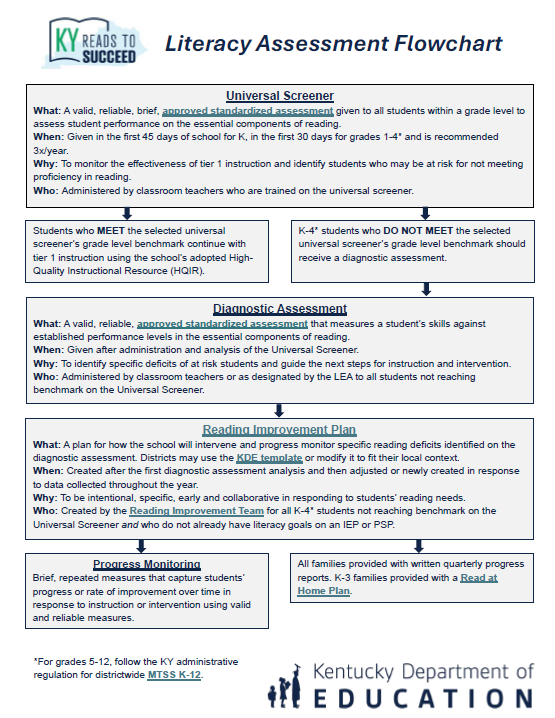 The Early Literacy Assessment Flowchart is a new resource designed to help educators navigate the who, what, when and why of early literacy assessments. This comprehensive tool guides educators through the process of assessing students' literacy development, ensuring students receive the appropriate interventions and support at the right time.
The flowchart outlines the sequence for administering assessments and helps educators identify the next steps in the assessment process. Additionally, the flowchart includes embedded links to related Kentucky Department of Education (KDE) resources, offering quick access to materials and additional support to enhance understanding of the assessment process.
This valuable resource supports data-driven decision-making and targeted interventions, ultimately helping all students achieve literacy success.
Kentucky Reading Academies: Cohort 4 of LETRS Professional Learning COMING SOON!
The Kentucky Department of Education (KDE) has an exciting partnership that brings the LETRS professional learning to educators across the Commonwealth, called the Kentucky Reading Academies. Through LETRS, teachers gain essential knowledge to master the fundamentals of literacy instruction required to transform student learning and create a more vibrant experience for each and every young reader.
The Kentucky Reading Academies LETRS training is a comprehensive no-cost professional learning opportunity open to all K-5 public school educators.
Two different courses are being offered through the Kentucky Reading Academies: LETRS for Educators and LETRS for Administrators. Interested educators can join the Kentucky Reading Academies for the course that pertains to their role:
-
LETRS for Educators Cohort 4: This course is recommended for K-5 teachers, interventionists, reading specialists, instructional coaches and anyone providing reading instruction or intervention supports to early readers.
-
LETRS for Administrators Cohort 4: This course is recommended for instructional coaches who have completed LETRS for Educators, district leaders and building administrators.
More than 4,000 Kentucky educators and administrators are completing the LETRS professional learning. Participants in both cohorts have stated that LETRS is a comprehensive professional learning that is enlightening, eye opening and life changing.
Find out more about the Kentucky Reading Academies on the Kentucky Reading Academies webpage. More information about Cohort 4 of LETRS professional learning will be available soon.
For questions about the Kentucky Reading Academies, please email KDE Director of Early Literacy Christie Biggerstaff.
Don't Miss the Early Literacy Newsletter
Did someone share this newsletter with you? Sign up to receive the Early Literacy Newsletter each week.
Did you miss last week's Early Literacy Newsletter? You can access all previous editions of the newsletter on the Early Literacy webpage.
|