UNCOVERING THE TRUTHS THAT DRIVE THE “KEY ACTIONS”
Common Misconception: Spelling words should be thematically related.
Have you been in the practice of developing spelling lists connected to a theme or topic? Some believe that grouping words by topic helps students remember and spell them, but research shows that phonetic spelling instruction is far more beneficial for developing strong readers and writers.
The truth is, the common alternative to generic weekly spelling lists, often based on a theme or topic, misses the opportunity to accelerate phonics learning and promotes rote memorization. Spelling (encoding) instruction and decoding instruction should be integrated and aligned to a shared scope and sequence because decoding and encoding derive from a similar set of phonological and phonics skills. However, it is important to note that the ability to decode some letter patterns happens sooner than the ability to encode the same pattern. Observing students’ encoding can reveal both phonological awareness needs and unmastered phonics skills related to spelling, giving teachers useful and specific information about how to support students.
Practicing phonetic spelling also supports development of sight vocabulary through orthographic mapping or matching of letters and letter sequences to sounds of the spoken word (Foorman et al., 2016).
Example: Themed spelling lists are typically words related to a subject or theme and do not follow sound/spelling patterns (e.g. ball, football, basketball, soccer, hockey). Phonological spelling lists allow students to focus on a certain sound/spelling pattern and then apply that practice to words that have the particular pattern (e.g. feet, green, keep, need, see).
To learn about other common misconceptions that may have led to ineffective literacy practices and how to shift to evidence-based structured literacy practices, see Key Actions for Meeting the Needs of ALL K-3 Readers and Writers.
2025 Approved K-12 High-Quality Instructional Resources for Reading/Writing and Mathematics
The Kentucky Department of Education (KDE) has released approved lists of K-12 high-quality instructional resources (HQIRs) for reading and writing and mathematics, focusing on Tier 1 core comprehensive resources. A core comprehensive instructional resource is one that serves as the primary means of instruction in a content area for a grade level or course. These lists are designed to assist superintendents in navigating the complex marketplace of educational resources. Kentucky law, specifically KRS 160.345, places the authority for developing local curriculum, including the selection of instructional materials, with local superintendents, following appropriate consultation.
To aid in the evaluation and selection process, the KDE has released the Model Curriculum Framework’s Curriculum Development Process and Instructional Resource Consumer Guides for reading and writing and mathematics. The guidance recommends utilizing EdReports.org, an independent nonprofit that provides free reviews of instructional materials that draw upon expert educators, as a starting point for local review teams to research available evidence-based materials.
While all materials on the approved lists meet the KDE standards for HQIRs and have been informed by feedback from the Quality Curriculum Taskforce, districts are encouraged to conduct thorough local reviews to ensure that selected materials align with their specific needs and the local instructional vision. Off-list notification is still protected and allowable per KRS 156.445.
More information about the approved reading/writing and mathematics lists can be found on KDE’s Instructional Resources webpage.
Kentucky Reading Academies: Cohort 4 of LETRS Professional Learning COMING SOON!
The Kentucky Department of Education (KDE) has an exciting partnership that brings the LETRS professional learning to educators across the Commonwealth, called the Kentucky Reading Academies. Through LETRS, teachers gain essential knowledge to master the fundamentals of literacy instruction required to transform student learning and create a more vibrant experience for each and every young reader.
The Kentucky Reading Academies LETRS training is a comprehensive no-cost professional learning opportunity open to all K-5 public school educators.
Two different courses are being offered through the Kentucky Reading Academies: LETRS for Educators and LETRS for Administrators. Interested educators can join the Kentucky Reading Academies for the course that pertains to their role:
-
LETRS for Educators Cohort 4: This course is recommended for K-5 teachers, interventionists, reading specialists, instructional coaches and anyone providing reading instruction or intervention supports to early readers.
-
LETRS for Administrators Cohort 4: This course is recommended for instructional coaches who have completed LETRS for Educators, district leaders and building administrators.
More than 4,000 Kentucky educators and administrators are completing the LETRS professional learning. Participants in both cohorts have stated that LETRS is a comprehensive professional learning that is enlightening, eye opening and life changing.
Find out more about the Kentucky Reading Academies on the Kentucky Reading Academies webpage. More information about Cohort 4 of LETRS professional learning will be available soon.
For questions about the Kentucky Reading Academies, please email KDE Director of Early Literacy Christie Biggerstaff.
Call for Vendors: Join the KY Reads to Succeed Conference
The Kentucky Department of Education Division of Early Literacy announces the opportunity for vendors to participate in the upcoming KY Reads to Succeed Conference, scheduled to take place on June 13, 2025, at The Galt House in Louisville, Kentucky. For this event focused on promoting literacy and educational excellence, we are seeking vendors whose products and services align with our mission to improve reading outcomes throughout our state.
The KY Reads to Succeed Conference provides a platform for vendors to showcase their offerings to a diverse audience of educators and administrators. This is an opportunity to connect with education professionals, demonstrate the value of your products/services and contribute to the advancement of literacy initiatives in Kentucky.
2025 Submission for Vendor Applications
ICYMI: Keynote Speaker Announced for Kentucky’s Read to Succeed Summer Conference
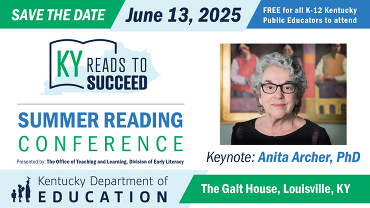 The Kentucky Department of Education (KDE) Office of Teaching and Learning (OTL) Division of Early Literacy invites you to the second annual Kentucky Reads to Succeed Summer Conference on June 13, 2025, at The Galt House in Louisville, Kentucky.
Keynote speaker and educational consultant to state departments and school districts on explicit instruction and literacy, Dr. Anita Archer has presented in all 50 states, all US territories, and many countries, including Australia and Canada, and has received ten awards honoring her educational contributions. Dr. Archer has served on the faculties of three universities, including the University of Washington, the University of Oregon, and San Diego State University. She is nationally known for her professional learning, and she has co-authored numerous curriculum materials and a best-selling textbook addressing reading and writing.
The conference, which will require registration but will be FREE to Kentucky K-12 public educators, will offer focused learning pathways to meet the needs of teachers and administrators. Attendees will learn from KDE Office of Teaching and Learning consultants and partners about:
- Evidence-based instructional shifts for literacy;
- The benefits of structured literacy;
- Why high-quality instructional resources matter; and
- Available resources for implementing the Read to Succeed Act.
Mark your calendar for this June 13 event, and please stay tuned for registration information coming soon.
Don't Miss the Early Literacy Newsletter
Did someone share this newsletter with you? Sign up to receive the Early Literacy Newsletter each week.
Did you miss last week's Early Literacy Newsletter? You can access all previous editions of the newsletter on the Early Literacy webpage.
|