|
May 4, 2026
Seasonal Update: Lyme Disease and Tick-borne Diseases
Following lower case counts from 2020 to 2022, Borrelia burgdorferi (Lyme disease) cases reported among Lake County residents returned to pre-pandemic levels in 2025 (Figure). Trends suggest a growing proportion of these infections are being acquired in Illinois, indicating increasing local transmission. While Lyme disease remains the most common tick-borne illness statewide and locally, additional tick-borne diseases were reported last year. Those include six cases of anaplasmosis and a case each of babesiosis, ehrlichiosis, and spotted fever rickettsiosis.
Figure. Reported Lyme disease cases* by year, Lake County, Illinois— 2017–2025
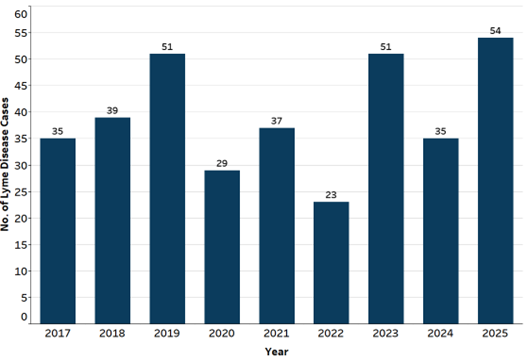 *Confirmed and probable cases only.
Note: Higher case counts after 2022 partly reflect a revised Lyme disease case definition, allowing confirmed and probable cases to be classified based on laboratory evidence alone, without requiring clinical symptoms. This change led to increased case reporting nationally, including in Lake County.
Data Source: Illinois National Electronic Disease Surveillance System (I-NEDSS)
For more information on vector-borne diseases in Lake County, LCHD’s prevention efforts, and steps residents and partners can take, check out our very FIRST Vector-borne Disease Annual Report 2024 for Lake County.
Tick Surveillance and Tick-borne Pathogens
The Lake County Health Department and Community Health Center (LCHD) has been monitoring tick populations in Lake County since 2013 to identify tick species present and to test species for tick-borne diseases. Additionally, monitoring identifies emerging species and pathogens, as ticks are expanding their habitat and ranges across Illinois and the United States.
In Lake County, Ixodes scapularis (blacklegged or deer ticks) are an established species and are the primary vector of Lyme disease. However, blacklegged ticks also carry several other pathogens. Tick surveillance by LCHD shows that on average 33% of blacklegged ticks test positive for Lyme disease. LCHD surveillance also detected other pathogens present in blacklegged ticks including: Anaplasma phagocytophilium, Babesia microti, Borrelia miyamotoi, and Erhlichia muris eauclairensis.
Powassan Virus Awareness
The Illinois Department of Public Health (IDPH) issued a health alert in March regarding Powassan virus.
-
Powassan virus is a rare tick-borne infection that can be transmitted within as little as 15 minutes of tick attachment and may cause severe neurologic illness.
-
Blacklegged ticks collected in Winnebago and Jo Daviess counties in Illinois have tested positive for Powassan virus.
-
A possible locally acquired human case of Powassan virus was identified in Illinois in late 2025.
Providers should consider Powassan virus infection in patients presenting with suspected symptoms and a history of tick exposure. Maintain a heightened suspicion of Powassan virus and consider serologic testing to avoid delays in diagnosis.
Guidance for Healthcare Providers
Remember to include Lyme disease in your differential. Clinical assessment considerations include:
- Likelihood of exposure to an infected blacklegged tick
- Signs and symptoms consistent with Lyme disease, including:
- Erythema migrans (EM), an expanding rash with a target-like appearance
- Neurologic symptoms, such as facial droop, numbness, or headache
- Cardiac symptoms, such as light-headedness or heart palpitations
- Joint pain or swelling, muscle aches
- Results of laboratory testing
Testing for Lyme disease should not occur immediately after a tick bite, as antibodies take four to six weeks to appear. The Centers for Disease Control and Prevention (CDC) recommends a two-step testing process, typically using enzyme immunoassays and western blots.
- If the first test is negative, no further testing is needed. If positive or equivocal, a second test is required.
- If the second test was collected from a patient experiencing symptoms for more than 30 days, positive IgG indicates Lyme disease in the recent or remote past. If the second test was collected from a patient with symptoms for less than 30 days, both IgM and IgG positive are needed for a positive result.
Treatment can be started based on clinical symptoms without positive lab results.
- Advise patients at risk for tick or mosquito exposure to use Environmental Protection Agency (EPA) - registered insect repellent outdoors, wear protective clothing, perform tick checks, and remove ticks promptly.
- Direct patients to LCHD’s Fight the Bite website for more prevention guidance and educational materials.
For questions or to report a human case, contact LCHD’s Communicable Disease Program at (847) 377-8130, option #1. For tick surveillance questions or tick identification requests, contact LCHD’s Environmental Health Program at (847) 377-8020.
Resources
Was this email forwarded to you? Join our list to receive updates for healthcare providers!
|