|
December 11, 2019
Dear Law Enforcement Leaders,
Season's Greetings, and welcome to another edition of “For the People.”
I first want to thank everyone for the positive feedback from our previous “For the People” newsletters. This December issue is geared primarily toward people in law enforcement, and features stories regarding the in's-and-out's of our specialty court program, and tips on how members of law enforcement can deal with depression. I hope you find these stories informative and help give you a better understanding of the state’s attorney’s office.
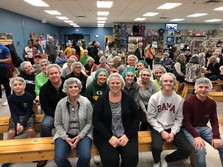
 People watch a video promoting the Lake County Children's Advocacy Center during the "Evening of Festivities" on December 5.
An Evening of Festivities:
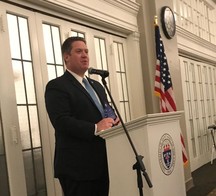
I’d be remiss if I did not give a huge thank you to the hundreds of people who attended the “Evening of Festivities” benefitting the Lake County Children’s Advocacy Center. The event was a huge success this year, in large part to the people who attended the fundraiser.
As always, we are extremely proud of the work we perform at the Children's Advocacy Center. We cannot do it without the large support from the community. We have many pictures of the event, and will post more down below.
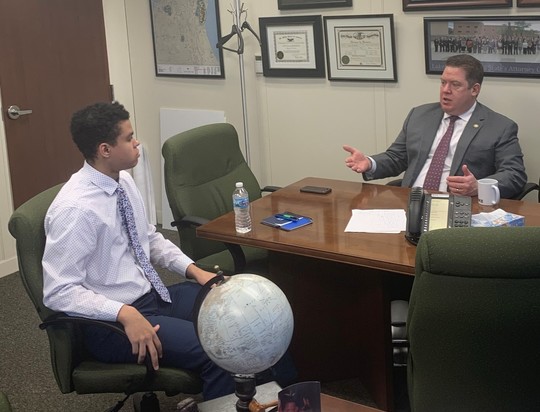 David Blaine, of Grayslake, meets with Lake County State's Attorney Michael Nerheim.
Thanks for stopping by:
I had the privilege this month to sit and chat with 18-year-old Daniel Blaine of Grayslake. He visited Monday morning to tour the office, review our policies and procedures, and check out the courtrooms. After he finishes high school at Lake Forest Academy, he plans to study communications in college, then wants to potentially run for office one day. We expect great things from him in the future!
I’d like to wish every person the warmest and happiest of holidays, and a very safe 2020. My pledge into the new year is to continue to work with the community to face many challenges together. I remain incredibly proud of the dedicated men and women of the Lake County State’s Attorney’s Office. As always, I encourage us to continue to work together to ensure that Lake County is a happy, healthy, and safe community.
Spotlight Story
 Experts give advice to officers during stressful holiday months
The holidays can be a rough time for many people, including the men and women in law enforcement. Stress from their everyday job, coupled with holiday stress, can lead to severe depression in even the strongest officer.
However, experts say help is available for officers feeling stress, and people should reach out for help before doing something drastic, like taking their own lives.
“There are simple remedies to those in law enforcement that experience stress,” said Nick Greco, board member of Blue H.E.L.P. and president of C3 Education and Research. “For a police officer, dealing with constant exposure to death, injury, motor accidents, then adding in the holiday stress, it can be overwhelming.”
Greco said there has been 212 law enforcement suicides nationwide in 2019, up from 172 suicides in 2018. He added there has been 12 officer suicides in Illinois in 2019 and 26 officer suicides in Illinois in the last three years. Of the 212 suicides nationally in 2019, he said 31 are retired officers who took their own life.
“For some, it’s cumulative trauma these officers are dealing with that hasn’t been dealt with previously,” Greco said.
He said officers often go from a murder in one area to a neighbor dispute or another violent crime in the matter of hours. Those officers often are expected to hide their emotions and not have feelings regarding the incidents they respond too.
“They are not expected to have any emotions and feelings when jumping from one crime to another,” he explained. “That’s why we are proponents of officers getting help, even when they don’t think it’s needed.”
Waukegan Police Chief Wayne Walles said the first thing officers should realize is they are just human beings.
“Even though police officers can be desensitized to some of the things they see, it still takes its toll on humans in a very cumulative effect,” he said. “When they see an accident, they have a job to do. But they are still human beings.”
Greco said, without healthy ways to deal with the stress, people in law enforcement tend to deal with the trauma in unhealthy ways.
“Officers start to self-medicate with alcohol or try and destress in other ways,” he said. “One of the biggest things we stress is to have officers talk with each other and have a peer support system in place.”
Walles said his department created a physical stress reduction gym to help officers release tension when needed. In addition, a 16-member peer support team specifically trained to act as basic counsellors and listening posts has been created to talk with officers and share their problems.
“Officers on both sides seem to enjoy doing it, and it’s been really well received,” he said. ““We started to look at changing the culture and providing resources to help officers deal with stress. We wanted to really look at the long-term effects of stress and how these issues hurt officers.”
In addition, he said there is a police-only psychologist available to all officers in Waukegan, and a spousal or significant other support group to help loved ones who may need help.
While some departments have EAP, Greco said many officers are reluctant to utilize those services. He said in those cases, officers should consider reaching out to private therapists who specialize in police issues, even when the officer feels it’s not needed.
“Find someone who you can discuss things in an uncensored way,” Greco said. “Even if you find that person who you can just say, “I’ve had a bad day and just want to sit here and talk with you.” Find a way to release it without bottling it up because, eventually, that stress will release in other ways.”
And, ultimately, doing things like yoga or taking a walk is always beneficial.
“Officers should accept their limitations, and take time to rest, recharge, and meditate,” he said. “Yoga is a great way to destress because it teaches the officer how to relax. A 20-minute walk is also beneficial to help clear an officers mind.”
For more information, Greco recommends contacting bluehelp.org, (800) COP-LINE, 1sthelp.net, or (800) 273-TALK. Officers are also able to text BLUE to 741741 if in crisis.
|