Memorial Day marks the official start of summer and many beaches open for the summer season. From Memorial Day to Labor Day, the Lake County Health Department monitors licensed swimming beaches throughout Lake County. Lake Michigan beaches are sampled 4 days a week and inland lakes are tested every two weeks. The water samples are tested for E.coli bacteria which are found in the intestines of almost all warm-blooded animals. While not all strains of E.coli are the same, certain strains can make humans sick if ingested in high enough concentrations.
If water samples come back high for E.coli (235 E.coli/100 mL), the management body for the bathing beach is notified and a sign is posted indicating the beach closure. Additionally, since rain events tend to lead to elevated bacteria levels in the water column, the Lake County Health Department advises that persons avoid swimming after a large rain event.
All beach closures are posted on our Health Department website. You can also find historic data at the Illinois Department of Public Health website.
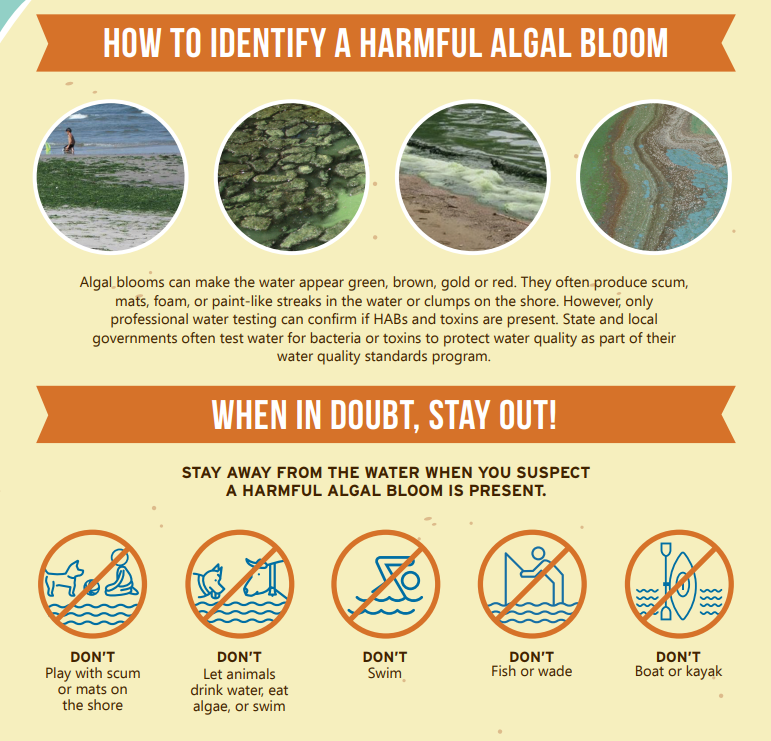
In addition to E.coli, the Health Department monitors presence of harmful blue green algae blooms. Blue-green algal blooms make the water appear green, gold, or red. They often produce scum, mats, foam or paint-like streaks in the water or clumps on the shore. If present, call us at 847-377-8020 so the bloom can be tested for the presence of toxins.
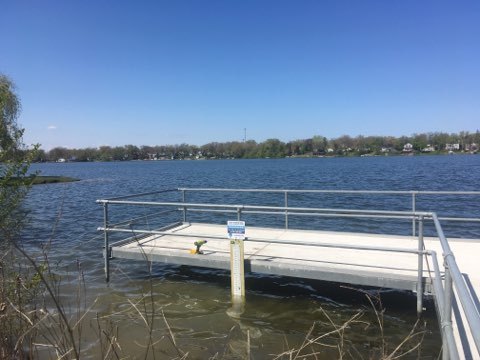 |
In May, researchers from University of North Carolina Chapel Hill came to Illinois to install lake level gauges on several lakes in Lake, Cook, and McHenry counties. The project, named Lake Observations by Citizen Scientists and Satellites (LOCSS), is a NASA-funded project which combines citizen science with satellite data to understand how the volume of water in lakes is changing over time. The project is a partnership between the University of North Carolina, University of Washington, and Tennessee Technological University working with local partners to study lakes. By 2021, LOCSS will be studying in more than 200 lakes in the United Stated, Europe, and Asia!
Why is it Important?
There are hundreds of thousands of natural lakes in the world, but probably only a few thousand of those are monitored. This project presents an opportunity to harness the power of volunteers & satellites to gather data that would otherwise be unfeasible by single research team to obtain. In particular, the group wants to know whether the lakes are all changing together on a regional scale--so if the water volume in one goes up, the volume in another goes up--or if they are being controlled by more local factors.
How Does it Work?
The LOCSS team installed a lake gauge, similar to a ruler, which can be installed in a lake along with a sign inviting people to participate. A citizen scientist or passeby can read the level of the water against the gauge and report it by text message to a phone number posted on the sign. That measurement is then added to the LOCSS database and displayed publicly on the project website, www.locss.org. The LOCSS team then pairs those lake height measurements with lake surface area measurements calculated using satellite imagery to determine if the volume of water in the lake is changing.
Can I help?
YES! We want anyone who see's one of these signs on a lake to please submit a measurement! Taking a measurement is easy, you simply text the current lake level status to the phone number on the sign. For example, on the sign featured below the lake level site's name is ZRL2 so you would text "ZRL2 2.00" to 847-380-8640. If you submitted the data correctly, you should receive a text back that tells you what the previous lake level reading was.
To learn more or view data visit the project website: www.locss.org. or watch this instructional video: LOCSS Video
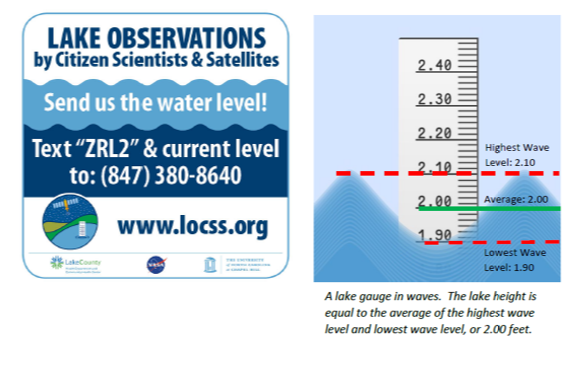 Images from www.locss.org
Bowfishing for carp is gaining popularity because it can be a fun experience while also doing some good for the lake by removing common carp, an invasive species found in many of our waterways that can cause turbidity, increased phosphorus issues. According to the State of Illinois Department of Natural Resources (IDNR), all are welcome to bowfishing if one possesses a valid sport fishing license (2019 Illinois Fishing Regulations Guide). It is also recommended that fishers who wish to take part in this sport, review all rules and regulations of bowfishing in Illinois to ensure their safety and the safety of others. In some municipalities it is illegal to discharge a bow, and bowhunting cannot occur in lakes that stock trout. Each lake may have specific regulations, so check with your township, municipality, and lake association before bowfishing.
Gear
It is important to understand the gear used for bowfishing. A bow, reel with line (most commonly braided nylon), and arrows with bowfishing tips, are all items that are necessary to take part in this sport. Bowfishing bows can be either bought as is or built from a compound bow with a bowfishing set up. The biggest difference between specialized bowfishing bows and kit bows, is that the draw on specialized bowfishing bows is a constant weight whereas a compound bow kit you would still get a break from the weight once the draw is all the way back. If you are not aware of these differences, a problem could arise. Knowing how each competent of your bow works will help provide a safe and accurate fishing hunt. As you get to know different set ups and companies, you will be able to determine what works best for you.
Techniques
As spring gradually transitions to summer, the water heats up and the carp begin to migrate to shallow waters to spawn. Wadding or trolling slowly through marshy areas along the shore is where you will see most carp during these conditions.
Once you see the target, you must act fast; it won’t stay for long. The specialized bowfishing bows are helpful in this case because they have a constant draw weight, like a recurve bow, that enables the ability to pull back at any distance and release putting the same amount of force on the arrow. This technique provides less of a chance to lose the target if you know how to use it.
 Image sourced from Recoil OffGrid
Aquatic Plant Identification Workshop
Tuesday July 30th, 1:00-4:00 p.m.
Lake County Health Department
500 W. Winchester Rd, Libertyville, IL
Join the Lake County Health Department and Illinois Lakes Management Association (ILMA) for an aquatic plant identification workshop. Participants will learn to identify native and invasive plants in their lake with hands on identification. The workshop will include real-plant ID on rooted floating vegetation, non-rooted floating vegetation, and submerged vegetation. This workshop is free, however, space is limited so RSVP to Alana Bartolai at abartolai2@lakecountyil.gov or 847-377-8009.
Algae Identification Workshop *Save the Date*
August 26, 2019
8:00 a.m.-5:00 p.m
1300 W. Fairchild St., Danville, IL
Join Illinois Lake Management Association, Aqua America and Aquatic Control for an Algae Workshop being hosted at the Water Treatment Plant in Danville, IL.. Dr. Ann St. Amand from PhycoTech will present in the morning and discuss algae ID and sampling techniques. Dr. Ciera Baird, an ecotoxicologist with Aquatic Control, will present in the afternoon about algae and HAB problems, water plant management and algae and HAB control techniques. Registration is not open yet, but will take place online at https://ilma-lakes.org/.
Questions? Contact Tim Holt at TimH@aquaticcontrol.com
Lake Management Planning Guide
Lake County Sets New Flood Stage Record in 2018
LOCSS Expands to Illinois
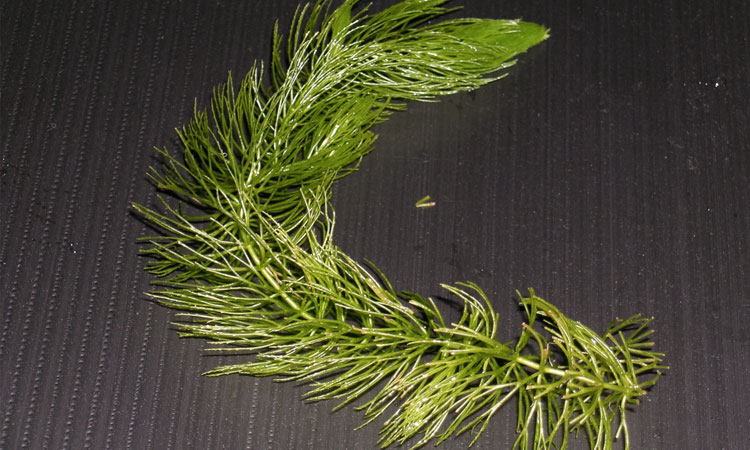 Clues
- This plant is often heavily branched, light green to brown.
- Leaves whorled with some leaves branching 3-4 times.
- Tip of plant very bushy
- Common
Think you know the answer? Email your best guess to ABartolai2@lakecountyil.gov.
Our Team
Mike Adam, Senior Biologist
Gerard Urbanozo, Water Quality Specialist
Alana Bartolai, Water Quality Specialist
|