|
|
Ensuring equal educational access across Iowa for blind and visually impaired students requires specialized expertise, strong agency collaboration and targeted resources. Iowa Educational Services for the Blind and Visually Impaired (IESBVI) serves as a vital statewide partner to local school districts, Area Education Agencies (AEAs) and families, ensuring students receive the tailored support they need to thrive academically, socially, and independently.
IESBVI serves students directly in their local communities across Iowa through a dedicated team of Teachers of the Visually Impaired (TVIs), Orientation and Mobility Specialists (OMS) and statewide consultants. These experts possess specialized training in visual impairments and work alongside local school districts, teachers and IEP teams. By bringing technical expertise into local classrooms, IESBVI helps educators create inclusive, accessible learning environments tailored to each student's visual needs.
In addition to classroom consultation, IESBVI provides direct services and comprehensive wraparound support designed to meet the holistic needs of students and their families. IESBVI prepares and distributes accessible educational materials and resources, ranging from braille and large-print media to specialized assistive equipment. Beyond the academic day, IESBVI supports the whole child by offering adaptive student athletics and robust family support programs, fostering connection and growth beyond the traditional classroom.
By offering statewide expertise, itinerant consultation and accessible media, IESBVI empowers students and supports local districts in fulfilling their mission to serve every learner.
Please contact iesbvi@iaedb.org with questions about IESBVI.
|
|
Invitations to eligible IDEA Parent contacts who have not yet created an ACHIEVE Family Portal account will start going out on the evening of Sunday, Nov. 8. All IDEA Parent relationship types who meet the following criteria will be sent an invitation:
- the family contact is validated and has an email address stored in the Family Contact stepper,
- the family contact does not yet have an active ACHIEVE Family Portal account, and
- the learner has an approved (and active) Consent for Early ACCESS Services or Consent for Special Education and Related Services.
There are several resources available to families to help make creating an account easier. Please share the following:
-
Family Portal Handout: IFSP and IEP teams may easily download an informational handout from the Family Contact stepper in ACHIEVE. This handout includes the last four digits of the learner's State ID to assist families in the account registration process and details about account benefits.
-
Quick Start - Create Your Account guide: Provides step-by-step instructions including screen shots on how to create an account.
-
ACHIEVE Family Portal webpage: Provides more information on the Portal, FAQ and other helpful resources.
-
Support Request: For help unlocking accounts or resolving other account issues, families can submit a support request to our help desk.
Please contact the ACHIEVE Family Portal Help Desk at achievesupport@iowa.gov with questions.
|
|

The Department offers the Universal Protocol for Accommodations in Reading (uPar) and Read&Write software to Iowa schools through the expanded Access for ALL initiative. These tools help educators identify students who benefit from a read aloud accommodation and provide access to grade-level content through a text reader.
The Access for ALL resources supports students as they transition from learning to read to reading to learn:
-
Universal Protocol for Accommodations in Reading (uPar): Helps districts and schools assess student reading comprehension and determine whether a student understands text best independently or with text-reader support.
-
Read&Write: Helps districts and schools support the learners that benefit from the read aloud accommodation. By providing access to the read aloud feature within Read&Write, you will provide students with access to grade-level content and support them in strengthening their reading and comprehension skills.
Join the 240 districts/schools that have already signed up to support learners, regardless of IEP status, who are reading below grade level. Register for both uPAR and Read&Write licenses at no cost by completing the uPar and Read&Write Deployment Form.
To learn more or get help with implementation, register for Access for All Open Office hours. Contact Education Program Consultant MeLissa Lawson at melissa.lawson@iowa.gov with questions.
|
The Department has made changes to the Testing Incident Reporting Application, including changing the name to better reflect its purpose as a singular place for all of your assessment needs.
In this new application you can:
- Submit test security incidents and accessibility errors.
- Request approval for an Alt ELPA Screener.
- Request unique testing accommodations that are not listed in accessibility manuals for federally mandated assessments.
- Document students who completed federally mandated assessments in another state.
- Request an exemption from a summative or screener ELPA21 or Alt ELPA domain test.
The new Test Incident Reporting and Special Assessment Request Application is available in the Iowa Education Portal under the EdInfo Tab. If the application is not visible, you must apply for a role to access it.
Please contact Education Program Consultant Jennifer Denne at jennifer.denne@iowa.gov with questions.
|
|

New legislation regarding graduation requirements in Senate File 369 went into effect this school year (2026-27). This legislation requires districts (including charter schools) and accredited nonpublic schools to ensure that each student passes the civics test as a condition of graduation and receipt of a regular high school diploma. Schools are reminded that students participating in 4+ services are still high school students and may not be awarded a regular high school diploma, or considered graduates of the school district, until all applicable state and local graduation requirements have been fulfilled, IEP services have concluded and the student’s IEP has been exited. Therefore, students participating in 4+ services are required to complete and pass the civics test in order to graduate and receive a regular high school diploma.
In response to these legislative changes, schools should ensure that IEP teams for transition-aged students, including 4+ students, consider this new requirement and address any relevant special education related needs for students planning to graduate with a regular high school diploma and provide FAPE accordingly. Decisions regarding the civics test and other graduation requirements must be documented within the Course of Study section of each student’s IEP.
While the IEP team maintains responsibility for placement decisions, the district determines service provider and location of services consistent with the placement decisions. Schools will need to utilize data from IEP team decisions and details within IEPs to identify any potential adjustments needed to programming, scheduling and staffing in order to provide FAPE.
To learn more:
Please contact Education Program Consultant Kelsey Teeter at kelsey.teeter@iowa.gov with questions.
|
|
The Policy & Practice Webinar topic, Appropriate Duties of Paraeducators, will be held on Nov. 18 at 9 a.m. Join us to learn about the role of paraprofessionals in special education (Part B). Participants will gain an understanding of the role paraprofessionals play in the provision of FAPE for a student with a disability. This includes understanding appropriate paraprofessional roles, responsibilities and duties based upon data and how paraprofessional supports are documented within IEPs. Finally, the webinar will outline the training and supervision requirements of paraprofessionals as well as relevant paraprofessional case law.
The next webinar in the series, Accessible Educational Materials, will be held on Dec. 9. Participants can join any of the webinars using Zoom and the passcode 431127. No registration is required. Webinar topics and recordings of past sessions are posted to the Department website.
Please contact the SDI Literacy Consultant Mary Beilke at mary.beilke@iowa.gov with questions.
|
|

Topics for the Accredited Nonpublic Schools and Special Education Webinar Series have been scheduled. This webinar series offers practical information for both public and accredited nonpublic school personnel as they navigate the shared responsibilities, relationships and systems that intersect when students with disabilities are enrolled in accredited nonpublic schools. Each session addresses a different aspect of this intersection, clarifies roles, answers questions and considers practices that can strengthen services and collaboration.
Upcoming Topics
Nov. 3: Funding and Contracts - This webinar will examine public agency special education funding as it relates to students enrolled in accredited nonpublic schools and public agency contracting arrangements used to provide educational and related services. Particular attention will be given to the continuing responsibilities of public schools when public funds are used through contractual arrangements, including fiscal oversight, accountability and compliance.
Dec. 1: Building Written Procedures for Strong Systems - This webinar will explore how to build written systems that create shared understanding, clarify roles, strengthen communication, support collaboration and make complex work easier to manage and monitor across organizations. Participants will consider what their systems need, what questions to ask and how written processes reduce confusion and conflict while creating consistent support for students. Explore how intentionally designed working relationships can improve how districts work with accredited nonpublic schools to monitor and support IEP implementation.
Webinars will be held at 9 a.m. on the first Tuesday of November, December, February, March and April. Join the webinar on Zoom using the passcode 431127. No registration is required, and the same link will be used for all sessions. More information about upcoming webinars and recordings of past webinars are posted on the Accredited Nonpublic Schools and Special Education webpage.
Please contact the Nonpublic School Liaison Janelle Danner at janelle.danner@iowa.gov with questions or feedback on additional topics.
|
|
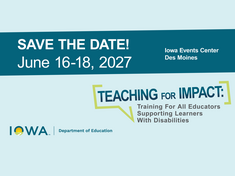
Save the date! A professional development opportunity focused on special education and support for learners with disabilities is coming to the Iowa Events Center in Des Moines on June 16-18.
Teaching for Impact: Training for All Educators Supporting Learners with Disabilities returns for another year of collaborative learning, providing Iowa educators with opportunities to expand their knowledge and skills related to the education of learners with disabilities from ages birth to 21. School administrators, building leadership teams, Early ACCESS providers and service coordinators, K-12 and early childhood educators and providers, Teachers of the Deaf & Hard of Hearing, Teachers of the Blind & Visually Impaired, AEA professionals, vocational rehabilitation partners and higher education faculty who support preservice educators are encouraged to attend the professional development.
Featured topics at Teaching for Impact will include academics, college and career readiness, early childhood, school-based behavioral health, and support and related services for learners receiving special education. Emphasis will be placed on integrating information into practice across a variety of educational settings, and sessions will include examples of the content in practice as well as suggestions for classroom application. Participants will also have many opportunities to share emerging ideas with other attendees and make valuable connections.
Please contact Education Program Consultant Nancy Hunt at nancy.hunt@iowa.gov with questions.
|
Find links to past issues of IDEA Insight on the Department website.
|