|
 September 2026
|
|
Inside this issue:
Department of Education Resources
|
Upcoming Deadlines
|
Due Date
|
What's Due
|
|
September 1
|
AEAs: IDEA PBC Application: 2026-27 IDEA Budget Due (Part C and Birth to 3)
|
|
September 1
|
LEAs: IDEA PBC Application: 2026-27 IDEA Budget Due (Part B)
|
|
September 15
|
CAR, SES, and ATR Applications Due
|
|
September 30
|
EL Excess Costs Application Due
|
|
October 1
|
AEAs: IDEA PBC Application: Claims Period 1 Open (Part C and Birth to 3)
|
|
October 1
|
LEAs: IDEA PBC Application: Claims Period 1 Open (Part B)
|
|
October 30
|
Fall BEDS Staff Application Due
|
|
October 30
|
Operational Sharing Application Due
|
|
October 31
|
AEAs: IDEA PBC Application: Claims Period 1 Due (Part C and Birth to 3)
|
|
October 31
|
LEAs: IDEA PBC Application: Claims Period 1 Due (Part B)
|
|
November 2
|
Facilities, Elections, and Sales Tax (FEST) Data Collection Due
|
|
November 2
|
School Association Reporting (SAR) Due
|
Staff Contact Information
|
|
 |
|
The Iowa Department of Education (Department) Bureau of School Business Operations is pleased to announce the addition of Tana Kelce to our team! “Tana K.” has extensive general ledger experience with over 25 years of accounting experience, including both private and public accounting.
Tana K. will be supporting the field as an Education Program Consultant (School Finance - Accounting) serving as a resource for the CAR, account coding, AEA finance, charter school finance, and more! She can be reached at tana.kelce@iowa.gov and 515-205-7650. Welcome, Tana!
|
The FY27 Local Education Agency (LEA)/Area Education Agency (AEA) State Aid Payments Schedule is available on the Department's State Payment Information web page. This schedule contains the electronic funds transfer dates for state aid and selected other state or federal categorical aid paid to school districts and area education agencies pursuant to Senate File 2201 and House File 2800.
School Bus Safety Week is observed by school districts throughout the country during the third full week of October. This year, School Bus Safety Week is October 19 through October 23. It is a great opportunity for parents, students, teachers, school bus drivers, emergency management personnel, and the media to remind students and other motorists of safe habits around school buses.
School Bus Safety Week Posters are available from the Department at no charge. There are three distinct posters featuring the artwork of winning artists from the first annual Iowa School Bus Safety Week Poster Contest. Requests for posters can be sent to Tom.Simpson@iowa.gov.
Effective September 1, 2026, the website for AEA Professional Learning registration has moved to www.aealearningonline.org.
Requests for modified supplemental amounts (MSA) related to a district’s special education deficit balance are required to be approved by the school board. Board minutes reflecting the approval are required to be uploaded to the Certification Screen in the Special Education Supplement (SES) application available in the EdPortal.
The board should consider the range and maximum level of spending authority defined in its unspent balance policy required pursuant to Senate File 2472 when making any requests for MSA.
Sample narrative for the board minutes is provided below.
The district experienced a special education deficit balance in fiscal year 2025-26 of $______________. The amount of modified supplement amount requested is $____________, which aligns to the board’s unspent balance policy based on [enter metric of percent or amount]. Making this request to the SBRC will not cause the unspent balance to exceed the board’s maximum unspent balance as defined in the board’s policy.
Motion was made by ____, seconded by ____ , to approve the request for Modified Supplemental Amount of $_______ related to the special education deficit balance for the fiscal year 2025-26. The motion _____ by a vote of __-__.
Questions related to the SES can be directed to Calli Thacher at calli.thacher@iowa.gov or 515-393-8349.
|
|
|
Question: Where should a fiscal agent for a special program (e.g., therapeutic classroom, alternative program, special education program) record related revenue for serving nonresident students?
Answer: If the district serves as a fiscal agent for a program, related revenues and expenditures must be captured in a Custodial Fund. Only the costs incurred by the district for serving its own students should be reflected outside of the Custodial Fund.
Reminder: The default appropriate source to pay for special programs is revenue received for that purpose or the unobligated General Fund.
|
|
|
The contract between the district and the community partner for Statewide Voluntary Preschool Program (SWVPP) should clearly narrate the documentation necessary to demonstrate, for auditing purposes, that SWVPP funds were expended for appropriate uses, the frequency with which such documentation must be provided to the district, and potential implications if the terms for providing documentation are not met, including the reversion of community partner funding to the district.
If a community partner does not expend the full amount allocated, all remaining unexpended funds must be returned to the district no later than June 30 of the program year (281 IAC 98.13(2)"b" and "c"). Additionally, the district may require the return of any funds already expended that do not have the documentation necessary to illustrate the funds were used appropriately.
Additional information relating to SWVPP Finance is available on the Department’s SWVPP web page under the Resource for SWVPP Educators section in the Finance FAQs for the Statewide Voluntary Preschool Program.
Questions relating to the SWVPP programming can be directed to Mary Breyfogle at mary.breyfogle@iowa.gov or 515-326-1030.
Questions relating to the SWVPP finance can be directed to Sheila Tharp at sheila.tharp@iowa.gov or 515-205-0259.
School districts will receive a payment from the County Treasurer in September and March for the Two-Tiered Assessment Limitation. The payment is for an exemption of taxable valuation in Commercial, Industrial and Railroad value for Assessment Year 2025 or Budget Year 2026. FY27 is the final year districts will receive a replacement payment.
The Business Property Tax Credit (BPTC) was changed from a credit to an exemption in HF 2552 during the 2022 Legislative Session. Property for Commercial, Industrial and Railroad has a 90% rollback, or 90% of the assessed valuation is used to calculate property taxes. This change to the BPTC (now called the Two-Tiered Assessment Limitation) changes the first $150,000 of property valuation to be assessed at a lower rollback equal to the residential rollback of 44.5345%. The difference between the residential rollback and 90% of the first $150,000 is what the payment replaces.
The FY27 Aid and Levy has been adjusted to account for and prevent a double payment for the Uniform Levy and Additional Levy portion of your tax rate. You will receive additional revenue for the following levies: Ed Improvement, Instructional Support, Management, Voted and Regular Physical Plant and Equipment, Public Education/Recreation (Playground) and Debt Service.
The payments from the County Treasurer will be distributed by levy rate. This will allow the district to code the payment to the correct fund. Most counties call the payment a Tier One payment.
Revenue will be coded to Source 3804, State Replacement for Two-Tiered Assessment Limitation.
Districts should calculate their unspent authorized budget (UAB) at the end of each fiscal year to determine if the district ended the year with a negative unspent balance. The determination of whether or not the district ended the year with a positive or negative unspent balance is not contingent upon any anticipated award of modified supplemental amount (MSA) from the School Budget Review Committee (SBRC) (e.g., MSA related to special education deficit, excess English Language (EL) instructional program costs).
Districts that ended the year with a negative unspent balance are required to notify the SBRC in writing by October 15, 2026 (289 IAC 6.4(3)). The notification requirement is satisfied through the completion of an SBRC Hearing Request. Please include the amount by which the district was negative within the district’s notification. Districts incurring a negative unspent balance larger than the amount of their special education deficit will be required to submit a corrective action plan to the SBRC for the December 2026 hearing. Upon receipt of the notification to appear, the district will receive further exhibit guidance.
Questions regarding the SBRC may be directed to Stephanie Edler, SBRC Liaison, at stephanie.edler@iowa.gov or 515-689-2258.
|
|
|
The Facilities, Elections and Sales Tax (FEST) application, due November 2, is anticipated to be available in early October on the EdPortal. The four forms required for FEST certification are listed below.
- Replacement Cost of Educational Facilities
- Voter-Approved PPEL
- Bond Issue Elections
- SAVE Reporting
Iowa Code section 256.9(19) requires the Iowa Department of Education to collect information about the use of Secure an Advanced Vision for Education (SAVE) tax dollars. The SAVE portion of the form requires the school district to update information about the revenue purpose statement, provide information whether the district has reduced levies through the use of SAVE funds, and miscellaneous information about whether the district had issued revenue bonds and reduced property tax through SAVE. Instructions are posted in the FEST application.
Additional questions can be directed to Ted Bauer at ted.bauer@iowa.gov or 515-979-5468.
The School Association Reporting application, due November 2, will be available in early October on the EdPortal.
Iowa Code section 279.38A requires boards of school corporations that pay membership dues to organizations which directly relate to the functions of the board of directors to report annually to the local community and the Department. The board must report the amount paid in annual dues to the organization, any fees paid and revenue or dividend payments received for services the board receives from the organization, and the products or services the school district received inclusive with the membership in the organization.
Districts must report information for four different associations: Iowa Association of School Business Officials (IASBO), Rural School Advocates of Iowa (RSAI), School Administrators of Iowa (SAI), and Urban Education Network (UEN). Districts are not required to provide information regarding the Iowa Association of School Boards (IASB) to the Department as this will be provided to the Department from IASB.
Instructions are posted on the home page of the School Association Reporting application. Additional questions can be directed to Ted Bauer at ted.bauer@iowa.gov or 515-979-5468.
Claims periods for IDEA Part B funds (LEAs) and IDEA Part C and Birth to 3 (AEAs) are listed below.
- Claims Period 1: October 1 - October 31
- Claims Period 2: January 1 - January 31
- Claims Period 3: April 1 - April 30
- Claims Period 4: June 15 - July 15
Area Education Agencies (AEAs) and Local Education Agencies (LEAs) are encouraged to submit claims as expenditures are incurred. However, a claim submission is not required in all four Claims Periods. In addition, the final claim can be submitted in any of the four Claims Periods if the funds have been fully expended at the time of submission.
Failure to Fully Claim
A final claim for the total allocation must be submitted by the July 15 deadline pursuant to Iowa Administrative Code r. 281-41.211. LEAs that fail to claim the entire allocation of IDEA Part B funds will be moved to the next risk level as determined through the IDEA Fiscal Risk Assessment, required to submit a corrective action plan to the School Budget Review Committee, and may be subject to other enforcement action.
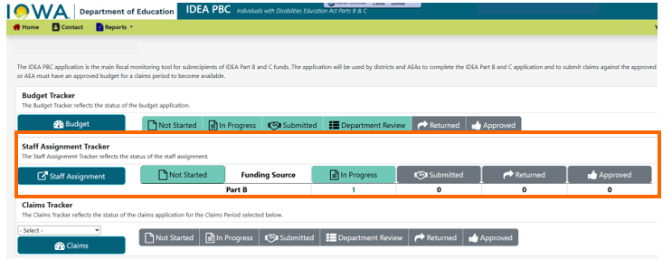
The Staff Assignment page is required if costs for salaries, benefits, and/or travel are included in a claim.
New: This page was removed from the claims part of the application and is now available on the Home Page of the application. The Staff Assignment page can be accessed, edited, and submitted at any time throughout the fiscal year. Only staff that are reflected as approved in the Staff Assignment page may be included in a claim.
 Resources
Statewide webinar recordings as well as detailed instructions for completing the application are available on the Department’s Special Education Finance web page under the Special Education Applications section.
Further questions can be directed to Sarah Sheeder at sarah.sheeder@iowa.gov or 515-326-0854.
|
|
|
Iowa Code section 256C.5(4) provides funding to the Department from preschool foundation aid to pay for state administration and oversight of the preschool program. This funding is critical for the ongoing implementation and monitoring of the program.
This is an on-behalf payment. The district will record the amount as preschool revenue with an equal amount recorded as a preschool expenditure. The amount is $33.17 per preschool budget enrollment. The deduction for the on-behalf payment will be spread throughout the 4 state aid payments. This is a reduction to cash flow (state aid) sent directly to the district but does not result in general fund spending authority in excess of state aid received, because it is recorded by the district as both an on-behalf revenue and expenditure. The on-behalf revenue will be recorded in Source and Project 3117, Program 460, and the expenditure in an equal amount will be recorded in Function 233X, Program 460, Project 3117, Object 31X.
The FY27 Preschool Funding document for preschool amounts is available on the Department’s State Payment Information. The amount remains at the $33.17 per preschool budget enrollment.
Further questions can be directed to Sheila Tharp at sheila.tharp@iowa.gov or 515-205-0259.
|
|
|
Verification is confirmation of eligibility for free and reduced price meals under the National School Lunch and Breakfast Programs. The United States Department of Agriculture (USDA) requires verification based on a school’s sample size of free and reduced price school meal applications as of October 1 each school year. The verification process must be completed by November 15. A school district may request an extension of the November 15 deadline. Extension requests may be sent to Patti Harding, Administrative Consultant. The State agency may approve an extension up to December 15 of the current school year due to natural disaster, civil disorder, strike, or other circumstances that prevent the district from timely completion of verification activities.
All School Food Authorities (SFAs), including SFAs that are not required to conduct verification, should complete the Verification Collection Report in IowaCNP by December 14. IowaCNP is the Bureau of Nutrition and Health Services Child Nutrition Program data system for reporting and claiming. A webinar covering the verification process was provided September 21 and the webinar on how to complete the Verification Collection Report for SFAs (public and nonpublic schools, including RCCIs) is October 19.
Districts should contact their assigned School Nutrition Program Consultant, Meredith Vrchoticky at meredith.vrchoticky@iowa.gov or 515-975-8103, or Patti Harding at patti.harding@iowa.gov or 515-868-1956 for assistance.
Information regarding Iowa’s Students First Education Savings Account (ESA) program can be found on the Department's Students First Education Savings Accounts web page.
|
|
|
For questions relating to School-Based Medicaid or other topics in this section, contact Jon Neas at jon.neas@iowa.gov or 515-326-1032.
Iowa Medicaid will bill any employer/commercial insurance that the Medicaid student holds. The IEP team or Medicaid lead for the district may receive inquiries from families regarding the impact of multiple coverages, including private insurance and Medicaid. An informative response would include the relationship between the coverages, including that Iowa Medicaid practices “pay and chase,” meaning that after paying a claim from a district or AEA, if Iowa Medicaid identifies another insurer/ funder, Iowa Medicaid will send the paid claim information to the other insurance company and seek reimbursement.
This is a required practice for Medicaid participants. Federal Code 42 U.S. Code § 1396a of the Social Security Act requires states to take all reasonable measures to ascertain the legal liability of “third parties” for health care items and services provided to Medicaid beneficiaries. As such, Iowa Medicaid Enterprise has no option but to bill third party insurers when policies exist. This is acknowledged on page 24 of the Medicaid application which reads, “You must agree to assign medical payments from a third party to the Medicaid agency for yourself and others who are eligible for Medicaid for whom you can legally assign benefits, cooperate in getting medical payments from third parties, give the Medicaid agency rights to pursue and get medical support from a spouse, and give the Medicaid agency rights to pursue and get money from other health insurance, legal settlements, or other third parties.”
|
|
|
In March, the U.S. Department of Education discontinued the REMS Technical Assistance Center. However, federal school safety resources are now jointly packaged by the U.S. Department of Homeland Security (DHS), U.S. Department of Education (ED), U.S. Department of Justice (DOJ), and U.S. Department of Health and Human Services (HHS) on the schoolsafety.gov webpage. Check out their latest Back to School Campaign.
Heartland School Safety and Security Summit is scheduled for October 6-7, 2026, in Lincoln, NE. The summit’s theme is “Better Recovery Outcomes Start with Prevention” and explores strategies to strengthen prevention, preparedness and crisis response to help create safer and healthier school communities. Multiple states across the Midwest are invited, so register soon!
Target audience: School safety professionals, educators, first responders, mental health practitioners, and community partners.
The summit agenda, registration information, and lodging details are available on the Department's School Safety web page under the Current Events section.
The Governor’s School Safety Bureau (GSSB) makes Safe + Sound available. Safe + Sound is an anonymous reporting system that is free to all K-12 schools with the goal of reporting school safety concerns and getting students in crisis the help they need before it's too late.
As of June 2026, 52% of Iowa school districts utilize Safe + Sound. Since its release, Safe + Sound has received tips that resulted in parent notifications and preventive measures, counseling, disciplinary actions, and, in rare cases, citations or arrests.
-
SY 22-23: 67 (March - May 2023 only)
-
SY 23-24: 300
-
SY 24-25: 441
-
SY 25-26: 385
|
|
|
Questions relating to the articles below may be sent to State Director for Pupil Transportation, Tom Simpson at tom.simpson@iowa.gov or 515-336-3965 or one of the following inspectors:
The Iowa Department of Transportation (IDOT) is now accepting grant applications across four eligible project categories for $7.6 million in funding through the Volkswagen Settlement Environmental Mitigation Trust funding program. Applications are being accepted through 5 pm on October 26, 2026. Schools that own and operate diesel fleets in Iowa are eligible applicants for Category 1 projects which include the replacement or repower of buses.
For-Profit businesses, incorporated non-profit organizations, government agencies of all types, and metropolitan or regional transportation planning organizations are all eligible applicants for projects that will install conveniently located and publicly accessible Level 2 Community Charging sites across the state. These electric vehicle charging equipment installations must meet the site and equipment requirements listed in the program guidance.
Additional information about these funding opportunities, including how to apply, is available on the IDOT Volkswagen Clean Air Act Partial Settlements web page. Questions must be submitted in writing via email to vwsettlement@iowadot.us.
Users can gain access to EdPortal applications (e.g., Driver Authorization, Vehicle Information System) by following the steps below.
- New user will establish an EdPortal account.
- New user will request access through EdPortal to individual applications needed.
- District’s local portal security officer will grant/deny access to applications.
The EdPortal team can provide technical assistance regarding account creation and are available at ed.portal@iowa.gov or (515) 725-2040.
The new school year brings a number of reminders regarding school transportation.
- One or more contacts should be reported in the Driver Authorization System (DAS) application found in the EdPortal.
- The driver list in the DAS should be accurate, which includes deleting drivers who no longer drive for the district, school, or entity.
- A current authorization must be issued and provided to each school bus driver to carry with them when driving the bus.
- For the school bus driver authorization to be valid, the driver's license, medical examiner's card, and in-service training must be current.
- Driver authorizations must be current for a school bus driver to legally operate a school bus if students are being transported.
Contact Information
Contacts for the sections below can be added in the Contacts section available in the application from the navigation bar. The Department uses this contact information for communications.
- Vehicle Information System (main contact - required)
- Transportation Director
- Lead Mechanic
- Billing/Accounts Receivable
Required Updates
The VIS also requires regular monitoring to ensure all vehicles (e.g., school bus, SUV, van) used to transport students are on the list and those no longer in use have been removed. Guidance, forms, links, training schedules, publications, code references, and other information pertaining to school transportation are available on the Department’s Pupil Transportation web page.
Purchases: Schools may purchase vans of up to 12-passenger capacity, but any van with a rated capacity of 11 or 12, including the driver, must be purchased as a “used” vehicle only. Iowa Code section 322.2(29) defines “used motor vehicle” or “second-hand motor vehicle” as any motor vehicle of a type subject to registration under the laws of this state which has been sold “at retail” as defined in this chapter and previously registered in this or any other state.
Seating Capacity Defined: The seating capacity of the vehicle is set at the time of manufacture, by the manufacturer. The seating capacity rating may not be changed or modified except by the original equipment manufacturer (OEM), dealer, or remanufacturer. Seating capacities which vary from the OEM are required by the National Highway Traffic Safety Administration (NHTSA) to be identified by an alterer’s certification and information label affixed to the frame of the driver’s door.
Seating Capacity Alteration: Iowa Administrative Code r. 281-44.5(1) states alteration of a Type III vehicle, following manufacture by the OEM, is prohibited. While this includes the addition or removal of seats, the Department will grant an exception for seats which are added or removed as long as the seating capacity does not exceed the capacity as certified by the OEM or on the installed alterer’s certificate and information label as referenced above.
Additional information regarding seating capacity definitions and alterations is available in the Type III Vehicle Information resource located on the Department’s Pupil Transportation page under the Guidance, Information, and Instructions section.
Districts may purchase and use Type III vehicles (typically vans) that are equipped with ramps for use with wheelchairs to transport students. Iowa Administrative Code r. 281-44.5(1) authorizes ramps on the passenger side of the vehicle only and requires compliance with all applicable FMVSS and ADA requirements.
Please note that only “curb-side” ramps are allowed; they may be powered or manual ramps. More information can be found in the Department’s Type III Ramp-Equipped Vehicles document.
Use of child safety restraint systems (CSRS) includes the potential for students to either intentionally or unintentionally unbuckle the safety restraint system. Any decision to use buckle covers or guards to prevent accidental and intentional unbuckling of CSRS by students should be considered within the context of student safety and the best interest of the students being transported.
The National Association of State Directors of Pupil Transportation Services (NASDPTS) released a document entitled “Buckle Guards - Why They Should Not Be Used” in July 2026. This document references National Highway Traffic Safety Administration (NHTSA) interpretations related to the use of buckle guards as well as the National Congress on Student Transportation (NCST) 2025 National School Transportation Specifications and Procedures (NSTSP) Manual.
September is a special time in Iowa. Students and teachers are eager to learn and teach, Friday night football is back, and farmers are preparing for harvest. These events, however, bring special challenges for student transportation. Student transportation personnel should consider the items listed below.
- Tall corn may reduce visibility at unmarked rural intersections.
- Farm machinery moves slowly and may take up a large amount of the roadway. Drivers should slow immediately upon seeing farm machinery on the road. Drivers should also remember that farm machinery may slow or turn unexpectedly and that the operator of the machinery may not be able to see vehicles around them.
- Drivers should remain patient with farm machinery and only pass when it is safe to do so. Drivers should also remember that other motorists are not necessarily professional drivers and may not exhibit the same level of caution or patience.
- In addition to increased farm machinery and school bus traffic, harvest season often creates more movement in the deer population. Drivers should be aware of the heightened risk of deer on the roadway.
Vigilant drivers are a key component to providing safe and efficient transportation to the students of Iowa during this special time of year.
|
|
|
It is the policy of the Iowa Department of Education not to discriminate on the basis of race, creed, color, sexual orientation, national origin, sex, disability, religion, age, political party affiliation, or actual or potential parental, family or marital status in its programs, activities, or employment practices as required by the Iowa Code sections 216.9 and 256.10(2), Titles VI and VII of the Civil Rights Act of 1964 (42 U.S.C. § 2000d2000e), the Equal Pay Act of 1973 (29 U.S.C. § 206, et seq.), Title IX (Educational Amendments, 20 U.S.C.§§ 1681 – 1688), Section 504 (Rehabilitation Act of 1973, 29 U.S.C. § 794), and the Americans with Disabilities Act (42 U.S.C. § 12101, et seq.). If you have questions or complaints related to compliance with this policy by the Iowa Department of Education, please contact the legal counsel for the Iowa Department of Education, Grimes State Office Building, 400 E. 14th Street, Des Moines, IA 50319-0146, telephone number: 515-281-5295, or the Director of the Office for Civil Rights, U.S. Department of Education, Cesar E. Chavez Memorial Building, 1244 Speer Boulevard, Suite 310, Denver, CO 80204-3582, telephone number: 303-844-5695, TDD number: 800-877-8339, email: OCR.Denver@ed.gov.
|
|
|
|
|