|

Iowa is proud to once again lead the nation in Workforce Pell, empowering students with low-income backgrounds to pursue and complete short-term, in-demand postsecondary education programs. As Iowa supports an outcomes-driven, coordinated postsecondary education and workforce system, we will continue to ensure students get a strong return on their investment and employers have the skilled talent pipelines they need here in Iowa.
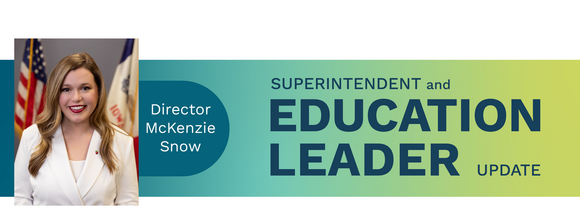
President Jesse Ulrich hosted the U.S. Secretary of Education Linda McMahon, Acting U.S. Secretary of Labor Keith Sonderling, Governor Kim Reynolds, Director McKenzie Snow and Division Administrator Amy Gieseke for the historic announcement of Iowa Central Community College’s Emergency Medical Technician (EMT) program as the nation’s very first federally approved Workforce Pell program. Iowa also has approved programs offered by Des Moines Area Community College, Eastern Iowa Community College and Iowa Western Community College and recently launched its spring 2027 application for Workforce Pell to identify additional postsecondary programs with the best completion, employment and earnings outcomes.
Please contact Higher Education and Postsecondary Readiness Division Administrator Amy Gieseke at amy.gieseke@iowa.gov with questions.
To comprehensively support Iowa schools and districts with coordinated special education and school improvement identification, planning, and improvement, Iowa’s ESEA and IDEA Accountability Systems will be directly aligned beginning in fall 2026.
This work builds upon Iowa’s 2024 ESEA Unified School Accountability System (also known as the Iowa School Performance Profiles), which aligned Iowa’s different ESEA and school improvement accountability systems, as well as the creation of Iowa’s 2025 District Performance Profiles. Now, the Department is aligning Iowa’s IDEA and state special education district accountability systems with the same transparent student outcomes measures: student achievement, growth, attendance, graduation and postsecondary readiness.
This critical system alignment work spanning the past three years ensures school and district accountability systems reflect high expectations, are easily understood and ultimately advance the purpose of accountability: supporting school and district improvement.
Please contact Central Special Education Division Administrator Leisa Breitfelder at leisa.breitfelder@iowa.gov and PK-12 Learning Division Administrator Tina Wahlert at tina.wahlert@iowa.gov with questions.
Last month, the Department awarded more than $2.35 million in Therapeutic Classroom Incentive Grants to 10 school districts to support students whose emotional or behavioral needs affect their success in the learning environment. The grants will help districts establish therapeutic classrooms that provide supports such as skill building, trauma-informed care, mental health treatment and crisis intervention. The 2026–27 awards mark the sixth year of funding for this statewide initiative.
The school districts awarded a Therapeutic Classroom Incentive Grant are Cedar Falls, George-Little Rock, Lewis Central, Oskaloosa, South Tama, Spirit Lake, Storm Lake, United, Van Buren and Winterset.
Please contact Administrative Consultant Lyn Jenkins at lyn.jenkins@iowa.gov with questions.
Last month, $2 million in Career Academy Incentive Fund grants were awarded to Ellsworth Community College and Iowa Western Community College. The funding will support two new regional centers serving students from 11 school districts and two nonpublic schools, expanding access to 11 career academy programs.
Please contact Administrative Consultant Heather Meissen at heather.meissen@iowa.gov with questions.
Iowa high schools continue to make strong progress in FAFSA completion. This year, the Department recognized 74 high schools through its FAFSA Focused Awards—46 as Schools of Achievement and 28 as Schools of Excellence. In August, 55.9% of Iowa high school seniors had completed the FAFSA, up 3 percentage points from last year. Visit fafsa.iowa.gov to view your school’s completion rate.
Please contact Community Engagement Consultant Elizabeth Yaddof at elizabeth.yaddof@iowa.gov with questions.
|
|

Iowa schools can now register for the next cohort of the HQIM Leadership Academy, a two-year learning experience supporting district and school teams in implementing high-quality instructional materials with integrity. Registration is open through Sept. 15.
Schools may choose the literacy pathway, mathematics pathway, or both. Priority consideration will be given to CSI and TSI schools, with space limited to 40 teams per pathway. Participants receive practical tools, personalized support and access to a statewide network of leaders focused on strengthening HQIM implementation and classroom instruction. Learn more on the Department’s HQIM webpage.
Please contact Administrative Consultant Darcie Kress at darcie.kress@iowa.gov or Education Program Consultant Christi Donald at christi.donald@iowa.gov with questions.
Iowa educators are invited to join Statewide Literacy Professional Learning virtual sessions on Sept. 18. Participants may attend one or all sessions. Registration is free and open through Sept. 17 at 3 p.m.
-
9–10:30 a.m. — Iowa Academic Standards for ELA and Literacy HQIM: Leading and Supporting Implementation, Iowa Department of Education and 2026 Iowa Teacher of the Year Stephanie Pritts
-
10:45–11:45 a.m. — Evidence-Based Practices for English Learners, Iowa Department of Education
-
1:00–2:00 p.m. — Research-Based Approaches to Morphology Instruction Grounded in the Science of Reading, Iowa Reading Research Center
-
2:15–3:15 p.m. — Sparking Early Literacy: Helping Caregivers and Educators Support the Development of Code-Focused Literacy Skills, Iowa Reading Research Center
Please contact Administrative Consultant Darcie Kress at darcie.kress@iowa.gov with questions.
The Department’s Special Education Policy and Practice Webinar Series returns for SY 2026–27. Sessions are held from 9–10 a.m. Participants may join via Zoom using passcode 431127, and registration is not required. Past sessions and materials are available on the Department’s webinar webpage, and upcoming sessions include:
- Sept. 9: Prior Written Notices
- Oct. 14: IEP Team Member Roles and Responsibilities
- Nov. 18: Appropriate Duties of Paraeducators
- Dec. 9: Accessible Educational Materials
- Jan. 13: A Deeper Dive into Secondary Transition
- Feb. 10 & March 10: Manifestation Determination, Parts 1 and 2
- April 14: Continuum of Services
- May 12: General Supervision for Learners Outside of Your District
- June 9: Lessons Learned from the Field
Please contact Education Program Consultant Mary Beilke at mary.beilke@iowa.gov with questions.
The Department has invested in two statewide professional learning cohorts, supporting emerging special education teachers and special education administrators.
Legal and Ethical Foundations and Effective Instructional Practices for Emerging Special Education Teachers is a foundational course for emerging special education teachers. Participants build knowledge of legal and ethical responsibilities, Iowa’s SDI Framework, effective instructional practices and special education procedures within ACHIEVE. The course uses a flipped learning model with nine monthly virtual sessions of 60–90 minutes and two 45-minute coaching sessions to support application.
Please contact Regional Special Education Director Molly Elston at molly.elston@iowa.gov with questions.
Special Education Leadership Series for Administrators is a professional learning series for administrators who lead and support special education programs. The series strengthens leadership capacity to support legally compliant, instructionally effective, student-centered systems that provide FAPE through a systems-based approach integrating legal requirements, instructional frameworks and organizational leadership. The course uses a flipped learning model with nine monthly 45-minute virtual sessions and one 30-minute coaching session each month to support application.
Please contact Regional Special Education Director Matt Cretsinger at matt.cretsinger@iowa.gov with questions.
As part of its general supervision responsibilities, the Department monitors the use of federal and state special education funds by school districts and AEAs. The Department conducts annual universal fiscal monitoring of all subgrantees and conducts targeted or intensive monitoring of at least 20% of subgrantees during each year of a five-year cycle, based on either district or student count. Any subgrantee may be selected for additional monitoring in any year and may be selected more than once during a five-year cycle.
Districts are encouraged to review the Department’s Special Education Lessons Learned and Allowable Uses resources and June 30 webinar for additional guidance. Questions regarding expenditures or the review process should be directed to SpecialEducationFinance@iowa.gov.
Please contact Central Special Education Division Administrator Leisa Breitfelder at leisa.breitfelder@iowa.gov with questions.
|
|

Eligible school districts are invited to apply for two new waiver opportunities for SY 2026–27:
-
Title I, Part A Excess Carryover Waiver: School districts may request to carry over up to 100% of unused Title I, Part A funds into the next fiscal year to support significant, evidence-based instructional investments that demonstrate a measurable impact on student outcomes (e.g., achievement, growth, work-based learning, industry-recognized credential and college credit attainment). Eligible school districts may apply for 2025–26 carryover through CASA from
Dec. 15–Feb. 15.
-
Title IV, Part A Spending Limitation Waiver: To better direct funds to local needs and state priorities, school districts may request to waive up to 100% of Title IV, Part A spending limitations, including requirements that larger grants allocate set percentages to well-rounded education, safe and healthy schools and education technology. (Without such a waiver, school districts receiving $30,000 or more must spend at least 20% on well-rounded educational opportunities, at least 20% on safe and healthy students, and no more than 15% on the effective use of technology.) Eligible school districts may apply through CASA from Sept. 15–Oct. 15.
Please contact Administrative Consultant Jina Brinks at jina.brincks@iowa.gov with questions.
The Consolidated Accountability and Support Application (CASA) will open Sept. 15 for the annual ESEA Title Programs application and close Oct. 15. The consolidated application includes Title I, Parts A, C and D; Title II, Part A; Title III, Part A; Title IV, Parts A and B; and Title V. Department subgrantees are encouraged to prepare required documentation in advance to ensure timely submission by the deadline.
Please contact Administrative Consultant Jina Brinks at jina.brincks@iowa.gov with questions.
The Iowa General Assembly increased funding for the Teach Iowa Scholar Program by 10% for FY 2026–27, bringing the total appropriation to more than $1 million. The program provides up to $20,000 in loan repayment or income bonus awards for qualified teachers who serve five years in designated shortage areas, with a portion of funding reserved for rural districts. Applications open Sept. 1 and close Oct. 31.
Please contact the financial aid team at grants.iowacollegeaid@iowa.gov with questions.
The 2027–28 STEM BEST (Businesses Engaging Students and Teachers) applications are now open for both new schools and returning schools in IowaGrants.gov, with applications closing Nov. 3. Accredited public and nonpublic schools may request up to $50,000 to develop or expand career-connected learning experiences through partnerships with business and industry. Awards provide a 17-month planning and implementation period, from Jan. 2027 through May 2028, and require a 2:1 cost share, a Community Partner Letter of Commitment and administrative approval. Funding is provided on a cost-reimbursement basis. Awards are expected to be announced in Jan. 2027.
Please contact STEM BEST Program Coordinator Tanya Hunt at tanya.hunt@iowa.gov with questions.
The Computer Science Incentive Fund grant opportunities are now open to support schools and educators in expanding access to high-quality computer science instruction. Applications are available through IowaGrants.gov.
-
Computer Science Professional Development grants support professional development and associated costs necessary to implement the learning opportunities, including coaching, physical computing devices and district planning. Applications close Nov. 2.
-
Computer Science Endorsement grants support Iowa educators pursuing K-8, 6-12, or K-12 computer science endorsements, or the CTE-IT endorsement. Districts can apply for reimbursement of associated costs, and applications close April 30, 2027.
Please contact Computer Science Consultant Michelle Meier at michelle.meier@iowa.gov with questions.
|
|

School administrators are again reminded of the mandatory reporting requirements. If an employee is disciplined by the district (e.g., written reprimands, written warnings, job separation agreements, resignations, nonrenewals or terminations that resulted from employee misconduct covered by the mandatory reporting areas), administrators must report to the Board of Educational Examiners within 30 days of any incident in the following areas:
- Committing any act of physical abuse of a student (Iowa Administrative Code chapter 282–25.3(1)e(1))
- Soliciting, encouraging, or consummating a romantic or otherwise inappropriate relationship with a student (282 IAC 25.3(1)e(4))
- Falsifying student grades, test scores, or other official information or material (282 IAC 25.3(3)e)
- Converting public property or funds to the personal use of the school employee (282 IAC 25.3(4)b)
- Being on school premises or at a school-sponsored activity involving students while under the influence of, possessing, using, or consuming illegal drugs, unauthorized drugs, or alcohol (282 IAC 25.3(2))
Please contact Board of Educational Examiners Attorney Beth Myers at beth.myers@iowa.gov with questions.
The application to begin the school year with a substitute in an open position is now available in the Licensure Tips for Administrators. Use of a substitute is intended as a temporary solution and may affect accreditation. Before applying, districts must document a diligent search and consideration of alternative solutions. If approved, continued advertising and recruitment are required.
Please contact Board of Educational Examiners Consultant Josh Moser at josh.moser@iowa.gov with questions.
The March 31 statutory deadline to submit FY25 audit reports to the Auditor of State and the Iowa Department of Education has passed, as has the deadline to request an extension. There are still 19 LEA audit reports that remain outstanding without a current approved extension. LEAs with outstanding FY25 audit reports should submit them immediately to submitreports@aos.iowa.gov and ed.audit@iowa.gov.
Please contact Chief Financial Officer Sandi Hurtado-Peters at sandra.hurtado-peters1@iowa.gov with questions.
Senate File 2231 directs the Department to distribute annually the most recent version of the Guidance on Constitutionally Protected Prayer and Religious Expression produced by the U.S. Department of Education to each superintendent of a school district and principal of a charter school. The legislation directs superintendents and heads of charter schools to distribute the guidance to each school board member, principal and teacher.
Please contact Bureau Chief for School Improvement Joanne Tubbs at joanne.tubbs2@iowa.gov with questions.
House File 299 enacted in May 2025 and Iowa Administrative Code chapter 281—14.2(5) require schools to include information about all approved immunization record options in any relevant public communication. All communication regarding immunization requirements—including registration materials, electronic communications, and social media—must include information about immunization records, medical or religious exemptions and provisional enrollment options. Please see the Student Health Requirements for Schools webpage as well as the Iowa Department of Health and Human Services' Immunizations Requirements, Program Documents, and Certificates webpage for more information.
Please contact Bureau Chief for School Improvement Joanne Tubbs at joanne.tubbs2@iowa.gov with questions.
House File 2412 enacted in July 2022 requires radon testing and mitigation in public schools, as well as radon-resistant construction techniques to be used for all new construction. Each attendance center in a school district must be tested for radon at least once by July 1, 2027, and at least once every five years thereafter. Additional information and requirements can be found on the Radon - K-12 Schools website.
Please contact Bureau Chief for School Improvement Joanne Tubbs at joanne.tubbs2@iowa.gov with questions.
In school year 2026–27, school food authorities participating in the National School Lunch Program must limit non-domestic commercial food purchases to 10% of total commercial food costs and maintain documentation to track compliance. In June 2026, the USDA issued a policy memo allowing an accommodation if non-domestic food purchases exceed the 10% Buy American Cap for SY 2026–27. Schools exceeding the cap may request temporary accommodation from the Bureau of Nutrition and Health Services using the SY 2026–27 Buy American Temporary Accommodation Request Form. Requests must include documentation showing the cap was exceeded and describe the school’s progress toward compliance.
Please contact the Bureau of Nutrition and Health Services school nutrition consultants with questions.
The Federal Communications Commission (FCC) has issued a Notice of Proposed Rulemaking outlining potential changes to the E-Rate program and is seeking input from school administrators. Comments are due Oct. 13, with reply comments due Nov. 12.
Please contact Chief Financial Officer Sandi Hurtado-Peters at sandra.hurtado-peters1@iowa.gov with questions.
Local media outlets amplified eight Department features this month. Many stories highlighted the Iowa STEM Teacher Externship program over the summer, including stories profiling educators in:
The HortiDaily covered Easton Valley Community School’s STEM BEST Explore greenhouse summer internship, and the Indianola Independent Advocate highlighted Simpson College’s Educator Preparation Program.
Please contact Communications Director Heather Doe at heather.doe2@iowa.gov if your district or school should be featured in an upcoming headline story.
The Annual Notices and Deadlines Calendar provides a centralized resource for key Department notices, reporting requirements, and submission deadlines throughout the school year. School leaders are encouraged to review the calendar regularly to stay informed of upcoming requirements and important dates.
|
|
 Visit and subscribe to the Annual Notices and Deadlines Calendar for a list of state and federal notices and deadlines for all public and nonpublic schools.
(Revised 7-1-25)
It is the policy of the Iowa Department of Education not to discriminate on the basis of race, creed, color, sexual orientation, national origin, sex, disability, religion, age, political party affiliation, or actual or potential parental, family or marital status in its programs, activities, or employment practices as required by the Iowa Code sections 216.9 and 256.10(2), Titles VI and VII of the Civil Rights Act of 1964 (42 U.S.C. § 2000d2000e), the Equal Pay Act of 1973 (29 U.S.C. § 206, et seq.), Title IX (Educational Amendments, 20 U.S.C.§§ 1681 – 1688), Section 504 (Rehabilitation Act of 1973, 29 U.S.C. § 794), and the Americans with Disabilities Act (42 U.S.C. § 12101, et seq.). If you have questions or complaints related to compliance with this policy by the Iowa Department of Education, please contact the legal counsel for the Iowa Department of Education, Grimes State Office Building, 400 E. 14th Street, Des Moines, IA 50319-0146, telephone number: 515-281-5295, or the Director of the Office for Civil Rights, U.S. Department of Education, Cesar E. Chavez Memorial Building, 1244 Speer Boulevard, Suite 310, Denver, CO 80204-3582, telephone number: 303-844-5695, TDD number: 800-877-8339, email: OCR.Denver@ed.gov
|
|
|
|
|