|
|
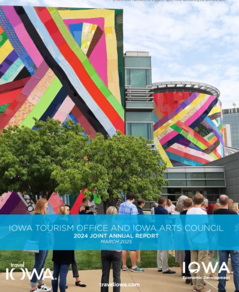
Career-connected learning is a growing priority across Iowa's education system, and fine arts educators are well-positioned to engage with it. The community partnerships, authentic projects, and transferable skills already present in arts classrooms align with what policymakers and employers are describing. This issue of Fine Arts Exchange explores that overlap and offers context for arts educators and organization leaders navigating career-connected learning conversations at the state and local level.
Why the Arts Matter to Iowa's Workforce:
- Arts and cultural production contributed $5.0 billion to Iowa's economy and supported 41,810 jobs.
- Iowa arts, civic, and business leaders view arts and cultural activities as critical to workforce recruitment and community vitality.
- Iowa leaders recognize the arts as preparing students with transferable skills for any career, and work-based learning programs are considered both a current strength and an emerging opportunity for the creative sector.
|
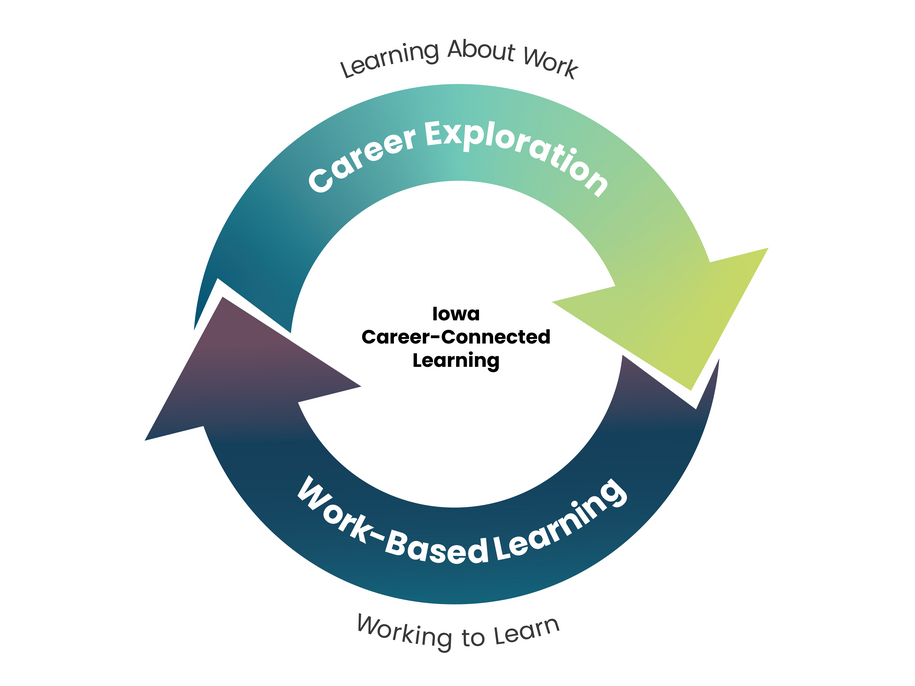 Senate File 2411 (May 2024) narrowed the definition of work-based learning, moving activities like job shadows and career fairs into a separate "career exploration" category. Together, they are now called "career-connected learning."
Career exploration activities help students learn about work, while work-based learning supports students working to learn the knowledge and skills they need to succeed in the workplace and beyond.
 Career Exploration introduces students to careers through structured, community-connected experiences, ranging from classroom speakers and job shadows to authentic projects and service learning. Most activities occur in middle and early high school, in both classroom and off-site settings.
Career exploration experiences require meaningful engagement with a business or community partner. Arts educators are well-positioned to leverage their existing professional networks to meet this standard.
Career Exploration in Action: Arts Examples
- Classroom speakers → visiting artists, composers, designers, arts administrators
- Informational interviews → students connect one-on-one with a working musician, designer, or arts nonprofit professional
- Career immersion experiences → hands-on sessions in a recording studio, design lab, or backstage at a theater
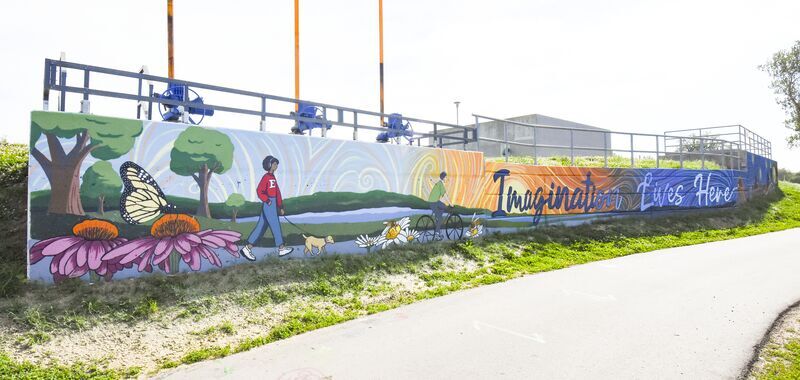
- Authentic projects → commissions, community murals, performance projects with real-world briefs
- Career-based service learning → arts partnerships with community organizations addressing local needs
- Interactive career events → arts-focused career fairs where students explore and "try out" creative careers
- Worksite exploratory events → tours of recording studios, theaters, design firms, museums
- Job shadows → shadowing a studio artist, arts nonprofit staff, or music director
- Professional skills workshops → audition prep, portfolio development, artist statements, professional image
- Mock interviews → portfolio reviews, audition simulations, interview prep with arts community partners
|
 Work-Based Learning (WBL) connects students to sustained, structured experiences with business and community partners, moving beyond exploration into skill development, professional relationships, and career preparation. These experiences primarily occur in high school and are a priority indicator in Iowa's school accountability ratings.
Every WBL experience intentionally includes three essential elements:
- Academic preparation before
- Direct partner engagement during, and
- Reflection and follow-up after.
Work-Based Learning in Action: Arts Examples
- Sustained project-based learning → multi-week commissions, community arts projects, or design challenges with a local arts organization as the ongoing partner
- Simulated work experiences aligned with industry recognized credentials (IRCs) → school-based recording studios, design programs, or early childhood arts settings working toward industry-recognized credentials
- School-based enterprises → student-run concert series, arts markets, design studios, or school stores with arts products
- Student learner programs → paid or unpaid work aligned to a CTE arts pathway (music production, graphic design, media arts)
- Internships → placed with arts nonprofits, theaters, museums, design firms, or creative businesses with a formal training plan
- Pre-apprenticeships → structured foundational preparation leading into a registered apprenticeship in a creative trade
- Apprenticeships → on-the-job learning in a creative trade or arts career with related classroom instruction
- Individual WBL experiences → summer internships, independent arts projects, or activities outside a formal course structure
- Teaching assistant (TA) → serving as a TA in an arts classroom is a simulated work experience within the school setting, connecting students to education as a career pathway
|
 |
|
Districts often jump straight to internships and apprenticeships, but these can be resource-heavy for districts and employers. Instead, as a low-lift entry point, consider What work might your students already be doing that connects to life and careers beyond the classroom? A good place to start is by building career-connected learning into experiences you already provide.
- Incorporate project-based learning within the classroom
- Invite one or two business or community partners into the classroom
- Create an authentic design project or event
This way, every student in the class earns career-connected learning credit while building the broader system with less initial strain on teachers and employers.
|
|
IOWinds Alliance is a 501(c)3 nonprofit dedicated to educating and inspiring young wind and brass musicians throughout Iowa. The organization’s programs include an annual festival, a Young Artist Competition, performing and teaching within school programs, and scholarships for Iowa wind and brass students.
On Saturday, September 12, 2026, we'll host WindFest 2026 at the University of Northern Iowa. This is a full day of masterclasses, chamber coachings, Q&A sessions, a parent session, and a final concert led by teaching artists from the UNI School of Music and beyond. WindFest also includes our Young Artist Competition (YAC), an optional competition open to all WindFest participants in grades 6–12. The YAC awards $6,000 in cash prizes across woodwind and brass divisions, with separate categories for 6th–8th, 9th–10th, and 11th–12th graders. Financial aid for WindFest is available for students. Questions? Contact lisaryoo@iowindsalliance.com.
|
|
 |
|
Keeping the Iowa fine arts education community informed and connected
|
Iowa Choral Directors Association (ICDA) Summer Symposiumowa Choral Directors Association (ICDA) Summer Symposium | July 20-22, 2026 | Central College, Pella
All-Iowa Show Choir Performance | July 20, 2026, 11:00 am | Douwstra Auditorium, Central College, Pella
All-State Jazz Choir Performance | July 20, 2026, 4:00 pm | Douwstra Auditorium, Central College, Pella
Iowa Thespian Leadership Day | August 8, 2026 | Boone High School, Boone
Iowa High School Speech Association (IHSSA) | Judges/Coaches Workshop | August 15, 2026 (Virtual)
IOWinds Alliance | WindFest & Young Artist Competition | September 12, 2026 | University of Northern Iowa, Cedar Falls
Know of an event, conference, or opportunity for Iowa fine arts educators? Send it to diana.hawley@iowa.gov to be included on The Iowa Arts Education Calendar.
 |
|
Sign up and share the Fine Arts Exchange with your colleagues.
Subscribers receive:
- newsletters
- invitations to events
- special announcements
|
Diana Hawley, DMA
Education Program Consultant, Fine Arts
Bureau of Academic and Learner Supports
Iowa Department of Education
Grimes State Office Building
400 E 14th St
Des Moines, IA 50319
515-371-0410
diana.hawley@iowa.gov
https://educate.iowa.gov
|