In This Issue
The 2026 legislative session has concluded and there is new legislation that will affect physicians and the Iowa medical community. Here are some to note:
-
HF 2676: Requires nutrition education as part of licensing requirements and allows ivermectin to be made available over the counter, among other health-related provisions.
-
SF 469: Establishes an emeritus license for doctors over the age of 60 whose primary duty is training and supervising residents.
-
SF 2184: Allows a person seeking an M.D. or D.O. to designate a person to submit application materials; requires the Board of Medicine to rule on an application within 45 days or 75 days of receiving all necessary materials; makes medicine licenses for three years (currently must be renewed every two years).
-
SF 2190: Changes references in the Iowa Code from Physician Assistant to Physician Associate.
-
HF 2788: Requires a doctor to get informed consent before performing an abortion; prohibits dispensing abortion drugs except in a clinical setting from a doctor authorized to dispense the drug; creates a private cause of action for damages; requires doctors to report if mifepristone or misoprostol was used to induce a spontaneous termination.
-
HF 571: Allows a medical professional or health care institution to refuse to perform a medical service for reasons of conscience.
-
SF 304: A bill for an act providing an exception to a minor’s legal capacity to consent to the provision of medical care or services for a sexually transmitted disease or infection.
What happens next?
The Iowa Department of Inspections, Appeals, and Licensing (DIAL) – where the Board of Medicine sits – now has the task of writing the rules related to changes in the law. This process takes several months and includes opportunities for public input. Please stay tuned!
Back to top
International medical graduates (IMGs) make up one in four doctors in the U.S. In this issue, we have a primer on this new licensing pathway, an update on a rule change to help IMGs looking to work in Iowa, and a reminder for hiring managers.
New Licensing Pathways for IMGs
Effective Jan 1, 2025, Iowa offers a specific pathway for IMGs to gain licensure without repeating a U.S. residency, enacted to address physician shortages. This pathway allows for the Iowa Board of Medicine to grant provisional licenses for experienced, qualified foreign-trained physicians, which can transition to full licensure after three years of supervised practice in good standing and without violation of Iowa Code Section 148.6, as long as the licensee was employed by the health care facility for the entirety of the three-year period and passes a background check, among other administrative components. Similar legislation has been enacted in at least 17 states.
Core Requirements for Iowa IMG Pathway:
-
Education: A medical diploma from an international medical school recognized by the Educational Commission for Foreign Medical Graduates (ECFMG).
-
Training: Completion of a residency or equivalent postgraduate training in their home country.
-
Experience: At least five years of licensed medical practice following their postgraduate training.
-
Exams: Passage of U.S. Medical Licensing Exam (USMLE) Steps.
-
English Proficiency: Basic fluency required.
-
Job Offer: A formal employment offer from an Iowa healthcare facility is necessary.
- See these Iowa Code sections that define a healthcare facility: 514j, 102, 135B, 135C
-
Background: A criminal background check and proof of good standing from their original licensing board
The license is state-specific and does not automatically transfer to another state if leaving Iowa.
For more information on the licensure process, visit DIAL's website.
OET Test Option: Proposed rule change moves to next step
At its February 2026 meeting, the Iowa Board of Medicine voted to file a Notice of Intended Action to Iowa Administrative Code 481.653 and 481.656, Special License Eligibility. The proposed rule change would add the Occupational English Test (OET) as a test option to show English fluency for physicians wishing to work in Iowa. The board will vote on adopting rules at its June board meeting.
Attention Hiring Managers: What to Know About the IMG Alternative Licensing Pathway
In 2025, Iowa added a provisional license option for IMGs. The bill adding this option, Senate File 477, was intended to help alleviate the doctor shortage in our state. For this new pathway to be effective in solving that problem, however, those looking to hire need to understand how the license works.
Foreign-trained doctors must have a job position secured to finalize their license through this alternative pathway. Make sure the hiring process isn’t eliminating the possibility of hiring an IMG too soon. Also take this step into consideration when thinking through your hiring timeline.
If you are having trouble finding physicians in this pool of applicants, the Iowa Medical Society and the Primary Care Association are working on finding job opportunities for IMGs. The Iowa Board of Medicine has also been in contact with groups representing IMGs looking for work in Iowa. A hiring entity could also consider creating a profile with 3RNET: National Rural Recruitment and Retention Network – for Health Professionals Seeking Careers in Rural and Underserved Communities.
Here are two other key points to keep in mind:
-
To qualify for a provisional license, the IMG must be a graduate of a foreign medical school evaluated by the ECFMG; be licensed and in good standing in another country for five years immediately preceding their application to Iowa, without pending disciplinary action; have completed a residency or “substantially similar” post-graduate training in their resident country; possess basic English fluency (see update above) and federal immigration status; have passed the USMLEs; and have an offer of employment at an Iowa health care facility in an area of need.
- The provisional license may be converted to a full license after three years of practice, provided the provisional license has not been revoked by the board or surrendered by the licensee.
Read more about IMGs in this AMA Issue Brief: Support for IMGs Practicing in the US.
Back to top

Below are common questions about issues frequently seen in complaints, with practical guidance for daily practice.
What should I do if I am unsure whether to report an issue to the board?
When in doubt, review reporting requirements or contact board staff for procedural guidance. Early clarification can help avoid compliance concerns. To ask the Iowa Board of Medicine a question, contact them at 515.281.5171 or ibmcomplaints@iowa.gov.
What is one of the most common reasons patients file complaints?
Breakdowns in communication with patients not hearing from providers regarding results. Physicians are responsible for having systems in place to track and follow up on ordered tests and referrals, especially when results are abnormal or time sensitive. Patients often report feeling unheard or unclear about next steps. Well-defined explanations and documented follow-up plans can significantly reduce risk of patient complaints and adverse events.
How should I handle missed or canceled follow-up appointments?
Document your attempts to contact the patient and communicating to the patient the importance of follow-up. When clinically significant, include clear instructions and risks of not returning.
What documentation issues are most often seen in complaints?
Common gaps include lack of documented clinical reasoning, failure to document patient communication, and incomplete follow-up plans. If it wasn’t documented in your clinic note, then it is hard to prove that the conversation, physical exam, etc. occurred.
How should I manage disagreements with patients about care?
Document the discussion, including options presented, risks explained, and the patient’s preferences. Maintain professionalism and avoid dismissive language in the record.
What if I am concerned about a colleague’s performance or impairment?
Physicians have a responsibility to prioritize patient safety, and are required by rules to report within 30 days any wrongful acts or omissions committed by another licensee [See 481 IAC 661.1(25)]. Follow appropriate reporting pathways to file a complaint. The Iowa Professional Health Program is available to all licensees struggling with substance dependency or mental health impairments.
In general, how should I approach prescribing in potentially high-risk situations?
Carefully document the indication, alternatives considered, and rationale for treatment. Ongoing monitoring and reassessment should also be documented.
Specifically regarding opioid prescribing, how does the Iowa Board of Medicine look at those complaints?
The Iowa Board of Medicine was recently asked by a licensee: How does the Board of Medicine handle complaints regarding opioid prescribing? The licensee felt their colleagues were hesitant to prescribe opioids for fear of board discipline.
As with other prescribing cases, the board is guided by the rules in Iowa Code and Iowa Administrative Code, namely IAC 481—655.2(124,148,272C) Standards of practice—appropriate pain management.
This code includes, in part: “Physicians treating pain with opioids in a manner consistent with appropriate pain management practices should not fear board action. Dosage is not the sole measure of determining whether a physician has complied with appropriate pain management practices. The board recognizes the complexity of treating patients with chronic pain or a substance abuse history. Generally, the board is concerned about a pattern of improper pain management or a single occurrence of willful or gross overtreatment or undertreatment of pain.”
The board encourages Iowa physicians who treat chronic pain to be familiar with the latest guidance on the topic. Additionally, many continuing medical education courses are available to keep yourself apprised of the most current concerns and regulations.
Quick Tip from the Board
Most complaints are not about the clinical decision—they are about communication, follow-up, and documentation.
|
Back to top
Beyond Resilience: A Nonprofit CEO Takes Up the Fight Against Physician Burnout
By Aneeta Mathur-Ashton, U.S. News & World Report
COVID-19 delivered a lasting blow to the healthcare system, pushing physician burnout to all-time highs. As hospitals were forced to take on unprecedented patient loads and accommodate shifting public health demands, doctors and their teams were forced to take on heavier workloads, face tougher decisions and endure emotional exhaustion.
One organization, the Dr. Lorna Breen Heroes’ Foundation, has been active in advocating for the well-being and mental health of healthcare workers for nearly five years.
Read the entire article.
Back to top
Here are some reminders on things we see, but are easy to avoid:
-
Only access medical records of your patients: Avoid the files of your ex-spouse, your ex-spouse’s new spouse, or the neighbor who is bothering you.
-
Self-report lost hospital privileges: Report to the board if you lose hospital privileges for more than 10 days. This is the responsibility of the licensed physician, not the hospital.
-
Communication is key: Take those extra few moments to ensure clear communication with your patients and document your discussions, particularly informed consent discussions. It’s common to use templates or macros, but it’s also good to include a little verbiage regarding this particular case. Document some specific questions that were asked, and what the answer was. Most of the time physicians truly do have such discussions, but we should document them. Many complaints are about inadequate informed consent, and these types of additions to the consent documentation can go a long way toward protecting the physician and improving patient care.
Back to top
As of April 30, 2026:
- Total active licenses issued by the Iowa Board of Medicine: 19,484
Of those,
- Permanent M.D./D.O.: 17,897
- Resident M.D./D.O.: 973
- Genetic Counselors: 362
- Acupuncturists: 82
- With the rest being special, temporary, administrative, or provisional licenses.
Back to top
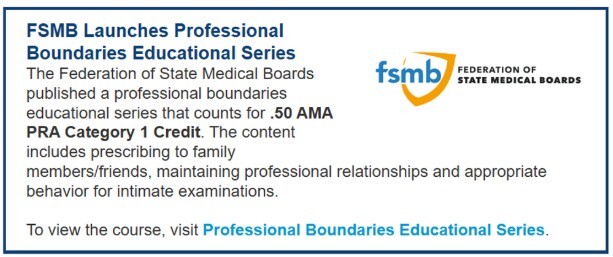 FSMB launches professional boundaries educational series. The federation of state medical boards published a professional boundaries educational series that counts for .50 AMA PRA category 1 credit.
Back to top
Have an idea for a guest blog post for this newsletter? Let us know!
Back to top
|