|
Effective April 1, 2026, the Iowa Board of Pharmacy began accepting the Uniform Multistate Pharmacy Jurisprudence Examination (UMPJE) as the only jurisprudence exam required to obtain licensure as an Iowa pharmacist.
The Iowa Board of Pharmacy is excited to offer this option as a way to encourage graduates and pharmacists to seek licensure in Iowa by reducing the number of exams that have to be taken, reduce cost for exam takers, and reduce time to licensure. This is also a pathway to establishing more efficient and robust license portability for pharmacists across the nation.
As a way to ensure knowledge of Iowa-specific rules and laws, a webinar will be required in addition to passing the UMPJE for graduates and pharmacists seeking licensure in Iowa.
For additional information you may visit DIAL's website.
Early Exam Option

There is also an option for pharmacy students who have completed the didactic portion of the Doctor of Pharmacy curriculum to take the UMPJE prior to degree conferral. Students will be allowed one attempt of the UMPJE prior to degree conferral. NABP staff will verify students have taken and passed the law course and grant eligibility through the student’s NABP e-Profile account to test. This will allow students the option to study for and take the UMPJE during their final year of school, leaving them the opportunity to focus on studying for and passing the NAPLEX after graduation.
|
Federal law requires that any individual granted a state-issued professional license must be a U.S. citizen, demonstrate compliance with lawful presence requirements, or meet an exception found in 8 U.S.C. § 1621(c)(2). Last October, Gov. Reynolds signed Executive Order 15 requiring state government departments to verify immigration status or U.S. citizenship through the Systematic Alien Verification for Entitlements (SAVE) process before granting state-issued occupational and professional licenses.
Commonly Asked Questions Regarding the Process
What happens with my information during the SAVE verification process?
Your personal information collected as part of the application process will be used to verify your citizenship and immigration status through the federal SAVE verification service.
If I am not a natural-born U.S. citizen, what type of documentation should I provide during the application process?
The more information you provide when you submit your application, the quicker we can get results from the SAVE system. Every case is unique, but information such as an alien verification number, Form I-94, SEVIS ID number, naturalization/citizenship certificate number, I-797 receipt number, visa number, or foreign passport number and country are all helpful in obtaining quick results from SAVE.
Do I have to provide my personal information?
You are not required to provide your personal information for the purpose of SAVE verification; however, failure to do so will prevent further processing of your application, pursuant to Executive Order 15.
What happens if I submit false documentation?
Information submitted through SAVE is retained by U.S. Citizenship and Immigration Services (USCIS) and may be shared by USCIS with law enforcement if fraudulent documentation is identified, in accordance with federal law.
Where do I go if I have questions?
Due to the highly individualized nature of immigration documentation and federal verification processes, Board staff are unable to provide updates, interpretations, or definitive timelines regarding an individual’s SAVE status. Verification is conducted through a federal database managed by U.S. Citizenship and Immigration Services (USCIS).
For more information about the SAVE verification process, please visit the USCIS website.
For questions related to the licensing process, please contact ibp-licensure@dial.iowa.gov.
The Iowa Board of Pharmacy has received numerous reports from pharmacists and pharmacy technicians regarding sophisticated telephone scams. These scammers impersonate board investigators, federal agents (DEA/FBI), or Department of Health officials to extort money and personal information.
How the Scam Works
Scammers are using advanced tactics to appear legitimate, including:
-
Phone Spoofing: The caller ID may display the official name and phone number of the State Board of Pharmacy.
-
Public Data: They may cite your actual License Number, NPI Number, or DEA Registration to gain your trust.
-
The Narrative: Callers claim your license is being suspended due to an "active investigation." Sometimes they will go so far as to claim you are involved in illegal drug trafficking, a "found rental car with fentanyl," or suspicious wholesale orders.
-
The Threat: They often demand immediate "bond" or "fines" to prevent arrest or to keep your license in "good standing" while the investigation is pending.
-
Isolation: You may be told not to hang up or speak to anyone else, claiming the "investigation is confidential" and speaking to others will "jeopardize your defense."
Red Flags to Watch For:
-
Demands for Immediate Payment: The Board will NEVER ask for payment over the phone via wire transfer, gift cards, or cryptocurrency to "settle" an investigation.
-
High-Pressure Tactics: Official board investigators will not threaten you with immediate arrest or demand you leave your pharmacy immediately to "receive a fax."
-
Requests for Sensitive Data: Be wary of unsolicited requests for your Social Security number, bank account details, or wholesaler login credentials.
If You Receive a Suspicious Call:
-
Hang Up Immediately: Do not provide any information. Even if the caller ID looks official, it can be faked.
-
Verify Independently: Call the Board of Pharmacy directly at 515.380.7377 or send an email to ibp@dial.iowa.gov. Explain you received a suspicious phone call and need to verify whether there is an active investigation.
-
Do Not Call Back "Provided" Numbers: Scammers often give a fake "direct extension" that leads back to their own call center.
-
Report the Incident:
-
State Board: Notify the Board of Pharmacy of the scam attempt.
-
Federal Authorities: Report the call to the FBI’s Internet Crime Complaint Center (IC3) or the DEA’s Extortion Scam Reporting portal.
-
FCC: If the number was spoofed, file a complaint with the Federal Communications Commission.
Following the update to the board’s rules last summer, several changes for licensees and registrants can be handled via a simple notification to the board instead of the submission of an application. Please be reminded of the following forms to submit notification of such changes:
-
Name Change form (note that you will be required to upload the legal document demonstrating the change)
- Other Changes via the Contact Us form:
- Email, phone, address, employment change
- PIC change
- Ownership change
- Authorized substances (CSA registrants) change
- Temporary facility manager (Wholesale distributors, 3PLs)
- Temporary supervising pharmacist (Outsourcing facilities)
When reporting a change for the license using the Contact Us form, please select the license type so that it can be routed to the licensing specialists. Please do not select “Compliance” to report license changes.
Additionally, licensees are reminded that when the licensee is subject to public disciplinary action in any jurisdiction, the licensee is required to report the action to the board within 30 days of the final adjudication (Final Order). A licensee can provide the required notice using the Discipline Reporting form.
For other communication that is not covered by these notification forms, you can email licensing questions to IBP-Licensure@dial.iowa.gov or general questions to IBP@dial.iowa.gov.
The Iowa PMP has enabled two new alerts and two new indicators for more insight and clarity when reviewing patient reports.
Co-Rx Clarity and Patient Threshold Alerts
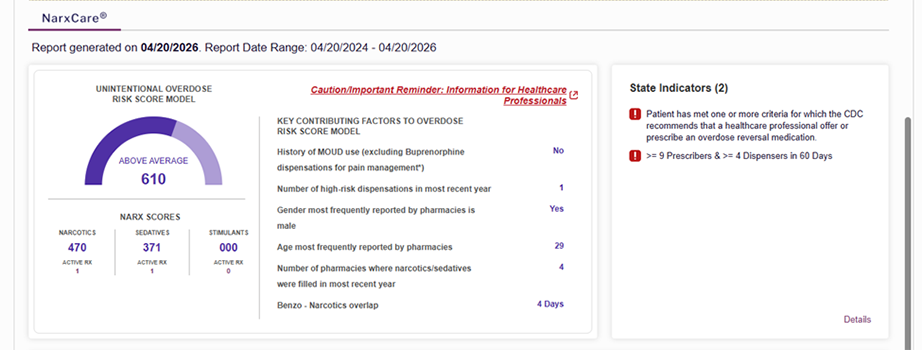
Co-Rx Clarity and Patient Threshold Alerts are now live on patient reports. Co-Rx Clarity alerts will remind prescribers that their patient meets CDC criteria for co-prescribing an opioid antagonist. Patient Threshold Alerts will appear on patients who have seen 5 or more prescribers and used 4 or more pharmacies within the past 60 days. Both alerts will appear next to the Unintentional Overdose Risk Score within NarxCare.
|
Patient Threshold Alert Additional Indicators
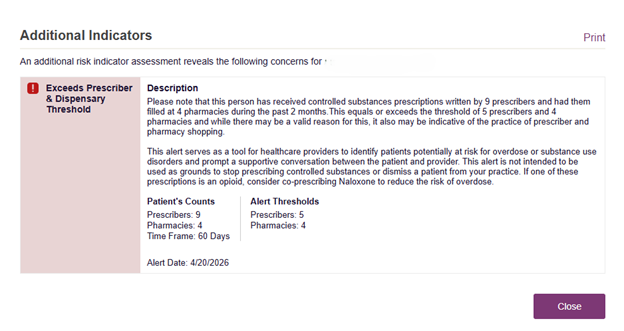
All Patient Threshold Alerts will provide additional information. Click on “Details” in the bottom right corner of the alert tile to review the information.
|
Veterinary Prescription Indicator
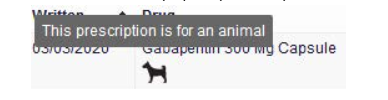
A Pet Med indicator will now appear when appropriate. Pet medications are reported to the PMP in two different ways, depending on the pharmacy’s software. Many pharmacies create a profile for the animal using estimated birth dates and may also include additional information, such as species, within the name field. This can lead to multiple profiles being created for the same animal due to variation in the reported name of the animal or their date of birth.
Alternatively, pharmacies may dispense pet medications under the owner’s name and are able to indicate the prescription is for an animal and include the pet’s name, species, and date of birth elsewhere in the dispensation record. While this is the preferred method of reporting pet prescriptions to the PMP, we recognize the limitations that exist with older pharmacy management systems that may not allow for the dispensation record to be created this way.
Regardless of how prescriptions are being entered at the pharmacy level, pharmacies should be submitting pet dispensation records to the PMP with an “02” in the PAT20 field to indicate it is a veterinary prescription. If pharmacies report pet prescriptions for controlled substances under the owner’s information, a small dog icon will appear in the record to indicate it was a pet medication. Hovering over the indicator displays the help text: “This prescription is for an animal.”
|
ICD-10 Indicator
|
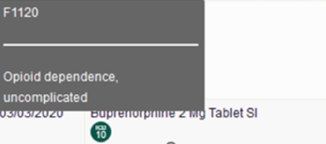
If a pharmacy collects and reports ICD-10 diagnosis codes in their PMP submissions, that data will now be visible within a patient’s report. Hovering over the ICD-10 indicator will display help text that includes the code and its meaning.
|
|
 |
|