 |
|
Last month, a technical issue prevented our newsletter from reaching more than 10% of our audience. The issue has now been resolved. Because of this, today’s newsletter is longer than usual. You may see a “Message clipped” notice—please click “View entire message” to make sure you can see all of the content. |
 The Iowa Department of Education has released implementation supports aligned with the Math Counts Act (House File 784) to assist districts in strengthening mathematics instruction for K–6 students.
These resources are designed to support the local implementation of a Multi-Tiered System of Supports (MTSS), ensuring all students receive timely, targeted, and standards-aligned instruction. Resources are available on the Department’s Mathematics webpage.
For questions regarding implementation supports:
-
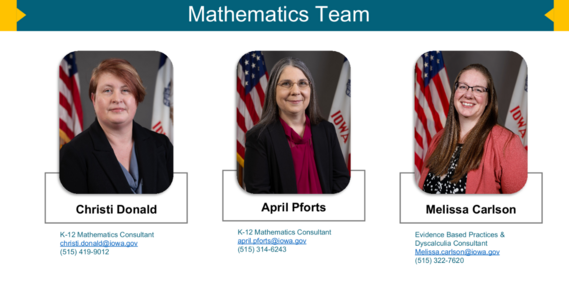
April Pforts – Standards & High School Pathways, HQIM Curriculum Reviews and Implementation, Instructional Practices, Flexibility Professional Learning, and Family Materials april.pforts@iowa.gov
-
Christi Donald – Standards, HQIM Curriculum Reviews and Implementation, Instructional Practices, Flexibility Formula Professional Learning, Iowa Comprehensive Mathematics Plan christi.donald@iowa.gov
-
Melissa Carlson – MTSS and Interventions and Dyscalculia melissa.carlson@iowa.gov
 |
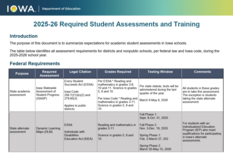
The Iowa Math Counts Act (HF 784) requires all K-6 students to be screened three times a year. Schools will use the results from the screener to identify any student who is persistently at risk in mathematics. For any student identified as persistently at risk, schools must create a personalized mathematics plan, provide interventions, and monitor progress.
The winter screening window starts on January 5, 2026 and concludes on February 6, 2026. The spring screening window is from April 20 - May 29, 2026.
Resources available to support schools:
|
Under Iowa’s Math Counts Act (HF 784), all students, including students with IEPs, who are persistently at risk (PAR) or not proficient on ISASP must be progress monitored using an approved assessment. When writing or updating an IEP, it is essential that the selected progress monitoring tool for the IEP meaningfully aligns with the student’s individualized goals. Progress monitoring is most useful when it directly measures the specific skills and outcomes identified in the IEP, providing accurate and actionable information about student growth.
IEP goals should guide the selection of progress monitoring tools, not the other way around, and goals should be revised only when there is a clear educational need for the student. If an approved assessment used for the purpose of meeting HF 784 requirements does not adequately measure the skills targeted in the IEP, teams may need to consider using multiple progress monitoring tools to meet both requirements (HF 784 and the IEP).
For example, if a district’s progress monitoring system does not assess fraction understanding, but a student’s IEP goals focus on Number and Operations–Fractions, the IEP team may consider selecting a different approved assessment that better measures progress in that area, or use an additional tool alongside the district’s chosen evaluation to monitor the student’s growth accurately for the purpose of the IEP goal and services.
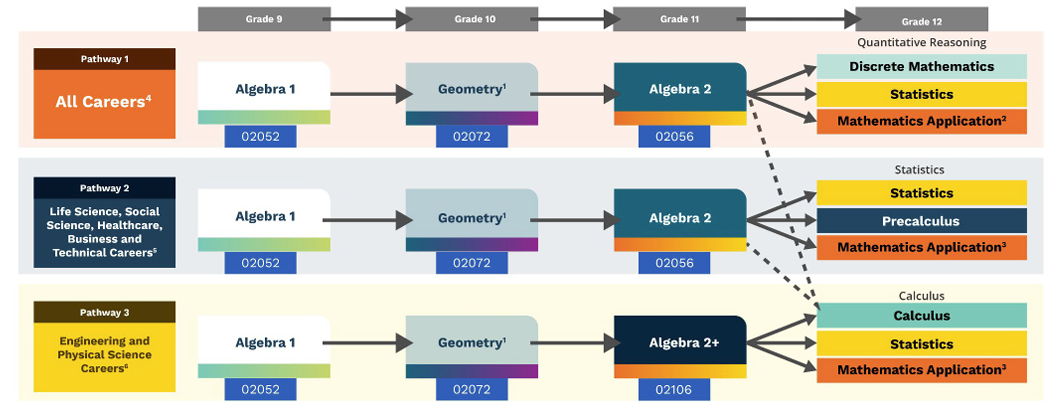 A new resource is available to support districts in reviewing Iowa’s model high school mathematics pathways and their alignment to the Iowa Academic Standards for Mathematics and SCED codes. As educators explore this document, we encourage close attention to how each path is intentionally designed around distinct mathematical priorities and postsecondary goals.
In particular, Pathways 1 and 2 are structured to support focused, coherent engagement with the required high school mathematics standards. At the same time, Pathway 3 extends that work to include a broader range of advanced algebraic, trigonometric, and precalculus concepts. Noticing how the scope and emphasis shift across pathways can support thoughtful conversations about course design, instructional time, and student access to rigorous mathematics aligned to plans.
This resource is intended to support planning, alignment, and local decision-making as districts design pathways that best meet their students' needs and goals.It is posted on the Iowa Department of Education Mathematics Standards webpage.
|
Mathematics Professional Development for Grades K-6
The Iowa Department of Education is providing professional learning aligned with the goals of House File 784 (HF 784), which prioritizes high-quality instruction in early numeracy at no cost for all educators in grades K-6. Build Math Minds -- The Flexibility Formula provides an overview of the components of the professional learning, including asynchronous modules and opportunities for digging deeper in synchronous virtual sessions.
This professional learning series is designed to strengthen mathematics instruction by building fluency and deepening educators' conceptual understanding. Developed by nationally recognized mathematics educator Christina Tondevold, The Flexibility Formula supports teachers in helping all students develop a strong foundation in number sense.
This professional learning opportunity is part of our ongoing commitment to ensuring that all Iowa students develop strong mathematical foundations. Additional support will be provided for schools identified for comprehensive support.
For any questions, contact April Pforts at april.pforts@iowa.gov.
|

The Iowa Department of Education is seeking qualified educators, administrators, higher education professionals, and community stakeholders to help set performance standards for the Iowa Statewide Assessment of Student Progress (ISASP) in English language arts and mathematics. This work will support the updated academic standards adopted by the State Board of Education.
The performance standard setting will take place June 8–12 in Des Moines, and participants must be available for the full schedule. An honorarium of $200 per day, plus reimbursement for travel and lodging, will be provided.
About 170 seats are available and all interested individuals with knowledge of the updated standards are encouraged to apply. Applications are being accepted through February 9, at 5:00 p.m. For more information and to apply, visit the Department’s website or contact Heather Briggs at heather.briggs@iowa.gov.
|
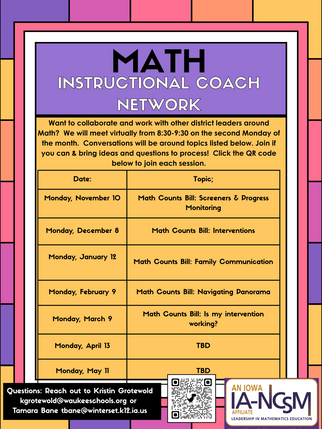
Are you a district math leader or instructional coach looking to collaborate, share ideas, and learn with others across Iowa? The Math Instructional Coach Network is the place for you!
This virtual network meets from 8:30 to 9:30 a.m. on the second Monday of each month to discuss timely topics and practical strategies related to the Math Counts Bill and effective math leadership.
Upcoming Topics:
- Feb. 9: Navigating Panorama
- Mar. 9: Is My Intervention Working?
- Apr. 13 & May 11: TBD
Bring your questions, ideas, and insights to share!
Questions? Contact Kristin Grotewold (kgrotewold@waukeeschools.org) or Tamara Bane (tbane@winterset.k12.ia.us).
This is made available through a collaboration of the Iowa Council of Teacher of Mathematics (ICTM) and the Iowa Affiliate of the National Council of Supervisors of Mathematics (IA-NCSM).
|
 |
|
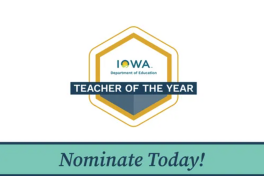
Help us find Iowa’s next Teacher of the Year! Iowans can now submit a nomination for an outstanding PK-12 teacher to serve as the 2027 Iowa Teacher of the Year. Nominations will be accepted through February 27. |
|

The Iowa State University Program for Women in Science and Engineering (WiSE) is offering several exciting opportunities for students this spring and summer. Middle and high school students can explore STEM through hands-on learning, campus experiences, and career exploration.
Go Further Girls STEM Conference (for grades 7–10) will be held on March 26 and April 2 from 9:00 a.m. to 2:00 p.m. at Iowa State University. Students participate in interactive STEM activities and learn about majors and careers they may not have encountered before. Registration is now open with early registration at $30 per student and late registration (after March 13) at $35 per student.
High school juniors and seniors can also apply for RISE with WiSE, a residential summer program for rising 11th- and 12th-graders, running July 12–16 or July 19–23, 2026. Students choose a Science or Engineering track, engage in hands-on STEM experiences, and explore life at Iowa State University. The cost is $450, which includes housing, meals, and program materials, and financial assistance is available. Applications are open and space is limited.
In addition, educators can request WiSE Student Role Models to visit classrooms or events for free. These Iowa State students provide engaging, hands-on STEM activities for PK–12 students across Iowa.
For more information and registration links, visit the WiSE Outreach website or contact rolemodels@iastate.edu.
|
Teaching and learning grants are available this spring through the Iowa Council of Teachers of Mathematics. ICTM members may request up to $750 to support professional learning or projects that promote access and equity for all students, or that are aligned with the Iowa Academic Standards for Mathematical Content and Practice Standards or the 8 Effective Teaching Practices.
This is a great opportunity to take a course, purchase classroom tools, or try out new instructional materials. Applications are accepted on a rolling basis and awarded quarterly, with up to $6,000 distributed each calendar year.
Applications for this cycle are due by March 31 and will be reviewed in early April.
|
|
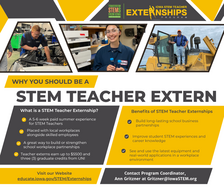
The Iowa Governor’s STEM Advisory Council at the Department of Education is currently accepting teacher applications for the Iowa STEM Teacher Externships Program for the summer of 2026. Summer placements will begin on March 2, 2026.
Now entering its seventeenth year, the Iowa STEM Teacher Externships Program pairs Iowa teachers with a local business or industry workplace host for a six-week summer experience.
Teachers who participate in externships benefit from exposure to real-world STEM applications and from building school-business partnerships. In turn, teachers can improve students' experiences and career knowledge.
STEM Teachers participating in the program earn a stipend of up to $5,500 and three graduate credits through the University of Northern Iowa’s Continuing Education program.
One of the great things about the Iowa STEM Teacher Externships Program is its flexibility. If you have read anything here that piques your interest and you have more questions about the program, we invite you to join the conversation. You can find more information on the Iowa STEM Teacher Externships webpage or by contacting Program Coordinator Ann Gritzner at Gritzner@IowaSTEM.org.
|
|
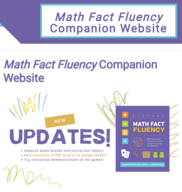
The Math Fact Fluency Companion Website offers free access to classroom-ready resources that support effective, research-based instruction in mathematics facts. Designed to accompany Math Fact Fluency by Jennifer Bay-Williams and Gina Kling, the site includes updated game boards and instruction sheets, now available in PDF and Google Slides formats.
Educators can also explore interactive demonstrations of the games, making it easier to understand how the activities work and how they support learning and retention. These resources are intended to help teachers provide engaging practice while building student confidence and understanding.
Connection to the Flexibility Formula
This free companion website supports the Flexibility Formula professional learning by emphasizing strategic reasoning, multiple ways to solve, and meaningful practice. The games, demonstrations, and instructional supports reinforce flexible thinking about math facts—moving beyond memorization to understanding, efficiency, and confidence.
|
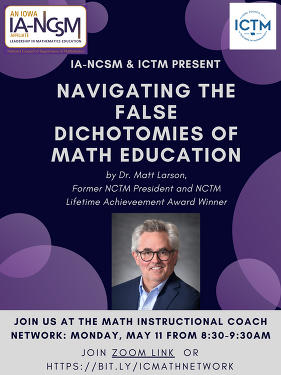
ICTM and IA-NCSM are proud to host Dr. Matt Larson—former NCTM President and NCTM Lifetime Achievement Award recipient—for a special session titled Navigating the False Dichotomies of Math Education.
In this session, Dr. Larson will explore common “either/or” tensions in mathematics education—such as direct instruction vs. inquiry, skills vs. concepts, and teacher-directed vs. student-centered—and how educators and leaders can move beyond them to support both strong learning and positive mathematical identities for every student.
The session will take place on Monday, May 11, from 8:30–9:30 a.m. during the Math Instructional Coach Network. This session will not be recorded, so be sure to mark your calendar. No registration is required—join using the Zoom link.
|
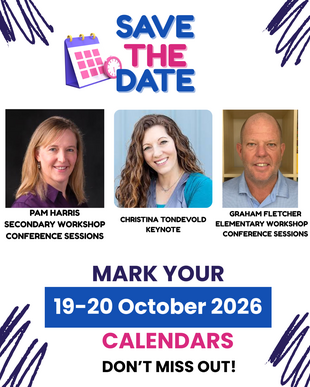
Mark your calendars for the Iowa Council of Teachers of Mathematics (ICTM) 60th Conference, October 19–20, 2026, for an unforgettable two-day professional learning experience!
Monday, October 19:
Join a full-day workshop with your choice of Graham Fletcher (elementary focus) or Pam Harris (secondary focus).
Tuesday, October 20:
Attend the ICTM Fall Conference, featuring keynote speaker Christina Tondevold, along with engaging sessions from Graham Fletcher and Pam Harris.
Iowa’s premier mathematics education event—packed with inspiration, collaboration, and classroom-ready strategies for every grade level.
Save the date and don’t miss out! Be sure to check out ICTM for other happenings.
Stay Connected:
Follow ICTM on social media for updates, resources, and event highlights!
|
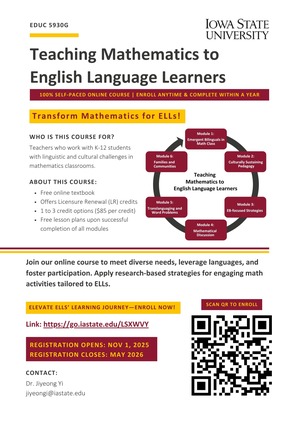
Transform your approach to mathematics instruction for multilingual learners!
This 100% self-paced online course from Iowa State University helps K–12 teachers apply research-based strategies to meet the diverse linguistic and cultural needs of students in math classrooms. Participants explore topics such as culturally sustaining pedagogy, mathematical discussion, translanguaging, and family engagement.
Course Highlights:
- Free online textbook
- Licensure Renewal (LR) credit available — 1 to 3 credits ($85/credit)
- Free lesson plans upon completion
Registration Opens: Nov. 1, 2025
Registration Closes: May 2026
Learn more or enroll: go.iastate.edu/LSXWVY
Contact: Dr. Jiyeong Yi – jjiyeongi@iastate.edu
|
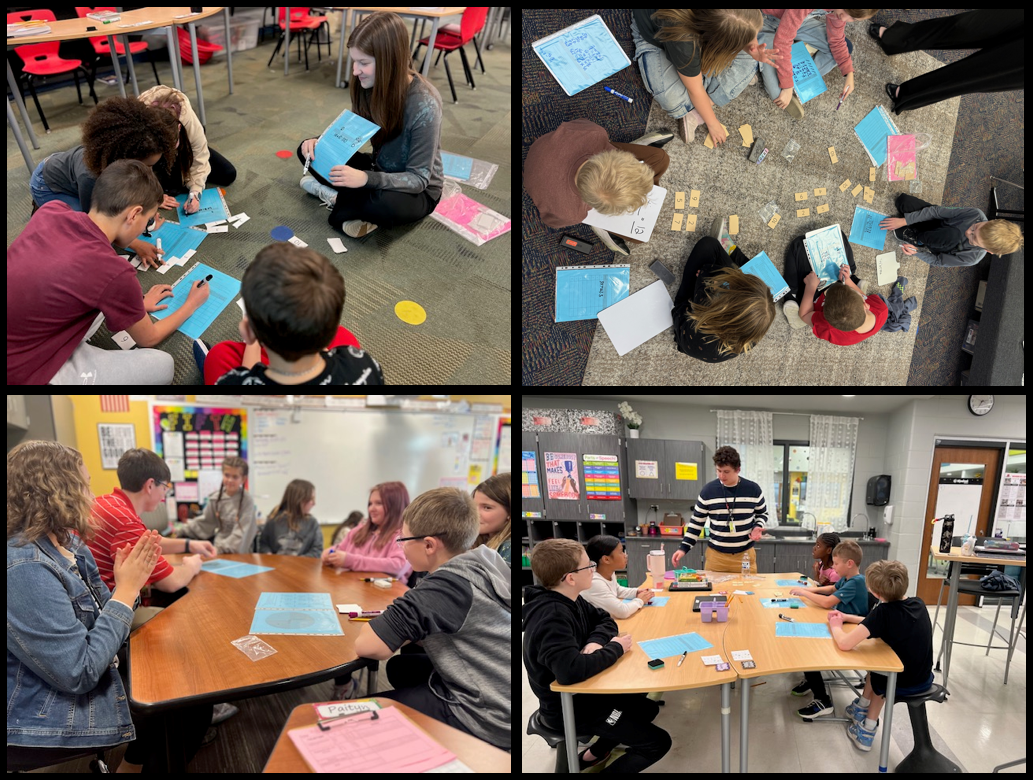 To support their K-Algebra 2 Illustrative Mathematics curriculum, Cedar Falls initiated a creative partnership between their 4th-grade classrooms and the High School Education (Center for Advanced Professional Studies) CAPS program. Recognizing that elementary students needed more time with math centers, theCAPS associates stepped in to design, model, and teach these lessons.
The result? 4th graders gained independence and confidence in math, teachers gained valuable time and resources, and their high schoolers gained real-world teaching experience, learning to adapt and reflect on the fly. It is a perfect example of students helping students to achieve high-quality math instruction.
This partnership exemplified the power of community in education, ensuring high-quality access to math while cultivating the next generation of educators.
 |
|
What are you doing to promote mathematics?
Are you utilizing tools to design instruction, assess learning, or create professional learning opportunities to support all students in meeting the expectations of the Iowa Academic Standards of Mathematics?
We value your work and would love to hear about your successes. Share your work and celebrations!!!
|
Have NEW educators (teachers, coaches, administrators) joined your district/school? Help them sign up for the Mathematics Update newsletter!
Melissa Carlson
Evidence Based Practices & Dyscalculia Consultant
Academics and Learner Supports
Iowa Department of Education
400 E 14th Street
Des Moines, IA 50319
515-322-7620
melissa.carlson@iowa.gov
Christi Donald
K-12 Mathematics Consultant
Academics and Learner Supports
Iowa Department of Education
Grimes State Office Building
515-419-9012
christi.donald@iowa.gov
April Pforts
K-12 Mathematics Consultant
Academics and Learner Supports
Iowa Department of Education
Grimes State Office Building
515-314-6243
april.pforts@iowa.gov
|