|
|

The Department has created training materials designed to support schools and districts in developing Behavior Intervention Plans (BIPs), with a focus on the latest updates to ACHIEVE. There are several training packages that will soon be available to districts.
Generalization Plans and Fading Plans (available now)
These materials provide an overview of generalization and fading plans, emphasizing how to effectively write and integrate these strategies within the teaching, preventative and response sections of the BIP in ACHIEVE. Materials include a recorded overview of the generalization and fading plans. For deeper learning, a slide deck with facilitated activities is also available to districts to provide the training to their staff.
Safety Plans and Reintegration Plans (available soon)
These training materials will provide an overview of safety plans, focusing on when they are required and how to effectively write them within ACHIEVE. Additionally, participants will explore reintegration plans for learners whose behavior may impact their ability to access content in the general education setting.
Lagging Skills (available soon)
These training materials will emphasize the strategies to identify lagging skills in Functional Behavior Assessments and how to address these skills in each component of a BIP. Additionally, there will be a focus on the five key lagging skills identified in ACHIEVE: attention & working memory, cognitive flexibility skills, emotion and self-regulation skills, language and communication skills, and social skills.
To access the training materials, visit the Training & Resources section of the ACHIEVE webpage. Please contact Education Program Consultant Rose Cartee at rose.cartee@iowa.gov with questions.
|
|
The Individuals with Disabilities Education Act requires Individualized Education Programs (IEPs) be reviewed at least once each year. For compliance purposes, IEP teams are required to schedule and conduct an IEP meeting to review a learner’s progress, needs, and goals, and make necessary revisions no later than the currently active IEP End Date. In ACHIEVE, initial and annual IEPs are labeled with three fields:
-
Date: This date is populated based on the date the IEP facilitator selects the Start New IEP button.
-
Start Date: This date is populated based on the date of the scheduled IEP meeting.
-
End Date: This date is calculated as 364 days after the Start Date.
Three new ACHIEVE reports will be available soon in the Reporting section (located on the left navigation menu) to assist Special Education (SE) teachers and administrators with oversight of annual IEP meeting compliance.
-
SE - IEP Review Meeting Overdue: This report (formerly known as SE - Overdue Plans) has been streamlined and now only includes information about learners with active IEPs with an overdue IEP Review meeting as of today. Learners may be flagged as having an overdue IEP Review Meeting if:
- The currently active IEP end date has lapsed and an annual IEP meeting has not been scheduled.
- The currently active IEP end date has lapsed and roll call for the scheduled annual IEP meeting has not been finalized.
-
SE - Historical Overdue IEP Meetings: This is a new report to capture a historical record of all learners for whom an IEP review meeting has historically been overdue. This report will include learners who are actively enrolled and those who have been exited from Special Education and Related Services. In addition to the reasons above, learners appearing on this report may be flagged as having an overdue IEP review meeting if:
- The currently active IEP end date has lapsed and the learner’s exit from Special Education and Related Services has not been finalized.
-
SE - Duration to Finalize IEP: This is a new report to capture information about learners with annual IEPs in draft status after the currently active IEP end date has lapsed. Learners included on this report may be in compliance with the annual IEP review meeting timeline, but do not yet have a finalized annual IEP.
Please contact ACHIEVE Management Analyst Lisa Lohman at lisa.lohman@iowa.gov with questions.
|
|

ACHIEVE will release the next set of progress monitoring enhancements this month. These updates improve clarity, streamline documentation, and strengthen the connection between written goals and ongoing data entry.
Key enhancements include:
- Clearer on-screen fields for defining goal mastery, including mastery direction, number of data points and required conditions.
- Expanded monitoring note options for documenting absences, refusals, or days when typical data cannot be collected.
- A streamlined workflow for entering multiple data points, supporting providers who collect repeated measures.
- Improved alignment between on-screen entries and the printed IEP/IFSP output.
To support implementation, several training resources are available on the ACHIEVE webpage. These supports are designed to ensure consistent statewide practices as teams begin using the updated features.
Please contact Education Program Consultant Shannon Grundmeier at shannon.grundmeier@iowa.gov or Education Program Consultant Katherine Hall at katherine.hall@iowa.gov with questions.
|
|
We are excited to announce new functionality (anticipated Feb. 2026) for ACHIEVE users called “My To-Do List.” This feature is designed to provide email and on-screen reminders for select tasks with upcoming deadlines. The first group of to-do list items to be released will focus on compliance-based and time-sensitive tasks for IFSP and IEP case owners, service providers and evaluation facilitators.
Learners on your case list will be flagged with a to-do list task for each of the conditions described below. Case owners will receive email notifications when tasks are nearing their due date or are overdue. In addition, a new “My To-Do List” accordion will appear on My Dashboard upon login, providing easy access to both system-generated and user-created tasks. You will be able to filter and sort to-do list items for better organization.
System-Generated To-Do Items
ACHIEVE will automatically generate the following tasks based upon predefined logic. Items will automatically be added to each responsible individual’s “My To-Do List”.
For Early Access:
- Complete the first service delivery log - Assigned service providers will receive this task when newly assigned services are added to an IFSP.
- Transition Planning required before 3rd birthday - The service coordinator will receive this task.
- Incomplete IFSP - The service coordinator will receive this task.
For Special Education:
- Child Find Evaluations - The evaluation facilitator will receive this task.
- Early Childhood Transition - The IEP facilitator will receive this task.
- Incomplete IEP - The IEP facilitator will receive this task.
User-Created To-Do List Items
In addition to system-generated tasks, users can create custom to-do items for each learner on their case list. This feature allows users to add descriptions, set due dates and mark tasks as completed.
Note for Family Portal Users
The "My To-Do List" feature will not be available to Family Portal users. Additionally, to-do list items created for ACHIEVE users will not be visible to families.
For a more detailed description of the "My To-Do List" feature, visit the ACHIEVE webpage. Please contact Education Program Consultant Shannon Grundmeier at shannon.grundmeier@iowa.gov with questions.
|
|
The Policy and Practice webinar, Unique Placements (Out-of-State and Residential, PMIC), was held on Dec. 10. This session provided an overview of the IEP team’s obligations towards students served in unique placements, including placements initiated by other State agencies. The recording and session materials are available on the Department website.
The next webinar in the series, Behavior and Discipline will be held on Jan.14 at 8:30 a.m. In coordination with the U.S. Department of Education's Office of Special Education Programs, all districts in Iowa are required to complete Department training on discipline procedures for students with disabilities. At least one school administrator from each district in Iowa is required to participate, but all school district administrators are welcome.
Participants can join the Policy and Practice webinars using Zoom and the passcode 431127. No registration is required, and the same link will be used for all sessions.
Please contact the SDI Literacy Consultant Mary Beilke at mary.beilke@iowa.gov with questions.
|
|

The use of Artificial Intelligence (AI) is growing across all sectors of life, including special education. While AI may be useful in some areas, there are several characteristics of AI that suggest it should be used with caution.
Thomas Mayes, General Counsel, Iowa Department of Education recently published an article Artificial Intelligence, Special Education, and the Law: Risks, Rewards, and Opportunities for Leadership (20 J. Bus. & Tech. L. (2025)), which discusses how AI may be used or misused in special education practice. Since the Individuals with Disabilities Education Act (IDEA) was not drafted with AI in mind, it is important to explore the legal principles implicated by its use and consider policies and practices around the use of AI by special educators.
Please contact General Counsel Thomas Mayes at thomas.mayes@iowa.gov or your own counsel with questions. Note that this article was written by Mr. Mayes in his personal capacity, and not as a Department of Education employee. All opinions expressed in it are solely his.
|
|
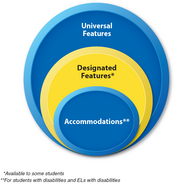
There are three levels of accessibility features available in the Iowa Statewide Assessment of Student Progress (ISASP): universal features, designated features and accommodations.
- Universal features are available to all students.
- Designated features are available to any student who, based on the decision of a team of teachers, requires that feature and uses that feature during instruction and local assessments.
- Accommodations are accessibility features available only when a need is documented in an IEP or 504 Plan and the need is identified in advance.
When determining accessibility supports, it is best practice that a team of educators familiar with the individual characteristics and needs of students, along with parents or guardians (and students, when appropriate) make instructional and assessment decisions. Educators are responsible for developing, implementing and improving accessibility practices for students. Decisions regarding accessibility features must be made on an individual student basis for each student, and must not be made for a group of students.
Remember, accessibility features must be added in TestNav prior to an ISASP testing session being created.
Resources
Iowa Statewide Assessment System Accessibility Manual - Use the five step decision-making process (starting on page 14) to make accessibility decisions.
ISASP Accessibility and Accommodation Manual - Check for specific accessibility features for ISASP testing.
Please contact Education Program Consultant Jennifer Denne at jennifer.denne@iowa.gov with questions.
|
|

Did you know that in Iowa, high school students with IEPs experience significantly lower rates of college enrollment and competitive employment compared to their non-IEP peers? In fact, just over 1 in 3 are not engaged in any kind of school, work, or training within one year after graduation. This is compared to 1 in 10 of non-IEP peers. Strong district systems of college and career readiness that include high-quality transition planning and services can improve these outcomes.
The November 2025 Special Education Policy and Practice webinar covered key topics and strategies for secondary special education programming that will support closing this critical achievement gap. The topics covered include:
- System-level frameworks to support alignment and coordinated service delivery
- Evidence-based practices and predictors that improve outcomes
- Critical elements of transition planning
- Recent trends and findings
- Tools and resources to support implementation
Most importantly, remember that high-quality transition planning is more than just a checkbox for compliance. It is the foundation for each student’s living, learning and working success after high school.
Please contact Education Program Consultant Kelsey Teeter at kelsey.teeter@iowa.gov with questions.
|
|
This February marks the one-year anniversary of the ACHIEVE Family Portal. We are excited to celebrate by helping more families access the powerful tools available to them. The portal gives families 24/7 access to their child’s IFSP/IEP documents, making it easier than ever to stay informed and engaged.
To support IFSP/IEP case owners and service providers in encouraging portal use and to increase confidence in guiding families through the account process, we are offering training webinars and open office hours in February. These sessions will include the benefits of the portal, tips for supporting families through navigation and answers to common questions. The webinar content will be repeated and each session will be recorded.
Training Opportunities
Supporting Early ACCESS Family Portal Account Engagement
When: Feb.16 or 17, 3:30-4:30 p.m.
Register to Attend
Supporting Special Education Family Portal Account Engagement
When: Feb.18 or 19, 3:30-4:30 p.m.
Register to Attend
Family Portal Office Hours
Have questions? Department representatives will be available for informal Q&A and navigation support during open office hours.
When: Monday, Feb 23 - Thursday, Feb. 26, 3-4:30 p.m.
Zoom Link
To increase participation, invitations will automatically be (re)sent to validated family contacts with an email address in ACHIEVE in March. We appreciate your partnership in helping families make the most of the ACHIEVE Family Portal. Questions about the ACHIEVE Family Portal can be directed to the Family Portal support team at achievesupport@iowa.gov.
|
|

The Iowa Department of Education has been diligently working to release functionality to support ACHIEVE users in the identification of learners who are eligible for Medicaid reimbursement of IFSP or IEP services. Conversations with the Iowa Department of Health and Human Services (HHS) to identify a firm timeline for release are still ongoing. In the meantime, you can learn more about anticipated ACHIEVE changes.
Recorded webinars, training materials, and confidentiality requirements will be shared prior to the release of this new Medicaid functionality. ACHIEVE users responsible for Medicaid billing can use this form to request the Medicaid Reporting role assignment in ACHIEVE. This role should only be requested for the primary Medicaid billing contact(s) at each AEA and LEA and must be assigned by Department staff.
The Department also hosted a recorded webinar in December to address commonly asked questions about Medicaid. This recording, along with PowerPoint slides and a document addressing questions raised during the webinar are available on the School-Based Medicaid webpage.
Key Takeaways
-
Special Education Behavior Log Requirements:
- Weekly behavior summaries and the associated approval signatures by MHPs are no longer required, effective immediately. Both the AEA and LEA Medicaid provider manuals indicate weekly summaries can be collected, but are not a requirement for Medicaid reimbursement.
-
Medicaid Exclusion and Sanction Checks
- Quarterly reporting of Office of Inspector General (OIG) checks of the exclusions and sanction list no longer need to be submitted to the Department. However, OIG checks must still be completed monthly and maintained in the LEA or AEA audit file.
-
Medicaid Consent Forms
- All approved one-page Medicaid consent forms, ACHIEVE Medicaid consent forms, and other previously signed versions of older Medicaid consent forms allow agencies to seek confirmation of Medicaid eligibility and, if eligible, request reimbursement of eligible services, share records with Iowa HHS as requested, and release records to contracted third-party billing vendors (provided that a data sharing agreement protecting PII and meeting FERPA requirements is outlined contractually).
-
Documenting the learner’s approved Medicaid consent in ACHIEVE is an essential component for inclusion on future Medicaid eligibility reports.
-
Consent must be obtained prior to requesting eligibility information from Iowa HHS.
- Agencies must also obtain consent to release and exchange information with respective organizations prior to contacting healthcare providers (example: obtaining medical records or obtaining required ICD-10 information for reimbursement, if applicable).
Resources
Please contact Administrative Consultant Melissa Walker at melissa.walker@iowa.gov for questions regarding Medicaid or Education Program Consultant Shannon Grundmeier at shannon.grundmeier@iowa.gov with questions about ACHIEVE functionality.
|
|

Under Iowa’s Math Counts Act (HF 784), all students, including students with IEPs, who are persistently at risk (PAR) or not proficient on ISASP must be progress monitored using an approved assessment. When writing or updating an IEP, it is essential that the selected progress monitoring tool for the IEP meaningfully aligns with the student’s individualized goals. Progress monitoring is most useful when it directly measures the specific skills and outcomes identified in the IEP, providing accurate and actionable information about student growth.
IEP goals should guide the selection of progress monitoring tools, not the other way around. Goals should be revised only when there is a clear educational need for the student. If an approved assessment used for the purpose of meeting HF 784 requirements does not adequately measure the skills targeted in the IEP, teams may need to consider using multiple progress monitoring tools to meet both requirements (HF 784 and the IEP). For example, if a district’s progress monitoring system does not assess fraction understanding, but a student’s IEP goals focus on Number and Operations–Fractions, the IEP team may consider selecting a different approved assessment that better measures progress in that area, or use an additional tool alongside the district’s chosen evaluation to monitor the student’s growth accurately for the purpose of the IEP goal and services.
Please contact Education Program Consultant Donna Sump-McClain at donna.sump-mcclain@iowa.gov with questions.
|
Find links to past issues of IDEA Insight on the Department website.
|