| |

November 2025
Inside this issue:
Department of Education Resources
|
Upcoming Deadlines
|
Due Date
|
What's Due
|
|
November 3
|
Facilities, Elections, and Sales Tax Data Collection Due
|
|
November 3
|
School Association Reporting Due
|
|
November 4
|
Last Date for an Election to Reorganize Effective July 1: 1st Tuesday in December (even numbered years), 1st Tuesday After 1st Monday in November (odd numbered years)
|
|
November 7
|
Exhibits Due for the December 16, 2025 SBRC Hearing
|
|
December 1
|
SBRC Application for MSA
|
|
December 1
|
Nonpublic Transportation Parental Claims Due
|
|
December 15
|
School Board Officers and District Leadership Application Due
|
|
December 16
|
SBRC Hearing
|
|
January 1
|
Last Date to Certify to the Department for Reorganization or Dissolution Action Effective July 1
|
|
January 15
|
At-Risk/Dropout MSA Application Due
|
Staff Contact Information
|
|
|
The FY25 CAR Report titled "Miscellaneous Income and Actual Expenditures (GAAP Basis)" on EdInsight has been updated to include the district's Education Support Personnel Salary Supplement (ESPSS) funds in the Miscellaneous Income amount (Row 11). This will match the Other Miscellaneous Income amount (Row 30) on the "Unspent Authorized Budget Report" available on the Department of Management's School Resources web page.
CAR reports are available in EdInsight in the Portal. Instructions to run CAR reports are in the How to Run CAR Reports on EdInsight resource document available on the CAR web page.
The FY26 Allocation Summary is available. The summary includes individual district data for selected federal, state, and local resources by source and/or project code in one file for easy reference. The second tab in the file provides additional information, which may be especially helpful for new School Business Officials (SBOs) or those looking to learn more about revenue streams.
Recipients and subrecipients of federal funds are required to maintain time and effort documentation as required by the Code of Federal Regulation’s Uniform Administrative Requirements for Federal Awards (2 C.F.R. § 200.430(b)). The documentation must prove costs for employee salaries and benefits that were paid using federal funding (e.g., IDEA Part B) were appropriate to the source and accurately reflect the work performed. Records requirements are listed below.
- Be supported by a system of internal controls that provides reasonable assurance that the charges are accurate, allowable, and properly allocated.
- Be incorporated into the official records of the subrecipient.
- Reasonably reflect the total activity for which the employee is compensated by the subrecipient, not exceeding 100 percent of compensated activities.
- Encompass federally-assisted and all other activities compensated by the subrecipient on an integrated basis but may include the use of subsidiary records as defined in the subrecipient's written policy.
- Comply with the established accounting policies and procedures of the subrecipient.
- Support the distribution of salary or wages among specific activities or cost objectives if an employee works on more than one award or activity.
Post-crash drug and alcohol testing requirements are available in the Transportation section below.
|
|
|
Question: What is the related account coding for the Special Education Support Services (SESS) funding?
Answer: Please refer back to the SESS AEA Payment article from the October 2025 School Business Alert (SBA).
Question: Does the school board have to approve the at-risk, alternative school, and returning dropouts and dropout prevention programs (AR/DOP) program plan each year?
Answer: Iowa Code section 257.38 requires school boards to approve an annual program plan with all required components before submitting a request for modified supplemental amount (MSA) to support at-risk, alternative school, and returning dropouts and dropout prevention programs. Failure to do so invalidates the district’s authority to request the additional spending authority. This section of the code also provides the 9 elements that each plan must include.
Board Action: Boards must approve both (1) the request for additional spending authority and (2) the at-risk/dropout plan each year.
Questions may be directed to Ted Bauer at ted.bauer@iowa.gov or 515-979-5468.
Question: If a district’s Statewide Voluntary Preschool Program (SWVPP) incurs costs beyond the available SWVPP funds, what options are available to cover the excess expenditures?
Answer: There are multiple options a district may consider.
- First, review the SWVPP expenditures to ensure costs are actually SWVPP costs or should be appropriately attributed to other programs (e.g., Head Start, child care, special education) as well as other sources (e.g., Teacher Salary Supplement (TSS)). For example, an associate salary may be appropriately split between SWVPP, child care, and Head Start programs; or a teacher may have part of their salary paid from SWVPP, TSS, and special education.
- Next, consider costs that could have multiple appropriate sources. For example, teacher salaries could also be paid from repurposed gifted and talented (TAG), Professional Development (PD), or Teacher Leadership & Compensation (TLC) funds (carryforward and current funding) for TSS purposes; computers could be purchased from PPEL, and other costs may be paid from the flexibility account.
Additional information about using the flexibility account or TLC, PD, or TAG for TSS purposes (i.e., teacher salaries) is available below in the article titled “Leverage Available Categorical Resources” and on the Department’s Levies & Funds and Categorical Funding web pages.
|
|
|
The December 2025 income surtax payment (to be paid by the end of December by the Department of Revenue) represents three quarters of the amount of income surtaxes collected for your district from January 1, 2025, through October 30, 2025. The rest of the payment, plus or minus any adjustments made by the Iowa Department of Revenue due to their audits of income tax returns, will be paid around February 1, 2026.
This payment is based upon the income surtax rates established for your 2024-2025 budget. If you didn’t have a surtax for the Physical Plant and Equipment Levy (PPEL) Fund, the entire payment should be credited to your General Fund. On the other hand, if you had both General Fund and PPEL surtax, then split the income surtax in accordance with the rates.
The Department of Education will post the payment amount, rates for each fund, and dollar amount for each fund on the State Payment Information FY26 web page.
Questions may be directed to John Parker at john.parker@dom.iowa.gov or 515-281-8485.
|
|
|
Coding reminders for TLC are provided below.
- Use Source/Project Code 3116 for coding revenue and expenditures.
- Expenditure functions are determined by the use of funds. For example, expenditures for Instructional Staff Support Services (Function 221X) are common. Keep in mind that use of the instruction function code (Function 1XXX) is only appropriate for expenditures related to instruction to students, not other teachers.
- FY26 district allocations are calculated based on the budget enrollment multiplied by the per pupil amount of $385.29 (Aid and Levy Line 4.46).
- Tuition received for open enrollment in (Source 1323) and expenditures incurred for open enrollment out (Object 567) should include the TLC project code (3116) for the portion of TLC received or paid.
- FY26 TLC amount for open enrollment of $385.29 is based on the current year amount.
Questions related to account coding may be directed to Song Luong at song.luong1@iowa.gov or 515-205-0259 or Bobby Wilson at bobby.wilson@iowa.gov or 515-210-9674.
Questions related to the TLC program may be directed to Stephanie Langstraat at stephanie.langstraat@iowa.gov or 515-402-8700.
|
|
|
Action Item #1: School districts are required to report school board membership changes to the Department annually by December 15 (Iowa Code § 291.11) in the School Board Officers and District Leadership Contacts application in the Education Portal.
The Department also uses other district leadership reported in this application to build other email distribution lists.
Action Item #2: Please check your district to ensure each of the key leadership position contacts for your district are reported and current. The Department uses information reported through the School Board Officers and District Leadership Contacts application to populate the Department’s email distribution lists. It is important for this information to be accurate at all times to ensure correct routing.
- Chief financial officer/school business official (CFO/SBO)
- Building and grounds director
- Transportation director
- Auditor
- Special Education
- Work-Based Learning
- Career and Technical Education
- School-Based Medicaid
- School Safety
- Curriculum Contact
The application is available for updates throughout the year, which helps ensure the Department has the most accurate contact information for each of these key district stakeholders.
Questions regarding this application may be directed to Holli Marolf at holli.marolf@iowa.gov or 515-281-5812.
The SBRC Application will open in mid November. The application calculates eligibility for modified supplemental amount (MSA) requests related to increased enrollment, open enrollment out not on prior year headcount, and English learners receiving instruction beyond five years.
Additional information, including board language for approving these requests, was published in the October 2025 School Business Alert.
Questions may be directed to Ted Bauer at ted.bauer@iowa.gov or 515-979-5468.
The At-Risk/Dropout Application will be available via the Iowa Education Portal by early December. The application will open after Fall 2025 Certified Enrollment numbers are finalized. The application includes an optional request for MSA so only those districts wishing to request SBRC-granted MSA (Project 1119) will need to complete a submission.
Eligibility: The purpose of the requested MSA is to provide additional resources for the 2026-2027 school year that are necessary to implement the at-risk, alternative school, and returning dropouts and dropout prevention programs (Iowa Code § 257.38). Boards must approve both the request for additional spending authority and the at-risk/dropout plan (with all required components) each year. Failure to do so invalidates the district’s authority to request the additional spending authority.
Questions about related programming or the application may be directed to Ted Bauer at ted.bauer@iowa.gov or 515-979-5468.
First semester parental claims for nonpublic transportation are due to the student's resident district no later than December 1 (Iowa Code § 285.3). Parents providing transportation for their children to attend an accredited nonpublic school are eligible to file a claim with their resident district. Please communicate this information to the nonpublic schools within your district.
Once the claims have been received by the district, it is important to establish a good record-keeping process to ensure accurate information is reported at the end of the school year by the district to the Department.
Tip: The most common information to track, possibly on a spreadsheet, are the names of the parent(s) and student(s), legal address, name and address of the nonpublic school, and the mileage distance for which the parent is transporting the student from home to the nonpublic school. This will make the claim from the district to the Department at the end of the year much easier to file and verify.
Verify Accuracy
- Please be sure to check for errors on parental claims as the information is submitted.
- Incorrectly submitted claims affect the proration factor and payment to all parties.
- Annually, the total amount of claims requested exceeds the available appropriation so all claims are prorated.
- Once the proration factor is determined, all claims are paid at once which fully expends the appropriation.
- Errors in parent forms or district submissions discovered after the nonpublic transportation claim is submitted are therefore unable to be addressed as the appropriation is fully expended.
As a reminder, second semester claims from parents to the districts are due May 1, 2026 (Iowa Code § 285.3). Information regarding this program can be found on the Department's Nonpublic Transportation Reimbursement web page.
Questions regarding nonpublic transportation may be directed to Tom Simpson at tom.simpson@iowa.gov or 515-336-3965.
|
|
|
School leaders and employees serve an essential role in preventing and responding to youth human trafficking. Understanding risk factors that make students susceptible is a critical first step to recognition. SchoolSafety.gov has published an issue brief published September 2025 titled Youth Human Trafficking Risk Factors and Protective Actions for K-12 Schools that outlines youth human trafficking risk factors and corresponding strategies that K-12 schools can implement to help protect students from trafficking situations.
The Transportation Security Administration (TSA), a branch of the United States Department of Homeland Security, offers free security training and assessments for school transportation departments in Iowa. The agency visits districts in Iowa to evaluate current plans and offer suggestions for improving transportation security. TSA will also offer training for school bus drivers regarding threat recognition, mitigating threats, and responding to threats. This training will include recognizing suspicious packages, suspicious persons, and suspicious behavior. These are free services to each school district.
Questions about, or requests to participate in, this program can be directed to TSA Inspector Ron Gann at ronald.gann@tsa.dhs.gov or 402-672-4898.
|
|
|
The School Budget Review Committee (SBRC) met in regular session to hold hearings on October 28, 2025. The Committee reviewed FY26 member terms and final FY26 cash reserve levy amounts totaling $211,904,981, up 13% from FY25. The Committee received an update from two districts that were granted MSA in FY25 based on anticipated costs and provided documentation the amount awarded was fully expended for the intended purpose. Action was taken to direct districts that were late filing financial reports to appear at the next SBRC hearing to present corrective action plans, approve MSA for three districts relating to hazard abatement, recommend approval of a district’s Certificate of Need (CON) request, and approve a transfer from the General Fund to the Student Construction Enterprise Fund including an equal amount of MSA for program start-up costs. The Summary of Action is available on the Department's SBRC web page.
Questions may be directed to Stephanie Edler, SBRC liaison, at stephanie.edler@iowa.gov or 515-689-2258.
If additional resources are needed now, consider leveraging available resources through either the flexibility account or the increased uses of some restricted funds for TSS purposes.
Flexibility Account
A school district may authorize a transfer of all or any portion of the unexpended, unobligated amounts remaining at the end of the fiscal year for the categorical funds below to the Flexibility Account.
- Project 3117: SWVPP
- Project 3373 or 3376: PD
- Project 1113: Home School Assistance Program (HSAP)
- Project 3116: TLC
- Other categorical sources if the program, purpose, or requirements for the expenditure of such moneys have been repealed or are no longer in effect
Requirements: The process to use the Flexibility Account, including information about the required public hearing and language for the board resolution, are available on the Department’s General Fund web page, under the Flexibility Account section titled “General Fund: Flexibility Account”.
Increased Use for TSS Purposes
Beginning FY24, a school district may use carryforward funds as well as the current year’s allocation of the categorical funding below for TSS purposes.
- Project 3373 or 3376: PD
- Project 3116: TLC
- Project 1118: Gifted and Talented (TAG)
Best practice: Include as an informational item to the district’s board of education or through formal board action (e.g., negotiation process) when using PD, TLC, or TAG funds for TSS purposes. Additional guidance on how to use these funds for TSS purposes is available on the Department’s Categorical Funding web page, under the Budgetary Allocation Information section titled “HF 68 Guidance: Categorical Funding and Operational Sharing”.
FY25 Statewide Carryforward Balances
Preliminary FY25 statewide carryforward amounts for categorical funds that may be available to transfer to a Flexibility Account or available to use for TSS purposes are provided below.
|
Project Number
|
Preliminary FY25 Statewide Carryforward Balances
|
Available for Flexibility Account
|
Available for TSS Purposes
|
|
1113 (HSAP)
|
$12,579,275.75
|
Yes
|
No
|
|
1118 (TAG)
|
$23,285,304.47
|
No
|
Yes
|
|
3116 (TLC)
|
$51,324,974.81
|
Yes
|
Yes
|
|
3117 (SWVPP)
|
$19,614,100.26
|
Yes
|
No
|
|
3373 and 3376 (PD)
|
$24,055,782.44
|
Yes
|
Yes
|
The Bureau of Nutrition and Health Services offers the following reminder about federal and program-specific procurement regulations for LEAs who are considering contracting with a Food Service Management Company (FSMC).
Federal regulations at 2 C.F.R. § 200.319(a) require all organizations that receive federal funding provide a level playing field that allows for full and open competition for all potential vendors. When one FSMC is allowed to promote their business to district officials, then an equal opportunity must be provided to other FSMCs. Only allowing one FSMC to promote their business is providing them with an unfair advantage in the bidding process. If an FSMC is found to have an unfair advantage they may be excluded from bidding on potential contracts. Additionally, vendors who assist with contract language or specifications shall be excluded from competing for the procurement.
For additional information, refer to USDA Guidance - Contracting with Food Service Management Companies: Guidance for School Food Authorities.
Questions may be directed to Shea Cook at shea.cook@iowa.gov or 515-326-1682.
Information regarding Iowa’s Students First Education Savings Account (ESA) program can be found on the Department's Students First Education Savings Accounts web page.
|
|
|
Questions relating to the articles below may be sent to State Director for Pupil Transportation, Tom Simpson at tom.simpson@iowa.gov or 515-336-3965 or one of the inspectors below.
The United States Department of Transportation’s Federal Motor Carrier Safety Administration (FMCSA) defines when drug and alcohol tests are required to be performed after a crash for a school bus driver with a commercial driver’s license (CDL) (49 CFR § 382.303).
Employer Responsibility: It is the responsibility of the employer to ensure that testing is performed as federally required. The employer may choose to perform post-crash drug and alcohol testing even when not federally required.
FMCSA’s “When does testing occur and what tests are required?” web page provides information related to post-crash drug and alcohol testing for CDL drivers. The table below, excerpted from the same site, defines the type of accident and whether testing is required.
|
Type of Accident Involved
|
Citation Issued to the CMV Driver
|
Test Must Be Performed by Employer
|
|
Human Fatality
|
Yes
|
Yes
|
|
Human Fatality
|
No
|
Yes
|
|
Bodily Injury With Immediate Medical Treatment Away From the Scene
|
Yes
|
Yes
|
|
Bodily Injury With Immediate Medical Treatment Away From the Scene
|
No
|
No
|
|
Disabling Damage to Any Motor Vehicle Requiring Tow Away
|
Yes
|
Yes
|
|
Disabling Damage to Any Motor Vehicle Requiring Tow Away
|
No
|
No
|
Fall brings frost and the ideal opportunity to ensure that each school bus driver’s view of the road remains unobstructed.
Key maintenance items to consider include those listed below.
- Determine whether new windshield wipers are needed. Many buses remain unsheltered over the summer causing rubber windshield wipers to deteriorate and become hard. Fall is a great time to replace blades so they are pliable for the colder weather.
- Cabin air filters should be checked and replaced as needed. Dirty filters can block airflow for defrosters and heaters.
- Verify defroster and heater fans are providing proper air flow to clear the windshield and other windows and provide heat for passengers.
- Check valves to ensure warm coolant is allowed to flow to heaters and defrosters. These valves may have been shut off over the summer to keep the heat out of the passenger compartment.
- Remind drivers to ensure the windshield is clear of frost and/or fog before driving the vehicle.
The ability for drivers to see out of the vehicle is critically important to the safety of the driver, passengers, and other motorists. Ensuring that drivers have adequate visibility makes everyone safer.
Many drivers have successfully completed the S.T.O.P. Training for New School Bus Drivers (Online Component) through AEA Learning Online.
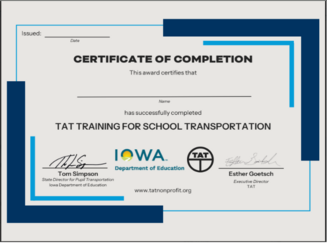
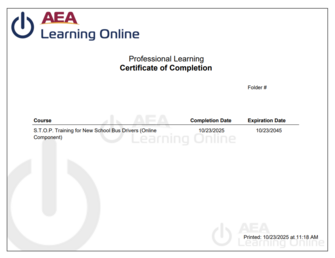
Upon successful completion of all nine modules, drivers will be able to print two distinct certificates.
 |
|
The first certificate is for the final module, How School Transportation Can Combat Human Trafficking. This certificate is co-branded by the Department and Truckers Against Trafficking (TAT). Iowa is one of only nine states that provides this type of training to all new school bus drivers.
|
 |
|
The second certificate shows that the driver completed the entire online component of New Driver S.T.O.P. Training.
|
Helpful Tip: Drivers should be reminded to print both certificates. Printing both certificates is the final step necessary for the driver’s records to show that the online component has been completed. The driver’s employer may ask the driver for a copy of the final completion certificate to help ensure that the driver has met the online training requirement.
|
|
|
It is the policy of the Iowa Department of Education not to discriminate on the basis of race, creed, color, sexual orientation, national origin, sex, disability, religion, age, political party affiliation, or actual or potential parental, family or marital status in its programs, activities, or employment practices as required by the Iowa Code sections 216.9 and 256.10(2), Titles VI and VII of the Civil Rights Act of 1964 (42 U.S.C. § 2000d2000e), the Equal Pay Act of 1973 (29 U.S.C. § 206, et seq.), Title IX (Educational Amendments, 20 U.S.C.§§ 1681 – 1688), Section 504 (Rehabilitation Act of 1973, 29 U.S.C. § 794), and the Americans with Disabilities Act (42 U.S.C. § 12101, et seq.). If you have questions or complaints related to compliance with this policy by the Iowa Department of Education, please contact the legal counsel for the Iowa Department of Education, Grimes State Office Building, 400 E. 14th Street, Des Moines, IA 50319-0146, telephone number: 515-281-5295, or the Director of the Office for Civil Rights, U.S. Department of Education, Cesar E. Chavez Memorial Building, 1244 Speer Boulevard, Suite 310, Denver, CO 80204-3582, telephone number: 303-844-5695, TDD number: 800-877-8339, email: OCR.Denver@ed.gov.
|
|
|
|
|