|
 October 2025
|
|
Inside this issue:
Department of Education Resources
|
Upcoming Deadlines
|
Due Date
|
What's Due
|
|
October 30
|
Fall BEDS Staff Application Due
|
|
October 30
|
Operational Sharing Application Due
|
|
November 3
|
Facilities, Elections, and Sales Tax Data Collection Due
|
|
November 3
|
School Association Reporting Due
|
|
November 4
|
Last Date for an Election to Reorganize Effective July 1: 1st Tuesday in December (even numbered years), 1st Tuesday After 1st Monday in November (odd numbered years)
|
|
November 7
|
Exhibits Due for the December 16, 2025 SBRC Hearing
|
Staff Contact Information
|
|
 |
|
The Iowa Department of Education (Department) Bureau of School Business Operations is pleased to announce the addition of Sarah Sheeder to our team! Sarah joins us from Guthrie Center, Iowa. She has served as a School Business Official for the past fifteen years, with experience in five different Iowa school districts through operational sharing agreements. Prior experience also includes serving as a junior high and high school girls' basketball coach. Sarah will be supporting the field in the realm of special education finance and fiscal monitoring and can be reached at sarah.sheeder@iowa.gov and 515-326-0854. Welcome, Sarah! |
The S.T.O.P. Training for New School Bus Drivers (Online Component) is now available.
Details and instructions are available in the Transportation section below.
Use the School District Look-Up Map to determine the resident district for any address in Iowa.
Directions: Click on the search icon, the magnifying glass, in the upper right-hand corner (it is the smaller and lower icon). Enter the address in the search box. Use your scroll to zoom in and out of the map. Click anywhere within the boundaries of the district to see the district’s information.
|
|
|
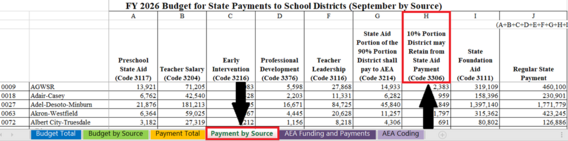
Question: Where can school districts find the monthly payment amounts for the 10% Special Education Support Services (SESS) funding?
Answer: Monthly payment amounts for the 10% SESS are in the LEA Monthly Payment Summaries section on the Department’s State Payment Information web page. The amounts can be found in Column H of the Payment by Source tab in the monthly LEA State Aid Payment Summary file.
 Question: What is the related account coding for the 10% SESS retained funds?
Answer: Revenues for the 10% SESS funding is coded to Source/Project 3306, Program 260. Expenditures for the 10% SESS funding is coded to Project 3306, Program 260. If a balance remains, a restricted fund balance (Program 260, Project 3306, Account 729) will be created.
Question: Where are the school district’s monthly payment amounts found for the 90% SESS funding?
Answer: Monthly payment amounts for the 90% SESS funding are in the LEA Monthly Payment Summaries section on the Department’s State Payment Information web page.
- State aid portion of the 90% - Column R (blue) of the AEA Funding and Payments tab in the monthly LEA State Aid Payment Summary file.
- Property tax portion of the 90% - Column S (yellow) of the AEA Funding and Payments tab in the monthly LEA State Aid Payment Summary file.
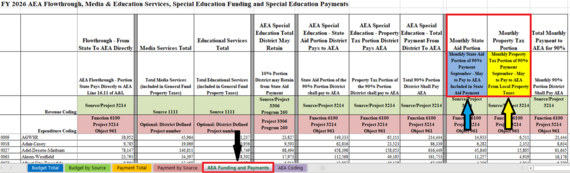 Question: What is the related account coding for paying the 90% SESS funding to the AEAs?
Answer: Districts will code revenues received as flow through, similar to prior practice for AEA flow through funding. Districts will code the funds to Source/Project 3214.
- The state aid portion of the 90% (blue from the previous question) is coded to Source/Project 3214.
- The property tax portion of the 90% (yellow from previous question) is coded to Source/Project 3214.
The amount required to be paid to the AEA will be coded to Function 6100, Project 3214, Object 961.
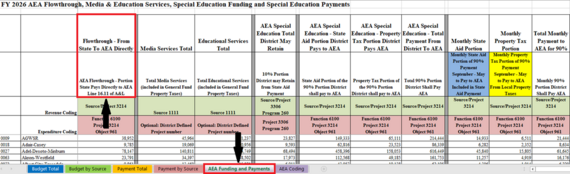
Question: How do school districts account for the AEA teacher salary supplement (TSS), AEA operational sharing, and educational and media services amounts generated by students attending nonpublic schools that the AEA receives directly from the State?
Answer: School districts are to record these amounts that the AEAs receive from the State as AEA flow through.
- Debit Function 6100, Project 3214, Object 961
- Credit Source/Project 3214
The FY26 amount to be recorded as AEA flowthrough is on Line 16.11 of the Aid & Levy and in the LEA Monthly Payment Summaries section on the Department’s State Payment Information web page. The amount is in Column C of the AEA Funding and Payments tab in the monthly LEA State Aid Payment Summary file.
|
|
|
Each year, districts may request a modified supplemental amount (MSA), or additional spending authority, from the School Budget Review Committee (SBRC) to support at-risk, alternative school, returning dropout, and dropout prevention programs. This request generated more than $150 million statewide this year and impacts nearly all districts.
Under Iowa Code section 257.38, boards must approve an annual at-risk/dropout plan before submitting an MSA request. Plans must include:
- Program goals and objectives for the designated population
- Student identification criteria and procedures
- Staff in-service education design
- Staff utilization plans
- Evaluation criteria, procedures, and performance measures
- Qualifications of personnel delivering the program
- A program for at-risk students
- A process for identifying at-risk students
- A budget supporting the request to the SBRC
Reminder: Boards must approve both the request for additional spending authority and the at-risk/dropout plan (with all required components) each year. Failure to do so invalidates the district’s authority to request the additional spending authority.
If you have questions related to the At-Risk/Dropout Application, please contact Ted Bauer at ted.bauer@iowa.gov or 515-979-5468.
Information in the Operational Sharing application is populated from Fall BEDS Staff. Once the Operational Sharing application is available, the information can be reviewed and certified. Any changes required in the Operational Sharing application must be made in the Fall BEDS Staff application. The deadline to certify Fall BEDS Staff and Operational Sharing is October 30.
Application Process
- Fall BEDS Staff must be updated before the Operational Sharing application is reviewed.
- The district or area education agency (AEA) holding the shared employee's contract reports the individual’s full salary and benefits according to the individual’s contract.
- The district or AEA purchasing a portion of the shared individual’s contract reports the purchased service (portion of the salary and benefits). This should be the projected amount to be reported in the local financial system with an Object code of 59X when the contract holder is another district or AEA, or with an Object code of 3XX when the contract holder is some other governmental subdivision.
- A shared individual must be reported by all parties as shared. The sharing information can be added or edited by editing the individual’s assignment that is being shared. “Shared Status” options for operational sharing are listed below.
- We hold the employee’s contract and the assignment is in both districts.
- We are the district purchasing services and assignment is in both districts.
- We hold the employee's contract, and an operational sharing position is in each district.
- We are the purchasing district, and an operational sharing position is in each district.
- We are sharing with some other governmental subdivision.
- The district must select the district that is also a party to the sharing, unless sharing with a non-district governmental subdivision.
- Use the drop-down arrow to select the sharing partner.
- Click Add.
- Click Save.
- If the contract holder has more than one sharing arrangement for the individual, select the second district that has also purchased a portion of the individual’s contract. Click Add and repeat step 5.
- Click Save to exit the edit pop-up screen.
- Data will need to be reviewed and certified in the Operational Sharing application.
Troubleshooting
If errors on shared staff are experienced, request the other district to check its Fall BEDS Staff information to see if the sharing status and sharing partner have been completed. A common error is for one district to identify an individual and related assignment as shared, but not identify the sharing district. Once the sharing information has been corrected, click the Check for Errors/Omissions button to clear the error message. Additional guidance about reporting shared staff can be found on the Fall BEDS Staff web page.
Tip: Curriculum Director
In order to have a curriculum director appear in the Operational Sharing application, the curriculum director must be reported with the Position code of 633, Director/Coordinator/Department Head. Individuals reported with the position code of Content/Curriculum Consultant position will not generate operational sharing supplementary weighting.
New Sharing Arrangements
For new shared positions with another governmental subdivision other than sharing arrangements with another Iowa public school district or AEA, please send a copy of the signed contract to ted.bauer@iowa.gov. Contracts are used to verify that the duties performed for the governmental subdivision are an eligible operational function (281 IAC 97.66). Sharing arrangements that were approved in a prior year do not need to be resubmitted unless a significant change in the arrangement has occurred.
Resources
A list of positions eligible to generate supplementary weighting for operational function sharing was published in the August 2025 edition of the School Business Alert newsletter and is also availablie in the Operational Function Sharing Guidance.
For assistance with corrections to Fall BEDS Staff or Operational Sharing application, please contact Shelly Wolterman at shelly.neese@iowa.gov or 515-336-3859.
For assistance determining if a sharing agreement is eligible for supplementary weighting, please contact Ted Bauer at ted.bauer@iowa.gov or 515-979-5468.
The School Association Reporting application, due November 3, is available on the EdPortal and the related due date is November 3.
Iowa Code section 279.38A requires boards of school corporations that pay membership dues to organizations which directly relate to the functions of the board of directors to report annually to the local community and the Department. The board must report the amount paid in annual dues to the organization, any fees paid and revenue or dividend payments received for services the board receives from the organization, and the products or services the school district received inclusive with the membership in the organization.
Districts must report information for four different associations: Iowa Association of School Business Officials (IASBO), Rural School Advocates of Iowa (RSAI), School Administrators of Iowa (SAI), and Urban Education Network (UEN). Effective with FY21 filing, districts are no longer required to provide information regarding the Iowa Association of School Boards (IASB) to the Department as this will be provided to the Department from IASB.
Instructions are posted on the home page of the School Association Reporting application. For additional questions, please contact Ted Bauer at ted.bauer@iowa.gov or 515-979-5468.
The SBRC Application is anticipated to open in mid-November. The application calculates eligibility for the Modified Supplemental Amount (MSA) requests below.
- Increased Enrollment – for districts showing Fall 2025 actual enrollment greater than Fall 2024 actual enrollment (Iowa Code § 257.31(5)”a”).
- Open Enrollment Out Not Included on Prior Year’s Headcount – students identified as open enrolled out in Fall 2025 who were not included in the district’s Fall 2024 certified enrollment count, minus any increase in enrollment described in item 1 above (Iowa Code § 282.18(9)"e”).
- English Learners (EL) Instruction Beyond 5 Years – for resident students included in Fall 2025 certified enrollment who already generated the maximum English Learner (EL) supplementary weighting earn an intermediate or intensive rating on the ELPA and are continuing to receive EL instructional services (Iowa Code § 257.31(5)"j”).
This application is pre-populated from each district’s certified enrollment and Student Reporting in Iowa (SRI) submission. Directions to complete the request are listed below.
- Verify the accuracy of the data. The amounts can change during the certified enrollment verification period of the last two weeks in October and early November. Therefore, do not certify the SBRC Application until the district’s certified enrollment information is correct.
- Enter the amount of a request. Click “Save Values".
- Certify the application.
- The SBRC considers individual action for each request and appreciates local boards doing the same when acting upon the requests during local board meetings, so please do not include requests as part of a consent agenda.
- Each request should be listed as a separate action item considered at the November board meeting. Sample board action language is provided below.
- Increased Enrollment - The district’s administration is authorized to submit a request to the School Budget Review Committee for a modified supplemental amount of $XXX due to an increase of certified enrollment from the prior year.
- Open Enrollment Out Not on Prior Year’s Headcount - The district’s administration is authorized to submit a request to the School Budget Review Committee for a modified supplemental amount of $XXX for open enrolled out students who were not included in the district’s previous year certified enrollment count.
- English Learners (EL) Instruction Beyond Five Years - The district’s administration is authorized to submit a request to the School Budget Review Committee for a modified supplemental amount of $XXX related to the EL program for students who have exceeded five years of weighting that are included on the Fall 2025 certified enrollment headcount.
- On the SBRC Application page, upload the board minutes authorizing the request(s). If board minutes are not available at the time of submission, enter the date the board will take action. Then upload the minutes within two business days of that board meeting.
If you have questions related to the SBRC Application, please contact Ted Bauer at ted.bauer@iowa.gov or 515-979-5468.
The Facilities, Elections and Sales Tax (FEST) application, due November 3, is available on the EdPortal. The four forms required for FEST certification are listed below.
- Replacement Cost of Educational Facilities
- Voter-Approved PPEL
- Bond Issue Elections
- SAVE Reporting
Iowa Code section 256.9(19) requires the Iowa Department of Education to collect information about the use of Secure an Advanced Vision for Education (SAVE) tax dollars. The SAVE portion of the form requires the school district to update information about the revenue purpose statement, provide information how the district has reduced levies through the use of SAVE funds, and miscellaneous information about whether the district had issued revenue bonds and reduced property tax through SAVE.
Instructions are posted in the FEST application. For additional questions, please contact Ted Bauer at ted.bauer@iowa.gov or 515-979-5468.
|
|
|
The U.S. Secret Service National Threat Assessment Center (NTAC) is offering a virtual training presentation on targeted violence prevention titled: Enhancing School Safety Using Behavioral Threat Assessment. The audience is school administrators, educators, and other school safety stakeholders. Register for one of the dates (11/19/25, 1/21/25, or 3/18/26) at SchoolSafety.gov.
Many districts across the state are using the Governor’s School Safety Bureau and the Iowa Department of Public Safety’s free tool for anonymous reporting of school threats. If your district is interested in joining other districts, or for more information, please visit the Safe + Sound Iowa website.
The Iowa State Patrol is offering Student Transportation Active Threat Training (STATT). Presentations will provide bus drivers with examples of active threats on school buses, including those that have occurred in Iowa, and statistics about past attackers. The training provides a look at some of the causes of violent behavior in children and possible warning signs. Drivers will be given examples of what can be done to prevent an attack. Drivers will also learn how people react under stressful conditions, how to manage that stress, and the three options a person has when encountering an active threat.
For more information about STATT or to schedule training, schools and contractors should contact their local Iowa State Patrol Public Resource Officer (PRO).
|
|
|
The Iowa Chart of Account Coding, found on the Department's Uniform Financial Accounting web page, is regularly updated to reflect changes necessary to meet fiscal reporting needs.
|
Account Code
|
Description
|
|
Source/Project 4629
|
Child Care and Development Block Grants (HHS) (Iowa Early Childhood Continuum of Care) (FAL/CFDA 93.575) (Sep25)
|
|
Source/Project 4682
|
Cooperative Forestry Assistance (Keepers of the Land Planting Grant (1/2)) (FAL/CFDA 10.664) (Name change Sep25)
|
|
|
|
Districts should indicate the primary route for a vehicle as special education in the Vehicle Information System (VIS) only if the vehicle is used exclusively for special education routes. A special education vehicle designation can be removed by updating the “Primary Routes” category in VIS to “Regular Route” or “Not Used For Routes”. The vehicle can also be categorized as “Activities”, “Spare”, or “Other”.
Funding is available to assist Iowa public schools and child care centers in testing and reducing lead in drinking water. Administered by the Department, the Water Infrastructure Improvement for the Nation (WIIN) grant is a voluntary funding opportunity that covers costs for water test kits, training and educational resources on lead exposure. Participating sites that are found to have lead levels in their drinking water can also receive funding assistance for lead remediation expenses. Applications for the WIIN grant opportunity are being accepted on a rolling basis while funding is available. Additional information is available on the Department’s WIIN Lead Testing Grant web page.
Specific inquiries can be directed to Lyn Jenkins, Education Program Consultant, at lyn.jenkins@iowa.gov or 515-664-6732.
Information regarding Iowa’s Students First Education Savings Account (ESA) program can be found on the Department's Students First Education Savings Accounts web page.
|
|
|
Questions relating to the articles below may be sent to State Director for Pupil Transportation, Tom Simpson at tom.simpson@iowa.gov or 515-336-3965 or one of the inspectors below.
The S.T.O.P. Training for New School Bus Drivers (Online Component) is now available.
Beginning July 1, 2025, the online component of the School Transportation Operators’s Program (S.T.O.P.) for new school bus drivers was transitioned to AEA Learning Online. The updated online component will usually take less than four hours to complete.
Accessing the Training
- Log in to the AEA Learning Online system and use this link to access the S.T.O.P. Training for New School Bus Drivers (Online Component).
- Begin the course.
All districts/schools that opt in to AEA Online already have a verification code. This includes many public and nonpublic schools. Bus drivers that need to establish new accounts must include the related verification code in their profile. Once affiliated, each driver will be able to access the training at no cost to them or the school. Drivers may access the step-by-step tutorial for setting up a new account.
Tip for nonpublic schools and contractors: Step 7 specifically addresses how to affiliate an account with a district.
Required Action
Ensure each driver’s AEA Learning Online account profile includes the driver’s license number.
Directions: How to add/update your Driver’s License Number
Frequently Asked Questions
Q: I don’t have an AEA Learning Online account. What should I do?
A: If you are certain you do not have an account, follow the directions to create a new one.
Directions: How to register for AEA Learning Online (Create an Account)
Q: It's asking me to pay—why?
A: Your account profile currently lists you as a “Pay Customer”.
Directions: Update your profile to reflect your district of employment
Please note, drivers from nonpublic school partners and contractors will also be able to access this training at no cost.
Impact of Changes
In addition to the change in delivery, the training has been updated with the priorities listed below.
- The user-friendly AEA Online interface is already familiar to drivers for other required training.
- The updated content does not overlap with ELDT training requirements.
- The content is relevant for both yellow school bus drivers and Type III school bus drivers.
- The updated content is much shorter than the previous 14-hour online portion.
- The training is available at no cost to the driver or employer.
- Applies to all new drivers after July 1, 2025.
Other helpful tips related to the online training include the items listed below.
- The online portion and the face-to-face portion are now independent and may be taken in any order.
- The online training no longer requires a final proctored exam. Each module includes an independent test.
- All drivers now have the option to test out of each module by scoring 80% or better on the pretest.
The face-to-face component of the new driver S.T.O.P training and the annual renewal training for returning drivers will continue to be offered through local community colleges and Mississippi Bend AEA.
School bus inspections are conducted twice per year at each facility. The Department sends reminders two to four weeks in advance of the inspection via email. These reminders are sent to the entity’s contact(s) listed in the Vehicle Information System (VIS) application within the EdPortal.
Schedule Availability: The school bus inspection schedule is always available on the Department’s Pupil Transportation web page.
Fees: Following each inspection, school bus inspection fees are processed and invoices mailed out. Invoices can also be accessed and downloaded from the VIS under the “Invoice” menu at the top of the page. Please note that payment information is not tracked within this application.
Trash containers and holding devices located in school buses are subject to federal and state requirements (281 IAC 44.3(69)) as listed below.
- Meet the requirements of Federal Motor Vehicle Safety Standard (FMVSS) No. 302, Flammability of Interior Materials.
- Be no greater than 20-quart capacity.
- Be secured by a holding device that is designed to prevent movement and to allow easy removal and replacement.
- Trash containers may be placed behind the rearmost passenger seat or, with Department approval, in an accessible location in the driver’s compartment.
- The container must not obstruct the aisle of the bus, access to safety equipment, or passenger use of the service door.
Recent Question: When should a driver use the strobe light on a school bus?
Answer: Iowa Administrative Code r 281-44.3 defines rules for strobe lights on school buses. Strobe lights are intended to be used when a driver experiences fog, rain, snow, at times when visibility is restricted, or when otherwise determined necessary.
Iowa’s current minimum construction standards for school buses require the strobe light to meet the provisions of SAE J845 Class 1. This is a very high intensity light equivalent to those used on emergency vehicles.
Strobe Light Impact on Other Motorists
The Department received recent reports of school bus operators using strobe lights when weather events were not present and visibility did not appear to be limited.
The combination of a clear evening and the high intensity light from a J845 Class 1 strobe light may be distracting to other motorists, at a minimum. More seriously, other motorists’ night vision could be impaired by the strobe light.
Requested Action
Please ensure drivers are trained on the appropriate uses of strobe lights, including events such as fog, rain, snow, smoke, and other limited visibility events, and that other use should be accompanied by extreme caution so others are not adversely affected.
|
|
|
It is the policy of the Iowa Department of Education not to discriminate on the basis of race, creed, color, sexual orientation, national origin, sex, disability, religion, age, political party affiliation, or actual or potential parental, family or marital status in its programs, activities, or employment practices as required by the Iowa Code sections 216.9 and 256.10(2), Titles VI and VII of the Civil Rights Act of 1964 (42 U.S.C. § 2000d2000e), the Equal Pay Act of 1973 (29 U.S.C. § 206, et seq.), Title IX (Educational Amendments, 20 U.S.C.§§ 1681 – 1688), Section 504 (Rehabilitation Act of 1973, 29 U.S.C. § 794), and the Americans with Disabilities Act (42 U.S.C. § 12101, et seq.). If you have questions or complaints related to compliance with this policy by the Iowa Department of Education, please contact the legal counsel for the Iowa Department of Education, Grimes State Office Building, 400 E. 14th Street, Des Moines, IA 50319-0146, telephone number: 515-281-5295, or the Director of the Office for Civil Rights, U.S. Department of Education, Cesar E. Chavez Memorial Building, 1244 Speer Boulevard, Suite 310, Denver, CO 80204-3582, telephone number: 303-844-5695, TDD number: 800-877-8339, email: OCR.Denver@ed.gov.
|
|
|
|
|