|
 Nov. 2025
|
|
 |
|

The Iowa Department of Education is excited to announce expanded access to the Read&Write Literacy tool to ALL districts and schools in the state of Iowa. The Universal Protocol for Accommodations in Reading (uPar) has been available for all districts and schools. The uPar is used to assess student reading comprehension and identify the method a student best understands text, whether by reading independently or using text reader support.
Districts and schools now also have free access to Read&Write, which is proven to improve both learning outcomes and standardized test performance. Students who use the tool build confidence in reading comprehension, writing and critical thinking skills that directly translate into better test results. If your district is focused on raising achievement, Read&Write is a research-backed solution that delivers measurable results.
Access for ALL supports students as they move from learning to read to reading to learn. Any Iowa student in grades 3-12, regardless if they have an IEP or not, who is reading below grade level can benefit from the Access for ALL supports. This initiative aligns with the Department’s priorities to provide evidence-based reading instruction and help narrow and close achievement gaps.
Iowa schools can register for uPAR and Read&Write licenses at no cost on the Access for ALL website. Please contact Education Program Consultant MeLissa Lawson at melissa.lawson@iowa.gov with questions.
|
|

A number of enhancements and bug fixes related to the entry of progress monitoring data will be released to ACHIEVE in December 2025. Most changes include improvements to increase clarity regarding what is shown on screen and on the IFSP/IEP output. A few items will require a slight change in practice and are summarized below:
-
IFSP Service Log: IFSP team members who contributed to a Service Log will now be able to make edits to the Family Guided Routines Based Intervention Plan in ACHIEVE.
-
IEP Goal Nickname: Nicknames will now be required for IEP goals. The goal nickname will be displayed consistently throughout ACHIEVE instead of the full goal description. As amendments to existing IEPs occur and new annual IEPs are initiated, the nickname field will have a red asterisk, which must be completed before the goal’s "Complete and Close" button will be enabled.
-
IEP Goal Mastery: New required goal mastery fields will be added to ensure teams are consistently including specific requirements that outline when a goal has been met. As amendments to existing IEPs occur and new annual IEPs are initiated, the new Goal Mastery fields will have a red asterisk, which must be completed before the goal’s "Complete and Close" button will be enabled.
-
Note: This change will not create or enforce decision-making rules, but is meant to support the IEP team in identifying when goals are achieved and when new goals may be appropriate.
-
Progress Entry (Multiple) Tool: Improvements have been made to facilitate IEP teams with entering data on behalf of multiple learners at the same time. Changes include:
- Learner’s name will now be a hyperlink to the Learner Management page.
- Goals with a scale will now display a scale icon allowing the team to quickly access the scale descriptions.
- A new "Enter More" icon will allow teams to enter multiple data points for the same goal.
- The option to manually save after entering each goal’s progress monitoring data.
More detailed information with screen shots is available on the Department website. Please contact Education Program Consultant Shannon Grundmeier at shannon.grundmeier@iowa.gov with questions about changes to ACHIEVE.
|
|

The June 2025 Teaching for Impact closing keynote with Chris and Nik Nikic reminded attendees the power of setting ambitious goals and working persistently toward them. The presentation emphasized the positive connections between goal setting, physical activity and overall well-being.
According to the CDC, regular physical activity positively impacts both physical and mental health and is linked to improved academic performance. A high-quality physical education (PE) program is an effective way to build students’ confidence and competence in physical activity.
If a learner needs adaptations or modifications to participate in PE, the physical education teacher should be a member of the Individual Education Program (IEP) team or be consulted when determining placement. The PE teacher should also be aware of the team’s decisions and goals regarding an eligible individual’s needs and placement in PE. If specially designed instruction (adapted physical education) is needed, the IEP must include goals and progress monitoring. Licensed and endorsed physical education teachers meet the qualifications to teach general and adapted/special physical education. Physical education teachers may also work with special education and general education staff or related service providers to meet the individual needs of learners.
Meaningful access for students can be provided through collective effort, supporting the road to their full potential. Please contact Administrative Consultant Lyn Jenkins at lyn.jenkins@iowa.gov or Education Program Consultant MeLissa Lawson at melissa.lawson@iowa.gov with questions.
|
|
The Policy and Practice webinar, Accessible Educational Materials and Assistive Technology on the IEP, was held on Oct. 8. This session provided an overview of assistive technology (AT) and accessible educational materials (AEM) in the Individualized Education Program (IEP) process. The recording and session materials are available on the Department website.
The next webinar in the series, Secondary Transition (with Work-based Learning content) and Four Plus Programming will be held on Nov. 12 at 8:30 a.m. This session will explore how administrators can strengthen compliance with the transition requirements in the Individuals with Disabilities Education Act (IDEA) while also improving postsecondary outcomes for students with IEPs. The webinar will highlight strategies that connect a school’s existing infrastructure with high-quality transition services and proven predictors of postschool success. By aligning compliance efforts with student-centered practices administrators can ensure that students leave high school prepared for success as lifelong learners, colleagues and community members.
Participants can join the Policy and Practice webinars using Zoom and the passcode 431127. No registration is required, and the same link will be used for all sessions.
Please contact the SDI Literacy Consultant Mary Beilke at mary.beilke@iowa.gov with questions.
|
|
The ACHIEVE Family Portal, a powerful tool available to families, is a secure and easy-to-use online platform that gives families and eligible learners direct access to view Individualized Family Service Plans (IFSP) or Individualized Education Programs (IEP). Service Coordinators and IEP Facilitators can encourage participation in the Portal by inviting eligible family members and learners to create an ACHIEVE Family Portal account. To individually send an invitation, simply click the blue “Invite to Portal” button in the Family Contact table.
The “Invite to Portal” button is available in the Family Contact Table when the following criteria are met:
- The learner has an approved Consent to Receive Early ACCESS or Special Education and Related Services.
- The family member has been validated as an approved IDEA parent relationship type on the Family Contact stepper.
- The family member has a valid email address stored in their Family Contact details.
Tip! You may need to scroll to the right using the scroll bar at the bottom of the Family Contact table to see the “Invite to Portal” button.
Remember, portal users will need the last 4 digits of the learner’s State ID to create an account. Visit the ACHIEVE Family Portal toolkit for ideas on how to distribute the State ID to families in your district or region.
Questions about the ACHIEVE Family Portal can be directed to the Family Portal support team at achievesupport@iowa.gov.
|
|
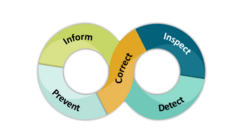
Individuals with Disabilities Education Act - Differentiated Accountability (IDEA-DA) is Iowa’s special education accountability model with a primary focus on improving educational results and functional outcomes for all learners with disabilities. The IDEA-DA model is built to ensure compliance with federal and state law with particular emphasis on those requirements most closely related to improving educational results for learners with disabilities. Iowa’s IDEA-DA system reflects our state’s commitment to providing leadership, oversight and technical support to ensure all learners have access to educational opportunities. Our system frames improvement and compliance conversations with school districts with the goal of ensuring the promises of IDEA.
In October, all districts received their IDEA-DA level of support assignments for the second designation cycle through the IDEA-DA Implementation Support Rubric (ISR). The ISR incorporates a selection of measures of student outcomes and opportunity across four focus areas based on primary foundations of IDEA: Secondary Transition, Child Find, Academic Success and Social Emotional Behavior. The ISR aggregates data across these 26 measures to create one summative score for each district which is used to categorize the district into a support level. The IDEA-DA Data Elements Guide provides additional information for each data element included in the ISR.
The Department hosted a statewide webinar on Oct. 14 which provided an overview of IDEA-DA and the requirements associated with the differentiated levels of support. A recording and presentation slides from the webinar are available on the Department's website.
|
|
The Specially Designed Instruction (SDI) Framework includes self-assessment tools to collect data which informs the development of technical assistance, support and professional learning content for SDI teachers and coaches. These self-assessment tools are intended to help all participants assess, plan, design and execute strategies for ongoing refinement of SDI across their school.
The SDI Framework Implementation Tool (SDI FIT) is an instrument designed to guide teachers in examining their use of SDI practices in order to diagnose, design and deliver instruction in an engaging manner to address individual learner needs.
The SDI Coach Self-Assessment (CSA) is an instrument designed to guide SDI coaches in examining their knowledge and ability to coach SDI team members in the use of the SDI practices.
Each of these tools are intended to be completed at least two times a year to allow teachers and coaches to reflect on progress over time. They are typically completed in the fall and then again in the spring, with at least five months in between each submission.
Participants from districts designated as a Level 2 or 3 in IDEA Differentiated Accountability (IDEA-DA) who are engaged in the SDI learning are required to complete the FIT and CSA twice a year.
To learn more, refer to the FIT and CSA User Guides found on the SDI Tools stepper in ACHIEVE. Please contact Education Program Consultants Mary Beilke at mary.beilke@iowa.gov, Kelsey Teeter at kelsey.teeter@iowa.gov or Tiffiny Poage at tiffiny.poage@iowa.gov with questions.
|
|

Iowa has expanded support for families raising children who are deaf or hard of hearing. The Family Support Mentoring Program provides tailored resources, mentorship and age-level support spanning from birth through age 21.
The program offers three mentoring options:
-
Inspire to Empower Mentors are adults who may be deaf, hard of hearing or deafblind and can guide families through communication, technology and education options.
-
Deaf Mentors provide insight into American Sign Language (ASL) and Deaf culture.
-
Family-to-Family Mentors share their lived experiences raising deaf or hard-of-hearing children.
Families can switch mentors as their needs evolve. In addition, the program provides events and curated resources for every age group across the state. With both in-person and virtual options, this program helps overcome isolation, strengthen connections and empower families to make informed choices for their child’s language and learning journey.
Please contact coordinator Anne-Michelle Pedersen at annemichelle.pedersen@iaedb.org with questions.
|
|
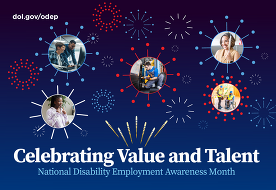
October marked the 80th anniversary of the National Disability Employment Awareness Month (NDEAM), which is dedicated to honoring the positive impact of people with disabilities in the workforce.
The Individuals with Disabilities Education Act (IDEA) exists to help students with disabilities prepare for education, employment and independent living. School districts and Area Education Agencies (AEAs) not only play a key role in preparing students for the workforce but are also uniquely positioned as potential employers of individuals with disabilities.
While October has come to a close, the commitment to recognize and celebrate these contributions can continue year-round. The NDEAM website provides display posters and ideas for your organization to promote disability employment. See below for some examples:
Student-Focused Ideas
- Hold discussions and provide instruction on disability related employment issues for transition-aged youth.
- Engage student leaders as champions of inclusion in the classroom and into the workplace.
- Strengthen and increase the services and supports available for students with disabilities to participate in Career Technical Education and Career-Connected Learning opportunities.
Employee-Focused Ideas
- Incorporate disability awareness training into onboarding processes.
- Sponsor a "Lunch and Learn" series about disability issues for employees.
- Offer American Sign Language (ASL) training classes to employees.
Every day offers an opportunity to elevate the strengths and talents of student's with disabilities while fostering high expectations for employment. Please contact Education Program Consultant Kelsey Teeter at kelsey.teeter@iowa.gov with questions.
|
 |
|
IDEA Insights, a newsletter from the Iowa Department of Education, is designed to provide timely information for professionals serving children with disabilities. Topics will include best practices, assessments, program updates and professional learning opportunities.
To unsubscribe, click the link to manage subscriptions at the bottom of this email.
|
|
|
|
|
|