Updates regarding adopted rules
On July 14, 2025, the Iowa Administrative Rules Review Committee (ARRC), a bipartisan, bicameral legislative committee tasked with reviewing agency rulemaking, voted to administratively delay the Board’s adopted rulemaking which rescinded 657 Iowa Administrative Code and created new 481 Iowa Administrative Code chapters 550 through 557. The rulemaking is delayed 70 days. The ARRC will request another review of the rulemaking at its next regularly scheduled meeting on Aug. 11, 2025, at 10 a.m.
Updates regarding the MPJE
Despite the delay in implementation of the new rules in 481 Iowa Administrative Code chapters 550 through 557 by ARRC as it relates to the practice of pharmacy, the Multistate Pharmacy Jurisprudence Examination (MPJE) content will reflect the new rules effective Aug. 1, 2025. This decision not to change the implementation date of the new rules on the MPJE content was made to avoid confusion by new graduates and pharmacists from other states wishing to become licensed in Iowa. Additionally, the individuals who are testing to become licensed pharmacists in Iowa will need to demonstrate an understanding of the new rules moving forward once those new rules have been implemented.
Meet one new board member
The Board of Pharmacy has two new members. As a reminder, board members are appointed by the governor and confirmed by the Senate. Below is a brief introduction of Dave Weetman. Learn more about our second new board member, Michele Garvin, in the next issue!
Dave Weetman introduces himself to the board
My name is Dave Weetman, and I currently serve as the Director of Acute Care Services at UIHealth Care in Iowa City. I’m a graduate of the University of Iowa College of Pharmacy and completed my pharmacy residency at Johns Hopkins Hospital in Baltimore. After completion of my residency, I worked as a clinical pharmacist at Johns Hopkins Hospital in the Medical Intensive Care Unit and HIV/AIDS/Internal Medicine while working toward my master of business degree from Johns Hopkins University.
Healthcare runs in my family: my wife, Jill, is a long-term care pharmacist, my son, Eric, just finished the first year of his two-year pharmacy administrative residency program at Froedtert Health Care in Milwaukee, and my daughter, Taylor, is an occupational therapist, soon to be working at Steindler Orthopedic Clinic in North Liberty.
I’ve been associated with pharmacy policy work at the state and federal levels for many years. I’m a member of the Iowa Pharmacists Association, serving in several different capacities over the years. I’m also a member of the American Society of Health-System Pharmacists, serving as a delegate from the State of Iowa for numerous years as well as membership on several policy and nomination committees. I also serve as the board chair of the Iowa Poison Control Center in Sioux City.
For hobbies, I co-own a cattle business on a family farm in Minnesota, and I play ice hockey and the guitar.
I’m proud to have the opportunity to serve the citizens of the State of Iowa by being a member of the Iowa Board of Pharmacy.

The newest addition to the Iowa Board of Pharmacy compliance team is Megan Myers, PharmD.
Dr. Myers brings over 20 years of pharmacy experience, 17 of which includes working as a licensed pharmacist in Iowa. Several of her past roles intersected compliance activities, including working as project manager for a board-approved pilot program with the Iowa Pharmacy Association. The pilot program studied technician product verification (TPV) in community pharmacies. Dr. Myers also has extensive experience developing policies and procedures related to community-based clinical services and implementing collaborative practice agreements and statewide protocols.
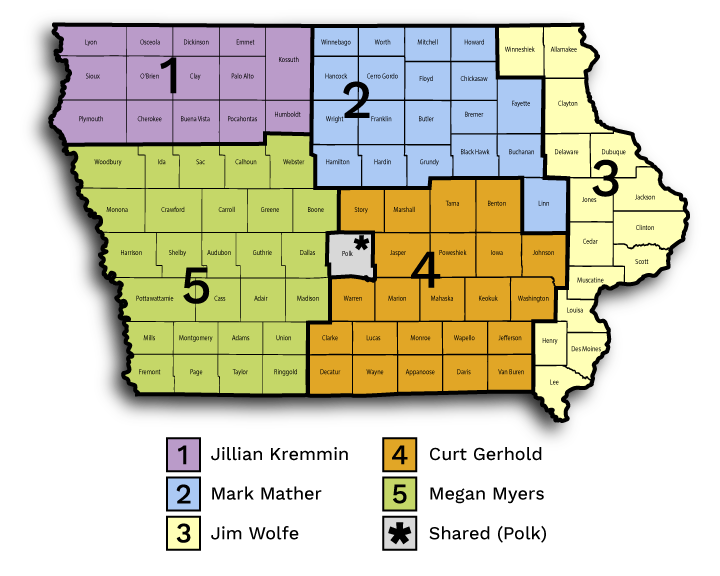
Updated compliance officers list and coverage maps released
Pharmacy compliance officers
Britney Origer, Pharm D - Eastern Iowa Compounding
Curt Gerhold, RPh - South Central/East
Jim Wolfe, RPh - East
Jillian Kremmin, PharmD, BCPS - Northwest and Western Iowa Compounding
Mark Mather, RPh - North Central/East
Megan Myers, PharmD - South/Central West
Sue Mears, RPh - Polk County
|
Retail compliance territory assignments
Hospitals, compounding pharmacies, nuclear pharmacies, and CSA vets
Iowa Code authorizes expedited partner therapy
Iowa Code section 139A.41 authorizes the treatment of the partner(s) of an individual who is being treated for chlamydia or gonorrhea without an examination of the partner(s). In an effort to eliminate barriers to treatment, the board’s rules authorize the issuance and dispensing of a prescription that does not provide the name of the partner(s) for whom the additional treatment is authorized. The rules provide exemptions for the issued prescription elements, prescription labeling, and provision of drug utilization review when a prescription is issued for an unnamed partner of a patient being treated for these conditions.
Tips to ensure your prescriptions are reported to the PMP
Most pharmacies submit their dispensation data to the Iowa Prescription Monitoring Program (PMP) automatically at the end of each day. But who verifies the data processed successfully? If your pharmacy doesn’t have a designated person verifying PMP submissions were successful, you likely have unresolved submission errors that need attention. Failure to address these errors can result in the records not being reported to the PMP, leading to incomplete/inaccurate patient reports and noncompliance with PMP reporting requirements.
Pharmacy PMP submissions can be monitored in two ways. Chain pharmacies primarily access this information via the PMP clearinghouse portal. This portal allows access to submission data for any location registered with the Drug Enforcement Administration (DEA) for which a user is registered to submit data, which is useful when managing submissions for many pharmacy locations. Read more information on the PMP clearinghouse. The second option allows onsite pharmacists to manage submissions directly within the AWARxE® online database using the Rx Management Portal. However, use of this portal is restricted to the locations whose DEA registration numbers have been added to the pharmacist’s PMP user profile. For more information on the Rx Management Portal, visit the PMP AWARxE® Support Center, and click on "LEARN MORE" under "Navigating PMP AWARxE."
NIOSH releases new list of hazardous drugs
As a reminder, on Dec. 19, 2024, the Centers for Disease Control (CDC) National Institute for Occupational Safety and Health (NIOSH) released its updated 2024 list of hazardous drugs in healthcare settings. This list is designed to assist employers in identifying drugs that are hazardous to the health and safety of workers who handle these drugs. Pharmacy board rules require compliance with United States Pharmacopeial Convention (USP) 800 for hazardous drug handling, in which an entity’s hazardous drug list must include, but may not be limited to, any items on the current NIOSH list that the entity handles.
FDA releases clarifying statements and deadlines relating to GLP-1 compounding
Federal litigation brought by the Outsourcing Facilities Association challenged the Food and Drug Administration's (FDA) determinations on the resolution of GLP-1 shortages. The federal district court overseeing the litigation has denied both of the preliminary injunction motions to bar the FDA from declaring an end to the tirzepatide and semaglutide shortages. Therefore, the periods of enforcement discretion have ended, during which the FDA did not intend to take action against compounders for violations of the Federal Food, Drug, and Cosmetic (FD&C) Act arising from conditions that depend on the products’ inclusion on FDA’s drug shortage list. For more details, please see this article.
New CMS rule set for electronic transfer of controlled substance prescriptions
The Centers for Medicare and Medicaid Services (CMS) has published its final rule which implements updated National Council for Prescription Drug Programs (NCPDP) standards. These standards are required for any pharmacy to be compliant with DEA regulations for the electronic transfer of controlled substance prescriptions which have not yet been filled. Pharmacies are reminded that such electronic transfer is not compliant with DEA regulations until the pharmacy has implemented the new NCPDP standards.
|