 |
|
FaDSS Program Newsletter |
Click to edit this placeholder text.
July 2020
|
|
|
|
|
|

On March 9, 2004 Senate Resolution 316 was passed designating April 2004 as “Financial Literacy Month.”
Financial literacy is the ability to understand and effectively use various financial skills, including personal financial management, budgeting, and investing.
Some FaDSS grantee agencies have already been utilizing Financial Literacy programs with FaDSS families. Mid-Iowa Community Action uses the "Four Cornerstones of Financial Wellness" curriculum.
Lutheran Services in Iowa uses "Your Money Your Goals" and "Your Money Your Future: Making Ends Meet". Training for use of these curricula is available through ISU Extension.
A free online resource available for use can be found here through InCharge.org. Whether it's developing a budget or completing more in-depth financial literacy training, there is no better time to start talking about the importance of financial literacy.
|
GEM Feature

In each newsletter, you’ll see a feature called GEM (Going the Extra Mile) where we will highlight a FaDSS worker who has gone above and beyond.
Leanne Corwin has worked at Operation Threshold in the FaDSS program for 15 years. She currently serves families in Black Hawk County, and when she first started, served families in the Buchanan County office.
She is very passionate about the work she does and had been working in this field long before she came to Operation Threshold. Her knowledge of mental health and substance abuse has made her a vital resource to her team and the families she serves. Leanne is regarded as a leader in the FaDSS team with her many years of experience and also serves on the FaDSS Equity Cohort.
Leanne's favorite thing about FaDSS is that it is a voluntary program and soon having the expanded eligibility. "We have the opportunity to be part of someone's journey in recognizing change is possible not only for them but also for the future of their children. I know and acknowledge it is a sign of trust when we are invited into their lives and into their homes," she said of the program.
Leanne says she is happiest when its sunny and warm enough to kayak, bike, swim and play with her five grandchildren.
The FaDSS program is lucky to have a GEM like Leanne Corwin!
|
Grantee Spotlight
Northeast Iowa Community Action Corporation
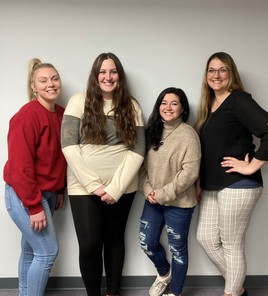
The Northeast Iowa Community Action Corporation (NEICAC) FaDSS program serves Howard, Winneshiek, Allamakee, Chickasaw, Bremer, Fayette, and Clayton counties. In FY21, the program served 98 families. A 2-Gen pilot site, NEICAC has helped the FaDSS program develop policies, procedures and explore activities to better serve non-FIP families.
NEICAC is currently participating in the Covid and Safety Net Innovation and Technical Assistance Initiative sponsored by the Administration on Children and Families along with partners from DHS, DHR and IWD.
Nichole Griese leads the FaDSS team. She was a FaDSS specialist for 5 years before moving into the role of FaDSS Coordinator in 2020. Nichole also participates in the FaDSS Equity Committee, the SPARK Implementation Team and the FaDSS Council's Assessment Review Committee. The FaDSS team at NEICAC includes Josi Baker, Paula Duff, Brooke Fay, and Nichole Griese (shown left to right above).
|
Resource Feature
One of the core components of the FaDSS program is Advocacy & Self-Empowerment. This can take on many forms depending on the needs of families. One way FaDSS Specialists can help empower families is by helping them register to vote if they are not already registered.
Many people become registered to vote when they are in high school or when they get their drivers license. Because people who are low income complete high school and obtain drivers licenses at lower rates, it is important to help them register to vote so they can exercise their civic duties.
The National Voter Registration Act actually requires that States offer voter registration opportunities at certain State and local offices, including public assistance and disability offices (such as DHS and IVRS). While it is not a requirement for FaDSS programs to offer voter registration, it can be a way to empower families to participate in the elections that impact their communities.
To be eligible to vote in Iowa, you must be:
- a U.S. citizen
- An Iowa resident, and
- At least 17 years old. A person may vote if they will be 18 years old on or before election day. In the case of primary elections, a person may vote if they will be 18 years old on or before the corresponding regular election.
Voter registration can be completed online or by completing a voter registration form. FaDSS Specialists can assist families with this by visiting the Secretary of State website.
Convicted felons are not eligible to vote, but those who have completed their sentences may apply to have their voting rights restored. On August 5, 2020, Governor Reynolds signed Executive Order Number Seven and has issued restoration of voting rights daily for those who have completed their sentences since August 5, 2020.
|
Notes from the FaDSS Program Managers
- Requests for FaDSS contract extensions are due May 1, 2022
-
FY23 FaDSS Program Eligibility Training- May 12th from 1:30-3:00
- Next FaDSS Coordinator meeting May 18, 2022
- Next FaDSS Council meeting May 19, 2022
- April 16, 2022, the FaDSS program will resume providing in-person services
- Extended transition will end at the end of the day on April 15, 2022
- Prevent Child Abuse Iowa virtual conference May 3-4. 2022
- Iowa Community Action Agency Conference July 20 -21, 2022
Please let us know if you have any questions. Thank you for all the work you do!
-Page and Lorie
|
|



