FaDSS 2020: Going the Extra Mile
Happy New Year from the Department of Human Rights, Division of Community Action Agencies! We hope you enjoyed time with family and loved ones over the holidays. We’re excited to start the new year and new decade with a FaDSS quarterly newsletter. The theme for 2020 is Going the Extra Mile because whether it’s supporting the families you serve or partnering with other providers in your areas, each of you go the extra mile. We at the Department recognize the importance of the hard work you do every day on behalf of Iowa families. We hope you’ll find valuable information in the newsletter as well as an opportunity to celebrate your successes. Each quarter, you’ll see a feature called GEM (Going the Extra Mile) where we will highlight a FaDSS worker who has gone above and beyond. Please help us celebrate your work by submitting stories to Page.Eastin@iowa.gov.
Best wishes for a successful 2020!
GEM Feature

Nancy Cleary has been with the Four Oaks FaDSS program for the last 29 years. She is dedicated to working with families and helping them achieve their goals. Nancy takes time to get to know families and engage them through collaboration which begins almost immediately. One of her many strengths is goal writing. She is able to talk through situations with families and help them put on paper what they want to achieve and how it will be done without it seeming too large or impossible. During the time the family is working on their goals she is there to support them, encouraging and challenging them along the way.
Recently Nancy worked with a family that moved to Iowa and was staying with family. This family was working and trying to go to school and establish themselves on their own. Nancy worked with the family to create a plan for to gain housing, increase employment and income, manage child care and to have more natural supports. Through the 8 months that this family was enrolled, they were able to achieve several goals and exited the program as a two-parent family with both parents employed and childcare issues addressed. They obtained their own housing and were no longer receiving FIP. The kids were all in school and were doing well. This is one example of how Nancy helps FaDSS families succeed.
|
Partner Feature
Vocational Rehabilitation is made up of a series of services that are designed to help people with disabilities find, maintain or advance in employment. Some of these services include vocational assessments and evaluation, training, upgrading of general skills, refresher courses, on-the-job training, career counseling, employment searches, and consulting with potential or existing employers for job accommodations and modifications. These services vary depending on the needs of the individual being served. In Iowa, we have two state Vocational Rehabilitation (VR) agencies: Iowa Vocational Rehabilitation Services (IVRS) and the Iowa Department for the Blind (IDB). IVRS is the general VR agency and IDB provides services specific to individuals who are blind. Both agencies provide services to Iowans statewide. To learn more about Iowa’s respective VR agencies, visit their websites:
https://ivrs.iowa.gov/
https://blind.iowa.gov/
|
Grantee Spotlight
Mid-Iowa Community Action
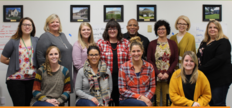
In early October, the FaDSS team from Mid-Iowa Community Action Agency attended an on-site, three-day training to learn more about family-centered coaching, a model that provides strategies, tools, and resources to refocus anti-poverty services. The training, facilitated by Devin Stubblefield with Prosperity Agenda, was attended by family development specialists primarily from the FaDSS program, as well as DHR staff Lorie Easter and Kelly Davydov. Prosperity Agenda focuses on the family first, a value that MICA shares. Their website states: “We challenge the dominant narrative that ‘the poor,’ particularly people of color, are lazy and inferior, and therefore deserve to live in poverty. By directly consulting with families living in poverty, tapping both their insights and resourcefulness, TPA works to design solutions that promote and amplify this family resilience.” The training emphasized the role of family development specialists as coaches to the families they serve. The approach is trauma-informed, helping specialists establish trust and a good rapport while the family leads with their needs at their own pace. Trainings like family-centered coaching are one way that MICA staff continue to improve their practices, embracing new research, skills, and tools as they work toward the best outcomes for the families they serve.
|
Notes from the FaDSS Program Managers
A huge thank you to the Mathematica sites who just completed random assignment! We know that it was a huge undertaking and we are grateful for your diligence and contribution to research. Iowa is one of 5 states participating in the study and we had the second highest number of enrollments.
The FaDSS program has received short-term funding to move forward with data collection enhancements to Iowa FaDSS. A webinar will be held to provide a preview of the work planned and to solicit input on select features.
The FaDSS Code of Ethics training will now be an online training. Modules will be posted to the Department of Human Rights website in early 2020. Notification will be sent to FaDSS Coordinators when the modules are available.
Finally, the 2020 onsite visits are underway. FaDSS programs scheduled for an onsite review in 2020 include:
- Four Oaks
- South Central Iowa Community Action Program (SCICAP)
- North Iowa Community Action Organization (NICAO)
- Mid-Sioux
- Youth Shelter Services (YSS)
- Community Action of Eastern Iowa
- Operation Threshold
- Community Action Agency of Siouxland
Please let us know if you have any questions. Thank you for all the work you do!
-Lorie, Kelly and Page
|