Commission of Asian & Pacific Islander (CAPI) Affairs
and
Office of Asian & Pacific Islander Affairs
ELDER CARE - Caregiving
November is National Family Caregivers Month
Family Caregiver Toolbox compiled by Care Giver Action Network
Caregiver Wellness Days have been scheduled by these Area Agencies on Aging
November 3 - Milestones Area Agency on Aging, Ottumwa. Free, registration encouraged: 641-684-1016
November 5 - Elderbridge Area Agency on Aging, Mason City Family-caregivers may attend for free, registration required: 641-422-4358
November 15 - Heritage Area Agency on Aging, Cedar Rapids. Free, call to register: 319-297-8813
November 16 - Northeast Iowa Area Agency on Aging, Decorah. Free, registration encouraged: 563-277-6024
ELDER CARE - Medicare Open Enrollment
Open Annual Enrollment runs October 15th through December 7th
If you use the Open Enrollment period to choose a new Medicare Advantage or Part D plan, that new coverage will begin on January 1. You cannot use Open Enrollment to enroll in Part A and/or Part B for the first time.
For more information on all of the parts of Medicare, and when you can enroll in them, visit the Explore Medicare Coverage Map.
Resource: National Council on Aging - Medicare Matters
Resource: US Dept. of Health and Human Services - Center for Medicaid & Medicare Services
ELDER CARE - Webinars
National Council on Aging
November 1
Home Safety & Modification, Part 1: Creating Better Homes for Aging in Place
American Society on Aging
November 1
The Hidden Storm: Aging, Chronic Pain and Opioid Addiction
November 7
Working After Retirement
November 8
Healthy Brain Initiative NEW Public Health Road Map: Strengthening the Public Health Response to Dementia
ELDERCARE - Des Moines-Area Senior Health Fair
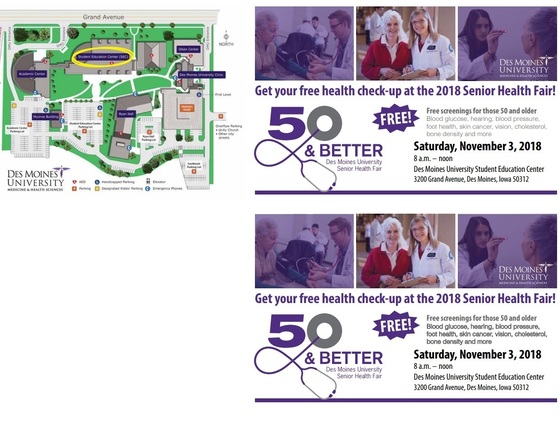
Saturday, November 3: Des Moines University’s annual “50 & Better” Senior Health Fair combines free health screenings and informational booths with a friendly, social atmosphere. Cholesterol/glucose screenings are very popular and available on a first-come, first-serve basis. If you plan on taking part in the cholesterol/glucose screenings, it is recommended to ensure the most accurate reading that you have nothing to eat or drink 8 hours prior. Highly recommended that screening participants wear easy-to-remove shoes.
What to bring: For those taking part in medication review, please bring all your medications including dosage and frequency.
The Polk County Health Department will provide flu vaccinations. Please bring your insurance card, as some costs may apply for vaccinations.
Limited foreign-language interpretation will be provided by volunteer medical students. Please contact Hannah de Geest, DMU Community + Public Relations Manager for additional details: 515.271.1374 or hanna.degeest@dmu.edu
Title 19 Home & Community Based Elderly Waiver provides support for the Frail Elderly to remain in their own homes. To qualify, a person must:
1. Be over the age of 65;
2. Meet Level of Care requirements (either Intermediate or Skilled Level of Care); if you have difficulty dressing, grooming, walking or thinking clearly, you may qualify; and
3. A monthly income of less than $2,250. There is also a limit to the amount of resources (savings accounts, annuities, etc.) a person may have. The maximum amount of resources is $2,000 for an individual. For a couple, the community spouse may retain one-half of the couples’ assets up to a maximum of $123,600 (resources for a couple totaling less than $24,000 do not count towards the institutionalized/elderly waiver spouse’s resources). If both are on the waiver, maximum resources are $3,000. House and car are not counted as resources.
The Iowa Department of Human Services is the state agency that reviews eligibility and processes applications. The elderly waiver information packet and application may be found here.
The Iowa DHS provides language assistance. Please contact them using the toll-free telephone number located in the box, below. Additionally, the Iowa Agencies on Aging is able to assist in completing the waiver.
If eligible, but denied, Iowa Legal Aid’s Older Iowan Hotline is able to assist you. Language translation services are available.
EDUCATION - Public Policy
Program for Experiential Learning in Public Policy - Grinnell College
Trustee George Moose and his wife Judith R. Kaufmann established the Program for Experiential Learning in Public Policy at Grinnell College with an endowed gift totaling $840,000. The fund aims at promoting the development of ethically-informed, public minded student leaders and college graduates. Its principal purpose is to encourage students to consider careers in public service, as well as to help ensure that students can afford to participate in related career development opportunities.
Administered by the Rosenfield Program in Public Affairs, International Relations, and Human Rights, the fund will support programs that provide students with direct, practical experience in public policy. It focuses support on reinvigoration of Grinnell’s Program in Practical Political Education (PPPE), which facilitated student involvement in politics in the 1960s, and establishes revised goals for the PPPE that include promoting interest in public service at the College and enhancing the free flow of ideas important for strengthening U.S. democracy.
Source: Grinnell College
2019 AAPD Federal IT Summer Internship Program
Deadline to apply: December 5, 2018 (5:00pm ET)
Microsoft and the American Association of People with Disabilities (AAPD) are once again offering a Federal IT Summer Internship Program within its broader 2019 Summer Internship Program. Two IT interns will be a part of the regular Summer Internship Program class and participate in the same activities, but will be specifically placed within the IT departments of federal agencies. At this time, the Federal IT Summer Internship Program is only available to US citizens.
Apply here: American Association of People with Disabilities (AAPD)
HEALTH CARE - Vaccinations
How to Boost Vaccine Rates for Low-Income Families
Statistics show that disparities persist between rates of young children on Medicaid and kids with private insurance. The disparities exist across different types of recommended vaccinations, including those for polio; diphtheria, tetanus and acellular pertussis (known as DTaP); measles, mumps and rubella (MMR); and pneumococcal conjugate vaccine (PCV).
Source: Pew Charitable Trusts
Related Article: Route Fifty
HEALTH CARE - Advocacy Training for Families
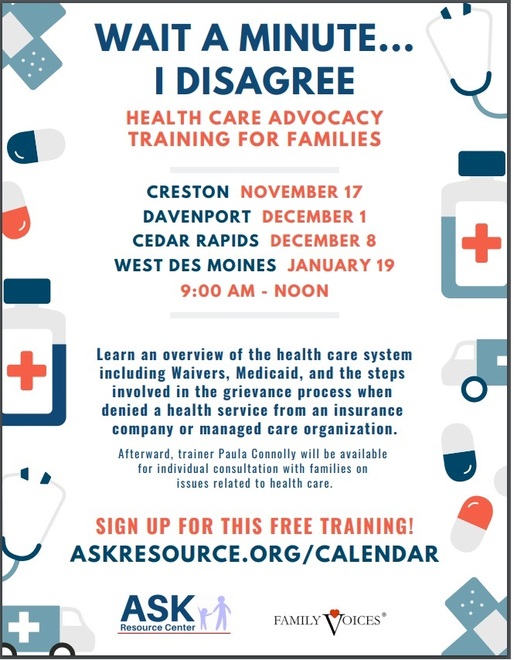
Four free, in-person health care advocacy training offers an overview of the health care system including Waivers, Medicaid, and the steps involved in the grievance process when denied a health service from an insurance company or Medicaid managed care organization. After each workshop, an ASK trainer will be available for a no-cost, individualized consultation with families on issues related to health care. Click here for more details.
November 17 Creston
December 1 Davenport
December 8 Cedar Rapids
January 19, 2019 West Des Moines
SMALL BUSINESS - Access to Capital
A government study examined lending of $1 million or less for commercial purposes by depository lending institutions. "Data on Minority Depository Lending institutions (MDIs) showed that growth of small businesses loans outstanding was positive in all size categories (total loans less than $100K, $100K to $250K, and $250K to $1 million), though minority lenders hold a relatively small percentage of total small business loans, and their share has been declining."
Overall, data shows that the downward pressure on small business lending is
easing. The largest lenders, in general, invest much smaller proportions of their assets in small business loans, but they dominate the market in terms of the amount of loan value they provide.
Source: Small Business Lending in the United States, 2016 (Released: 9/18/18) Office of Advocacy, Small Business Administration
 NATURALIZATION - Test Preparation
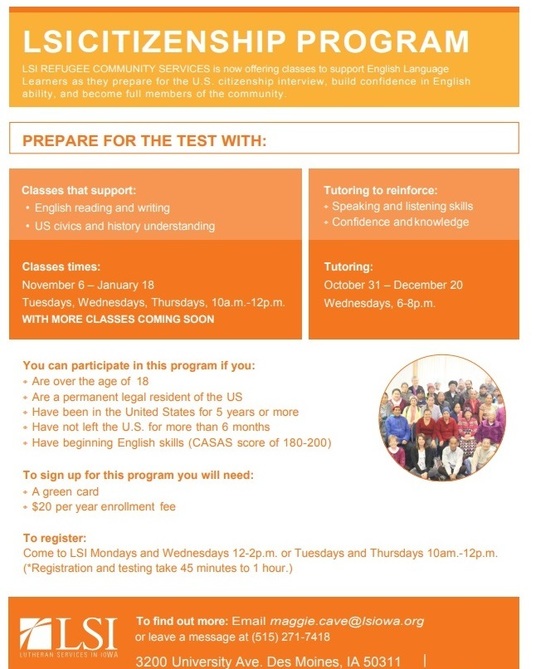
Lutheran Services of Iowa - Refugee Community Services in Des Moines provides classroom instruction and tutoring for former refugees as they prepare to take their U.S. Citizenship Exam. Please see flyer below for upcoming test preparation classes. LSI informed our office that if Fall 2018 classes reach capacity, additional courses will be offered in January 2019.
Source: LSI - Refugee Community Services
Related website: USCIS Citizenship Hub
NATURALIZATION - Testing
USCIS Using Tablets to Administer the English Reading and Writing Tests for Naturalization
As of October 1, the US Citizen & Immigration Services (USCIS) agency began using digital tablets to administer the English reading and writing tests during naturalization interviews. Although USCIS applicants already use digital tablets to sign or verify parts of their applications, this new approach expands tablet usage, allowing the device to be used for a greater portion of the application process. USCIS will be able to continue using the paper process on a case-by-case basis.
While the eligibility requirements and the subject material of the naturalization test have not changed, applicants are now using a stylus on a digital tablet instead of a paper application. Applicants will be instructed on how to use the tablets by Immigration Services Officers (ISO) before administering the tests.
For the reading test, a sentence will appear on the tablet and the ISO will ask the applicant to read it. For the writing test, several lines will appear on the tablet, replicating the appearance of a piece of blank paper. The ISO will read a sentence aloud and ask the applicant to write it on the tablet.
Applicants will continue to take the civics test verbally, without the tablet. USCIS is now using digital tablets to administer the English reading and writing tests during naturalization interviews.
VOTER ENGAGEMENT: November 6 Elections
Who can register to vote in Iowa? To register to vote you must:
- Be a citizen of the United States
- Be a resident of Iowa
- At least 17½ years old to register (must be 18 years old to vote)
- Have not been convicted of a felony (or have had your rights restored)
- Not currently judged by a court to be ‘incompetent to vote’
- You must have given up your right to vote in any other place.
Verify if you are registered to vote here.
Same-Day Voter Registration permitted in Iowa - with proper proof.
Know where to vote.
Contact your county auditor for a sample ballot or to early vote.
Be An Informed Voter!
Look Up Your Sample Ballot here. (Source: Ballotpedia)
Information on Voting for Judges
Set a reminder or use an app (like TurboVote) to remember to VOTE on November 6!
Transportation to the polls:
-
Des Moines Area Rapid Transit (DART) will offer free rides on Local, Express Flex and On Call routes, all day long, on Election Day, Tuesday, Nov. 6, 2018.
-
Iowa City Transit will provide free rides to the polls. One exception: The city does not serve Terry Trueblood Recreation Area, which is the location of precinct 10.
- Central Iowa Center for Independent Living (CICIL), a nonprofit organization, is providing rides to anyone on Election Day who reaches out to them. (Iowa DD Council provides support to CICIL for this accessibility, mobility project.)
- UBER providing a discount on Election Day to get to the polls.
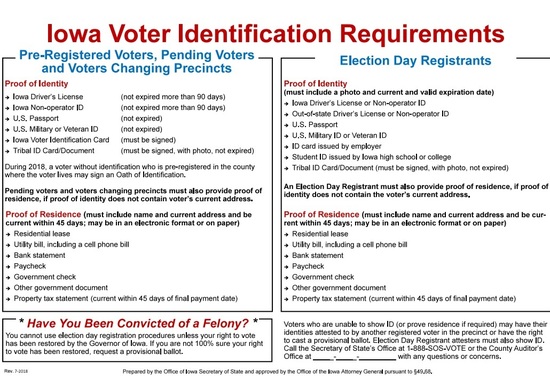
New Voter Identification Law in Effect
FEDERAL PROPOSED RULE: "Public Charge"
Recently, the US Department of Homeland Security (DHS) released a proposed regulation on October 10, 2018, which seeks to change longstanding policy about the meaning and application of the “public charge” provisions of immigration law. DHS states this is “[t]o ensure that foreign nationals coming to the United States or adjusting status to permanent residence, either temporarily or permanently, have adequate means of support while in the United States, and that foreign nationals do not become dependent on public benefits for support.”
"Exempted populations include: refugees; asylees; survivors of domestic violence; individuals who have or are applying for U or T visas (victims of certain crimes and trafficking survivors); children seeking Special Immigrant Juvenile status; and active duty service members. Public charge policies also do not apply to legal permanent residents seeking to obtain citizenship.
DHS will consider 15 factors for a public charge determination, including age, health, resources, financial status, education and skills. DHS estimates that 382,600 green card applications a year would be subject to the new public charge test and an additional 517,500 visa applications." (Source: NCSL)
The regulation is not yet in effect. The public comment period is open until December 10, 2018. Online comments may be submitted here.
Impact on Employers and Immigrants: Forbes
Policy Resource: National Conference of State Legislatures (NCSL)
Analysis: Asian Pacific Institute on Gender Based Violence
CAPI CONTINUES TO SEEK PUBLIC COMMENT
The Iowa Commission of Asian & Pacific Islander Affairs (CAPI) invites the community to comment on its Strategic Plan by the end of November 2018.
As part of its charge to recommend public policy, CAPI is seeking input and feedback from the Asian & Pacific Islander community and those who provide direct services to this micro-diverse population. CAPI Commissioners constructed a five-point, three-year strategic plan of policy areas for policymakers to address that will be presented in early 2019.
For more information or to submit oral or written comments, please contact Tina Shaw, Iowa Department of Human Rights, Office of Asian & Pacific Islander Affairs: tina.shaw@iowa.gov or 1-800-922-8917
UPCOMING EVENTS
3RD Annual Iowa Asian Alliance "Pho King Cook-off"
The third annual Pho King Cook-Off takes place from noon to 4 p.m. on Saturday, Nov. 3 inside the Val Air Ballroom at 301 Ashworth Road in West Des Moines. Tickets required. It includes an all-you-can-eat pho tasting, live entertainment, music, and eating contests.
Source: Iowa Asian Alliance
Related Article: Des Moines Register
|